
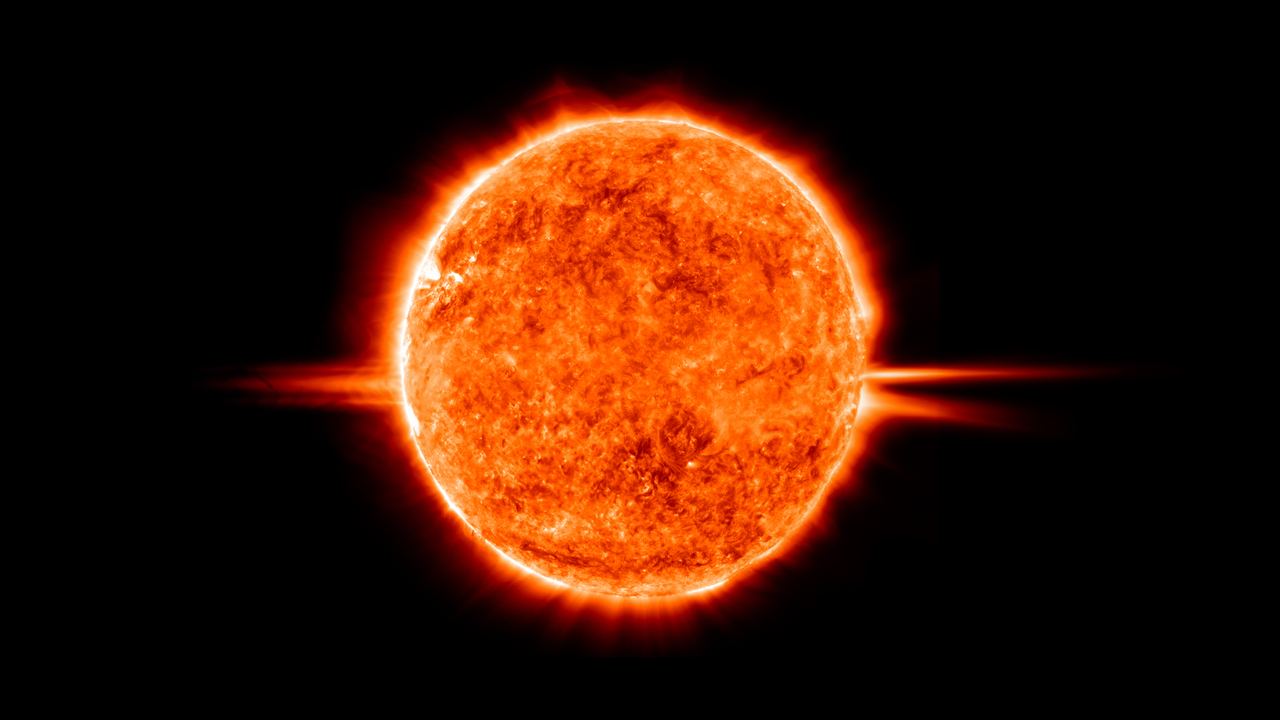
The short version is that the sun throws charged particles at us continuously, the earth's magnetic field catches some of them, and where that field funnels them into the upper atmosphere they make the air glow.
The longer version is more interesting, mostly because of what it explains about timing. The aurora is not a direct response to something you can see happening on the sun. There is a gap of a day or three, and understanding why is the difference between reading a forecast and guessing.
The solar wind is always blowing
The sun's outer atmosphere is hot enough that its own gravity cannot hold it. It leaks constantly, in every direction, as a thin stream of electrons and protons moving at something like 400 kilometres per second. This is the solar wind, and it never stops.
What varies is speed and density. A coronal hole, a region where the sun's magnetic field opens out into space instead of looping back, lets the wind escape faster, sometimes above 700 km/s. A coronal mass ejection is different: a discrete blob of magnetised plasma thrown off in an eruption, carrying far more material and often arriving with a shock front.
Both can produce an aurora. They behave differently enough that the distinction matters for anyone booking a trip, which we come back to on the solar cycle page.
Why there is a delay, and how long it is
Light from a solar flare reaches us in about eight minutes. The particles do not. A fast coronal mass ejection crosses the 150 million kilometres to earth in roughly one to three days; a slow one takes longer.
This is why aurora forecasting works at all. We can see the eruption, measure its direction and speed, and know roughly when the material will arrive before it does. It is also why the forecasts are vague about strength: what matters most on arrival is the orientation of the magnetic field embedded in that plasma, and we cannot measure that properly until it passes the satellites parked about 1.5 million kilometres upstream, which buys us somewhere between 15 and 60 minutes of warning.
So the honest state of the art is: days of notice that something is coming, under an hour of notice about how good it will be.
The part where the magnetic field does the work
Earth's magnetic field is not the neat symmetrical thing from a textbook diagram. The solar wind squashes it on the sunward side and pulls it out into a long tail on the night side, stretching well past the moon's orbit.
When the magnetic field carried by the solar wind points south, opposite to earth's own field at the boundary, the two can connect. Energy and particles load into that stretched tail. It builds, and then it snaps back, flinging particles down the field lines towards both poles at once. That release is called a substorm, and it is what you are actually watching when a quiet arc suddenly brightens, breaks up and starts moving fast.
Those particles hit oxygen and nitrogen atoms somewhere between 100 and 300 kilometres up, knock their electrons into higher energy states, and the light comes out when the electrons drop back. Which colour comes out depends on which atom, and on how long it stays excited. That turns out to be a better story than it sounds, and it has its own page.

September 1859, and the night the telegraph ran on the sky
On 1 September 1859 two English astronomers, Richard Carrington and Richard Hodgson, independently saw a patch of brilliant white light flare up over a large sunspot group. Neither knew what they were looking at.
What followed is still the most intense geomagnetic storm on record. Aurora were reported as far south as the Caribbean and Venezuela. And on telegraph lines between Boston and Portland, Maine, operators disconnected their batteries entirely and kept exchanging messages for about two hours, running on the current the storm was inducing in the wires.
That detail is worth holding onto. It is the moment it became clear that something happening on the sun could reach down and push electricity through infrastructure on the ground, and it is roughly where the science of space weather begins. A storm of that size hitting the current grid is a scenario power companies plan for.
What this means for booking a trip
- Nobody can forecast usefully more than a few days out. Anything offering you aurora probability for a date three months away is selling climatology at best, and invention at worst.
- Substorms are sudden. A sky that has been showing nothing but a dull arc for an hour can become the display in the photographs within a couple of minutes. This is the single best argument for a longer tour rather than a shorter one.
- The best predictor you can act on is cloud, because you can plan around climate and you cannot plan around geomagnetics. Which is why our weather data gets the most space on this site.
Common questions
Does a solar flare mean aurora tonight?
No. The flare's light arrives in eight minutes; any particles take one to three days. And plenty of flares produce nothing at earth because the material was thrown in another direction entirely.
Is there aurora at the south pole too?
Yes, simultaneously. The particles travel down field lines to both poles, so the aurora australis is happening at the same time as the aurora borealis, often as an approximate mirror image. There is simply far less land, and far fewer people, underneath it.
How high up is the aurora?
Usually between 100 and 300 kilometres, occasionally higher for the red emissions. That is well above where aircraft fly and above most of the atmosphere, which is why it looks like it is draped on the sky rather than sitting in it.
Can the aurora be dangerous?
Not to you on the ground. The particles stop far overhead. Strong storms do affect satellites, radio propagation, and in extreme cases power grids, which is the reason space weather is monitored at all.
Birkeland, and fifty years of being told he was wrong
The explanation above, that charged particles from the sun follow magnetic field lines down into the polar atmosphere, sounds obvious now. It was proposed in 1896 by the Norwegian physicist Kristian Birkeland, and it was rejected for most of the following century.
Birkeland did something unusual for the time: he built the thing in a laboratory. His terrella, literally a little earth, was a magnetised sphere suspended in a vacuum chamber. When he directed a beam of electrons at it, they curved towards the poles and produced glowing rings around them. He photographed the result, and it looks unmistakably like an auroral oval.
He also went and measured. Birkeland ran magnetic observatories in the Arctic through the polar winter, in conditions that killed members of comparable expeditions, to record the currents flowing overhead during displays.
The objection came mainly from the British geophysicist Sydney Chapman, who argued that electric currents could not flow through the vacuum of space, and proposed instead that the currents were confined to the ionosphere. Chapman was formidable, well placed, and wrong on this specific point, and the disagreement lasted decades. Birkeland died in 1917 with the question unsettled.
It took spacecraft to settle it. Direct measurements from orbit in the 1960s found the field-aligned currents flowing between the magnetosphere and the ionosphere exactly where Birkeland's model required them. They are now called Birkeland currents, and they are the reason this page can describe the mechanism as fact rather than theory.
Two things are worth taking from that story. The first is that the aurora looked so obviously like a thing of the sky that connecting it to the sun, 150 million kilometres away, was a genuine leap. The second is that the disagreement was settled by going and measuring, which is a good habit generally, and one this site tries to keep.
How forecasting actually works today
Modern aurora forecasting has two horizons, and knowing which one you are looking at prevents most of the confusion around apps.
Days out, forecasters watch the sun. A coronal mass ejection is visible when it erupts, its speed and direction can be estimated, and models predict roughly when it will arrive. That is how you get a warning several days ahead that something is coming. What it cannot tell you is how effective the arrival will be, because that depends mostly on the orientation of the magnetic field inside the plasma, which is not measurable from here.
Under an hour, forecasters watch the solar wind itself. Spacecraft sit at the L1 point, roughly 1.5 million kilometres upstream between earth and sun, where they sample the wind before it reaches us. DSCOVR is the operational one today, with ACE still contributing. The travel time from L1 to earth gives the actual lead: between about 15 and 60 minutes, depending on how fast the wind is moving.
That measurement feeds the OVATION model, developed at the Johns Hopkins Applied Physics Laboratory, which produces the familiar map of the oval with its 30 to 90 minute forecast. When an app shows you a coloured oval over the pole, this is usually what it is showing.
So the honest state of the art: days of notice that something may happen, and well under an hour of notice about whether it actually will. Anything claiming to tell you the aurora probability for a specific night three months out is not forecasting. It is either climatology, which is useful and should say so, or invention.
Sources
- NOAA Space Weather Prediction Center — aurora background and the operational forecasts: aurora overview, 30-minute aurora forecast (OVATION), and the 3-day forecast.
- OVATION model, developed at the Johns Hopkins University Applied Physics Laboratory, driven by solar wind measurements from the L1 point.
- Carrington event: the storm of 1-2 September 1859, documented in contemporary accounts of the telegraph disruption and in the modern space weather literature.
- Kristian Birkeland: terrella experiments from 1901, auroral theory from 1896, and the field-aligned currents later named after him and confirmed by spacecraft measurements in the 1960s.
- Met Office — space weather background and current solar cycle commentary: metoffice.gov.uk.
Data verified on. Physics summarised from NOAA Space Weather Prediction Center material. Carrington event details from contemporary accounts and published histories of the 1859 storm.
So why does everyone quote the Kp index?
It is the number in every aurora app, it is measured after the fact, and it knows nothing about the cloud above your head.