

Iceland
The most consistent sky in this catalogue, which is worth more than the best one
Iceland's reputation is that it is beautiful and cloudy, and half of that is wrong. Across eleven seasons of reanalysis, counting nights with at least two hours of cloud cover at or below 50% in the hours tours run, Reykjavík gets a usable sky on 35.6% of season nights. That puts it second in Europe on this site, ahead of Rovaniemi at 31.5%, Alta at 29.3%, Tromsø at 25.4% and Abisko at 18.7%. Only Kiruna, at 38.8%, does better.
The more useful number is the spread. Reykjavík's worst month is 31.1% and its best is 40.7%: a range of nine points across the entire season. Tromsø swings seventeen, Rovaniemi thirty, Yellowknife thirty-two. Everywhere else in this catalogue there is a right month and a wrong month; here there is barely a difference.
That flatness is the argument for Iceland and nobody makes it, because it is a boring virtue. If you are planning around a specific week, or you have a single night, or your dates are set by somebody else's calendar, a destination that is the same in November as in March removes the largest variable from the decision. The Arctic destinations offer higher peaks and demand that you turn up in the right month.
What Iceland charges for it is the second-best sky rather than the best, and a latitude that is not really the point: at 64°08′N Reykjavík is under the auroral oval every night the sun is down.
Choose a destination in Iceland


Northern Lights Experiences in Iceland
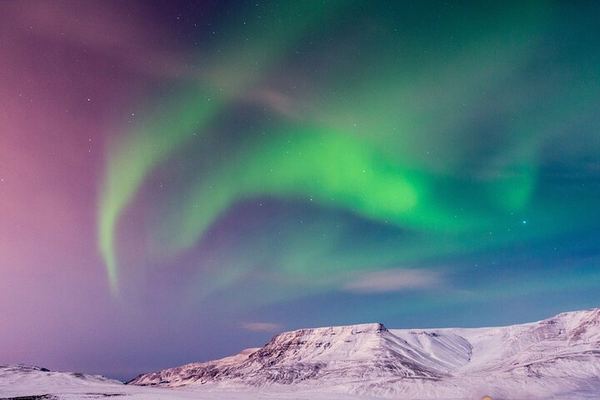
Active Volcano Hike and Northern Lights Night Tour from Reykjavík
Ninety minutes on foot each way to the eruption site at Meradalir in the afternoon, then the aurora hunt after dinner. Only Iceland offers both in a day.
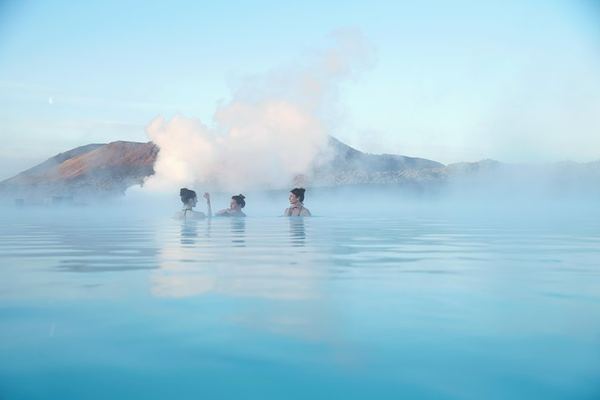
Blue Lagoon Comfort Entry and Northern Lights Hunt from Reykjavík
Comfort admission to the Blue Lagoon at 14:00, back in town for dinner, then the aurora hunt leaves BSÍ at 21:00. One booking with the gap built into it.
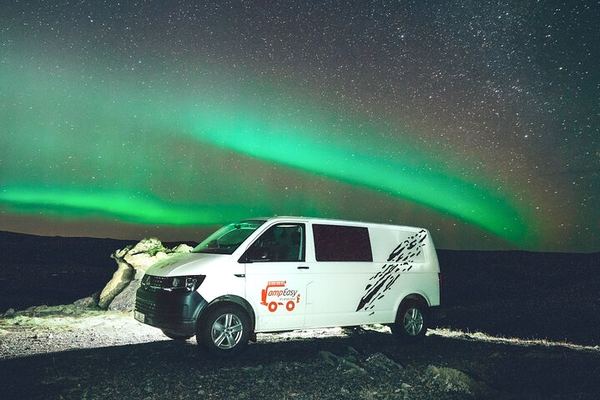
Five Day Self Drive Campervan Break in Iceland with Ice Cave and Aurora
Five days and four nights with the route, the campsite fees and three activities already booked, including a super jeep ice cave run from Skaftafell.

Forest Lagoon Geothermal Baths and Northern Lights Night from Akureyri
The Forest Lagoon looks down Eyjafjörður with birch and pine to the water's edge, then guides take you out of town for the aurora. Warm water first, cold after.
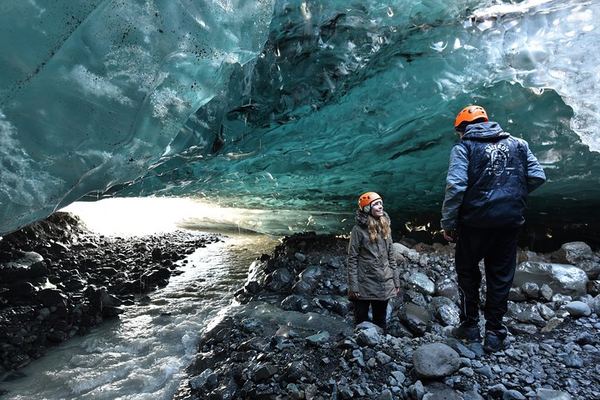
Four Day Blue Ice Cave, South Coast, Golden Circle and Snæfellsnes Tour
Golden Circle, Snæfellsnes and the south coast to Jökulsárlón, ending with a super jeep run into a blue ice cave. The aurora is on the card all four nights.
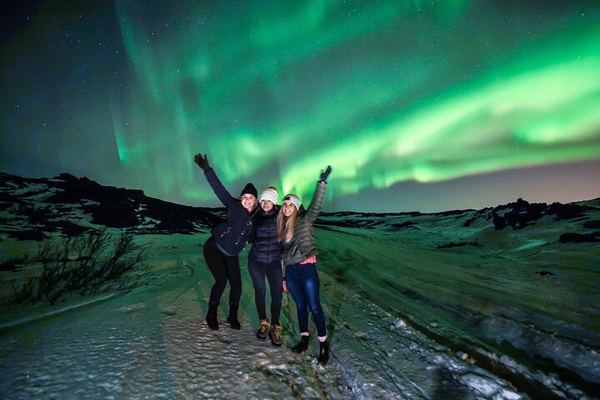
Four Day Iceland Tour: Golden Circle, South Coast, Volcano Hike and Aurora
The routes most visitors squeeze into day trips, done properly: Golden Circle, south coast, a glacier hike on Vatnajökull and the recent eruption site.
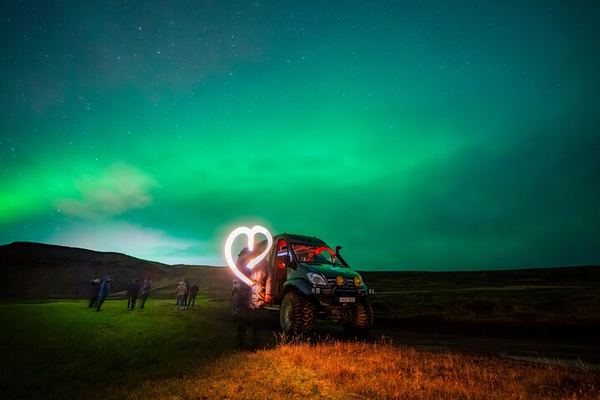
Four Hour Super Jeep Northern Lights Chase from Reykjavík
A super jeep uses gravel and mountain roads a coach cannot, which decides how many viewing spots exist that night. Blankets, hand warmers, free rebooking.
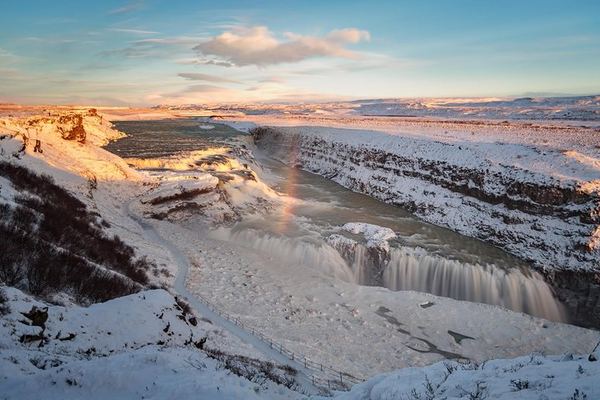
Golden Circle and Northern Lights Small Group Tour from Reykjavík, 11 Hours
Thingvellir, Geysir and Gullfoss by daylight, then the hunt once dark comes down. Iceland's winter night is long enough to fit both halves into one day.
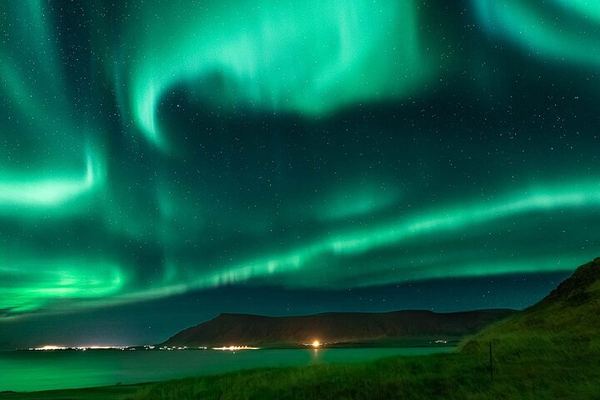
Golden Circle and Northern Lights Tour from Reykjavík in One Day
The full Golden Circle, a few hours back in town to rest and eat, then out again. The guides look for clear sky rather than scenery, with cocoa for the wait.
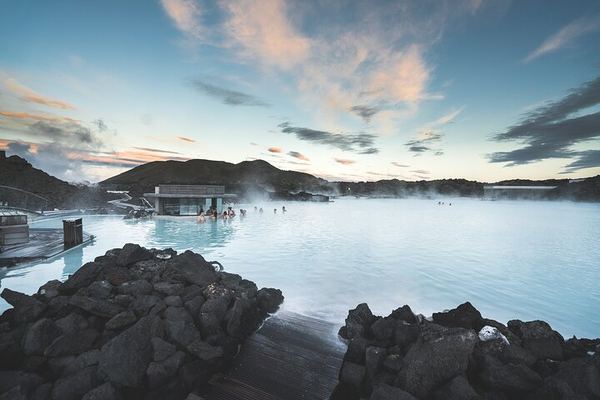
Golden Circle, Blue Lagoon and Northern Lights in One Day from Reykjavík
Thingvellir, Geysir, Gullfoss and Keríð crater, then two hours in the Blue Lagoon, then 90 minutes to eat before the aurora hunt. Three trips, one booking.
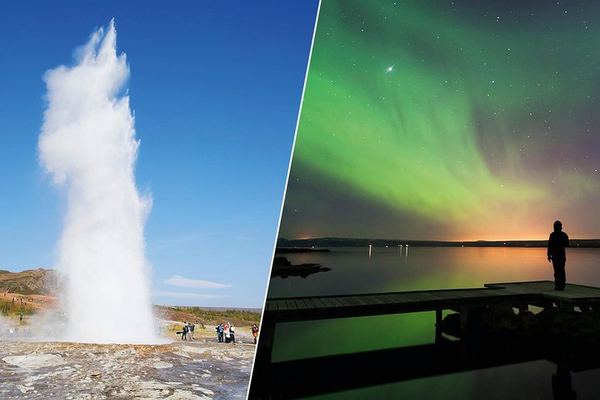
Golden Circle by Day and Northern Lights by Night from Reykjavík
Two tours with a gap between them for a shower and dinner. After dark the guides work from live aurora updates instead of driving to a fixed viewing spot.
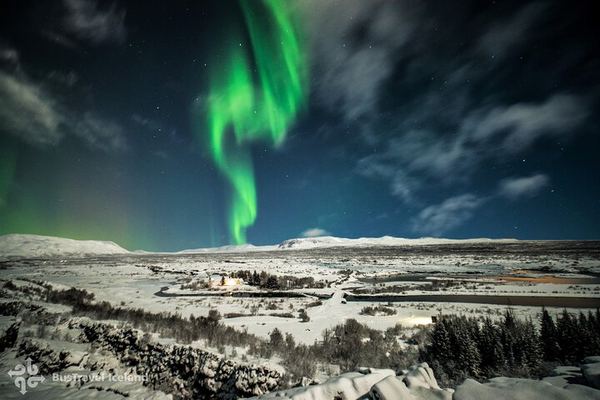
Golden Circle, Keríð Crater, Secret Lagoon and Northern Lights Combo
Five daylight stops including Keríð crater and the Secret Lagoon, then hours off in town, then a second bus out past the city lights. Two tours, one rate.
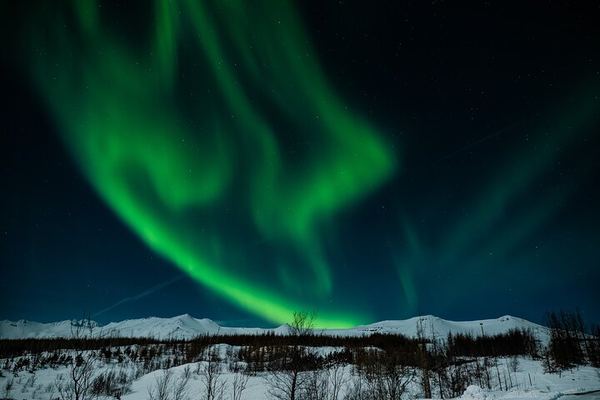
Guided Northern Lights Bus Tour through North Iceland
A warm bus, local guides and one purpose: being under dark sky when the aurora appears. On a changeable northern night, that call is most of the tour.
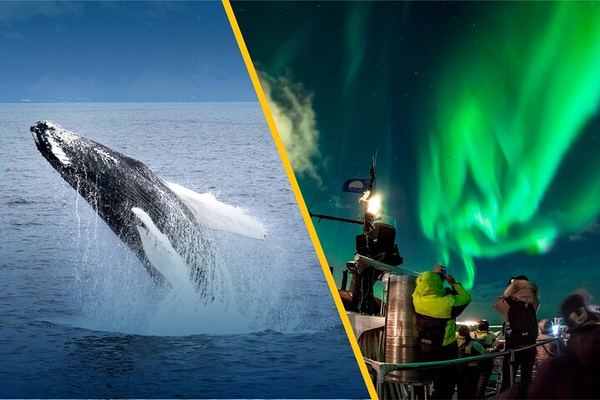
Iceland Super Saver: Northern Lights Cruise plus Whale Watching in Reykjavík
Two boat tours bought together and taken on whichever days suit your trip. Coveralls before boarding: standing still on a winter deck is a different cold.
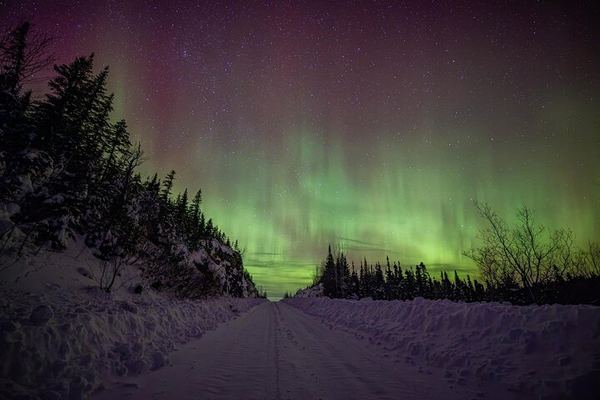
Northern Lights 4x4 Hunt from Reykjavík, Guided in Spanish
Spanish-speaking guides and a 4x4 that reaches ground a coach cannot, which counts on a night when the cloud breaks in only one corner. Photos included.
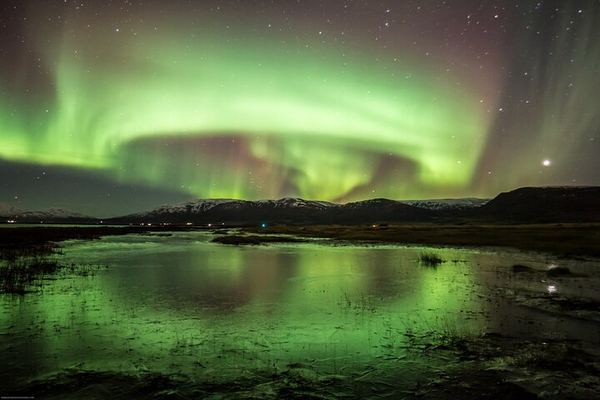
Northern Lights 4x4 Minibus Photography Tour from Akureyri
A 4x4 minibus takes the group far enough from Akureyri that the colours are visible rather than guessed. Free hotel pickup, and a free retry if nothing shows.
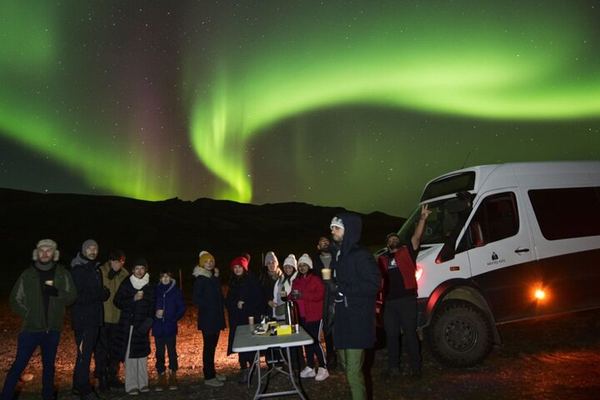
Northern Lights 4x4 Tour from Reykjavík with Icelandic Pastries and Cocoa
Four hours by 4x4 minibus, guided in Spanish and English, with hot chocolate, traditional pastries and hand warmers: the things that decide if you last.
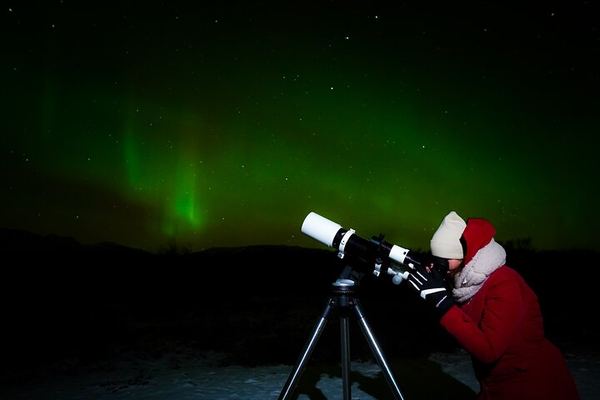
Northern Lights and Telescope Stargazing Small Group Tour from Reykjavík
A telescope turns the waiting into planets and deep space objects rather than staring at cloud. Small group, and the route set by that evening's forecast.
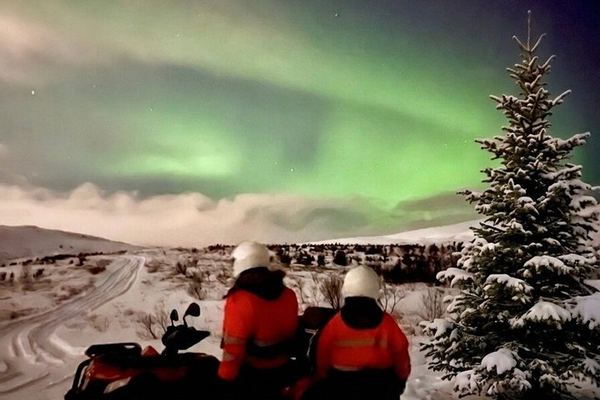
Northern Lights ATV Quad Ride from Reykjavík to Hafravatn Lake
Rough trails by quad to Hafravatn lake and Mount Hafrafell, with the city laid out below. While the sky makes up its mind, the guides turn you to the stars.
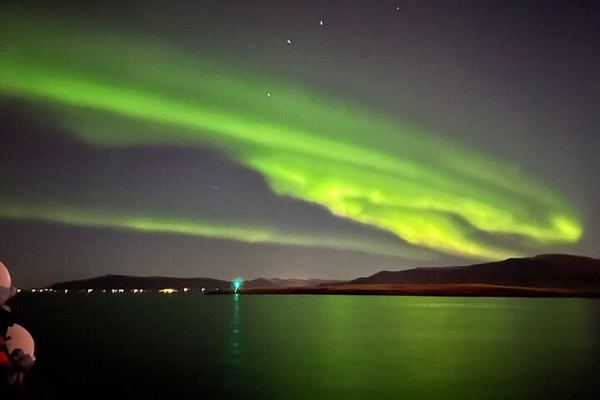
Northern Lights Boat Cruise from Reykjavík Old Harbour with Sea Trips
Out on the North Atlantic the water picks up whatever is happening overhead. Check in at Aegisgardur 5b half an hour early; a free ticket if nothing shows.
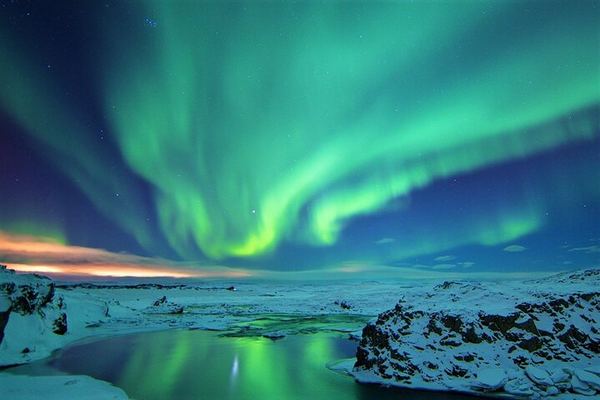
Northern Lights Bus Tour from Reykjavík with Hot Chocolate
The straightforward version of the hunt: no jeep, no small-group premium, a coach that drives to wherever the sky is clear, with hot chocolate for the wait.
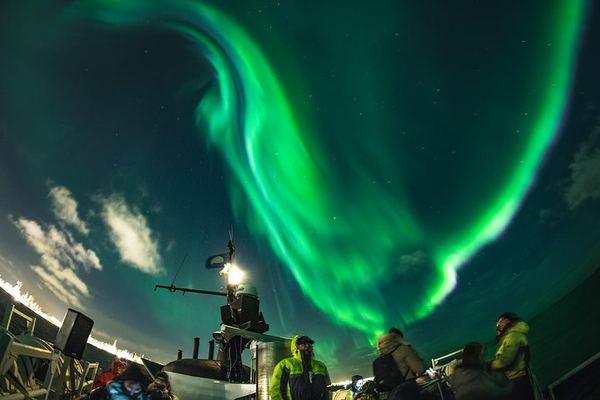
Northern Lights by Boat from Reykjavík Old Harbour, with a Backup Plan
If the forecast cancels the sailing, the evening moves to the Whales of Iceland exhibition at 21:00, so one of the two happens whatever the weather does.
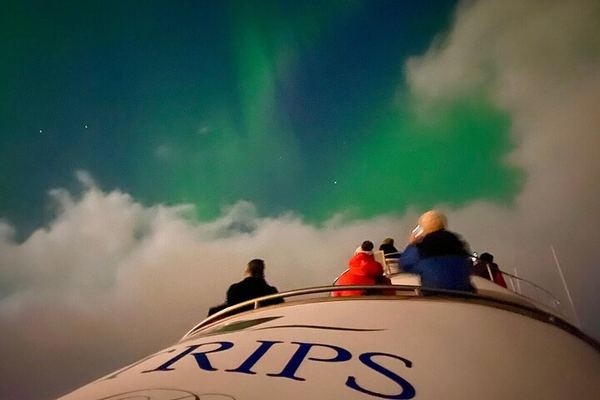
Northern Lights Cruise aboard the Amelia Rose from Reykjavík
Genuinely dark water sits minutes from the harbour, which is why this hunt sails instead of driving. No lights means a free return sailing, valid three years.
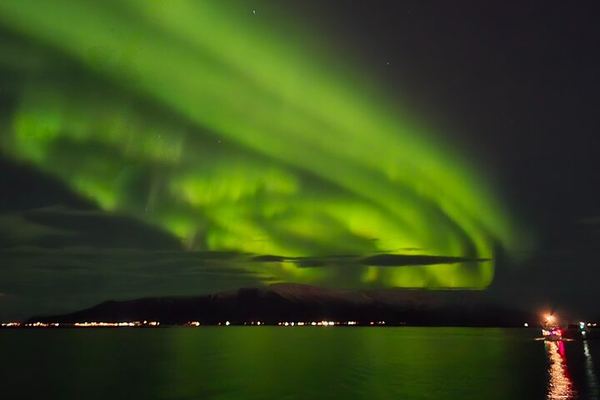
Northern Lights Cruise from Downtown Reykjavík
The Old Harbour is a short walk from downtown, so there is no long transfer before the watching starts and none after it. The city glow drops behind the stern.
Ratings collected by Viator and Tripadvisor
Two bases, and they are not interchangeable
Almost everything sold in Iceland leaves the capital. The north has a much smaller operation and, on our numbers, a considerably worse sky, which is the opposite of what its latitude would suggest.
| Base | Latitude | Usable sky, season | Range across the season | Departures | Price band |
|---|---|---|---|---|---|
| Reykjavík | 64°08′N | 35.6% | 31.1–40.7%, the flattest here | 61 | 68–6,515 EUR |
| Akureyri | 65°41′N | 23.3% | 18.1–29.7% | 5 | 97–195 EUR |
Akureyri is a degree and a half further north and gets a third fewer usable nights, worse in every month of the season. Latitude is not what decides this: the north coast sits under weather the southwest does not get. With five departures and no fallback, it is a place to go for the fjord and the quiet rather than for the odds.

The numbers, month by month
| Month | Reykjavík | Akureyri | Darkness per night | Expected usable dark hours |
|---|---|---|---|---|
| December | 38.7% | 18.1% | 6.9 h | 2.67 |
| November | 37.0% | 21.7% | 6.4 h | 2.37 |
| January | 33.9% | 19.7% | 6.3 h | 2.14 |
| October | 34.5% | 24.5% | 5.1 h | 1.76 |
| February | 31.1% | 21.9% | 5.1 h | 1.59 |
| March | 33.5% | 29.7% | 3.5 h | 1.17 |
| September | 40.7% | 27.3% | 2.7 h | 1.10 |
December is Iceland's best month, and in Tromsø it is the worst of the year. That single contrast is the most useful thing on this page: seasonal advice written for Norway does not transfer here, and most of what is published about aurora travel is written for Norway.
The reason is the flatness of the Icelandic sky. Reykjavík moves nine points across the entire season while Tromsø swings seventeen and Rovaniemi thirty. When the cloud record barely changes, the darkness peak in midwinter is a clean gain rather than a trade, and December arrives with 6.9 hours of astronomical night and a sky no worse than any other month.
September is the weakest month despite having the best cloud figure of the year at 40.7%. Two point seven hours of darkness is not enough to use it.
One limit on that ranking, stated because it argues against it. It measures how much dark clear sky a month contains, not the chance the aurora does something inside it. Geomagnetic storms are close to twice as frequent around the equinoxes, an effect described by Russell and McPherron in 1973, favouring September and March. Even doubling September leaves it behind December here.
What Iceland actually trades
Not the sky, then. Reykjavík is second in Europe for usable-sky nights, behind only Kiruna, and it is the most consistent destination we measure anywhere. What Iceland trades away is depth of darkness: 6.9 hours at midwinter where Tromsø and Rovaniemi get the full eight, and only 2.7 in September.
What it buys with that is everything around the sky. Flights are cheap and frequent from both sides of the Atlantic, and a stopover costs nothing on some routes. The daylight hours have somewhere to go: glacier lagoons, black beaches, waterfalls still running in February, and in some years an eruption site you can walk to. The road network reaches almost all of it, and when the cloud does move, a guide with a vehicle can move with it.
The comparison worth making is with the North American destinations rather than with Scandinavia. Fairbanks at 48.9% and Yellowknife at 47.8% have skies Iceland cannot match, and neither has a Golden Circle to fill the afternoon or a two-hour flight from London.
What the Sun is doing, and the 27-day trick
Two things drive the aurora and they behave differently. Coronal mass ejections are the dramatic ones: an eruption on the Sun, a warning of one to three days, then a storm that can push the oval far south of Iceland. They cannot be predicted more than a few days out.
The other source is steadier and more useful to a traveller. Coronal holes, gaps in the Sun's magnetic field, throw out fast solar wind that hits Earth on a schedule, because the Sun rotates once every 27 days or so as seen from here. A good display often has a sequel about four weeks later. Forecasters have used that recurrence for a century and you can too: if the aurora was strong in the last week of one month, the same week of the next is worth a look. Not a guarantee, but better than nothing, which is what most people plan a trip with.
When to come
The Icelandic season, on our numbers
| Month | 1 | 2 | 3 | 4 | 5 | 6 | 7 | 8 | 9 | 10 | 11 | 12 |
|---|---|---|---|---|---|---|---|---|---|---|---|---|
| ReykjavíkDecember is the best month here and the worst in Tromso. The cloud record moves only nine points across the whole season, so the midwinter darkness peak costs nothing. | 1 | 2 | 3 | 4 | 5 | 6 | 7 | 8 | 9 | 10 | 11 | 12 |
| Akureyri23.3% season average against Reykjavik's 35.6%, and worse in every month despite being further north. Five departures with no fallback. | 1 | 2 | 3 | 4 | 5 | 6 | 7 | 8 | 9 | 10 | 11 | 12 |
Cloud: ERA5 via Open-Meteo, 11 seasons. Darkness and moon: ephemerides. Ranking by cloud multiplied by darkness; method in the site's data notes.
How Iceland became a place people fly to in winter
The origins
1920
The Met Office opens
Veðurstofa Íslands is founded. A century later it publishes the cloud and aurora forecast at vedur.is that every guide on this page reads before deciding where to drive, and that you can read too, for free.
1957–58
The International Geophysical Year
Sixty-seven countries coordinate observations of the upper atmosphere, and the auroral zone gets measured systematically for the first time. Much of what a guide tells you at the roadside dates from this work.
The growth
April 2010
Eyjafjallajökull
The ash cloud closes European airspace for the better part of a week and puts Iceland on every television at once. Visitor numbers climb steeply afterwards, and winter, until then the dead season, becomes something the industry can sell.
Today
October 2024
Solar maximum declared
NOAA and NASA confirm Solar Cycle 25 has peaked. Activity stays elevated for a year or two either side of a maximum, which is the window the current seasons fall inside.
Before you plan an Iceland trip
When should I come?
December, November or January, which is the reverse of the advice that holds in Norway. Iceland's cloud record barely changes across the season, so the midwinter darkness peak is a clean gain. September has the best cloud figure of the Icelandic year and only 2.7 hours of real darkness to use it in, which puts it last.
Is Iceland actually a good place to see the northern lights?
Better than its reputation. On eleven seasons of data Reykjavík is second in Europe for usable-sky nights, behind only Kiruna, and it is the most consistent destination we measure anywhere. What it does not have is the depth of darkness of the high Arctic, or the raw clear-sky record of interior Alaska and Canada.
Reykjavík or Akureyri?
Reykjavík, and the data makes it less close than it looks. Sixty-one departures against five, and a usable sky on 35.6% of nights against 23.3%, worse in every month despite Akureyri being further north.
How many nights do I need?
Three is still the honest answer everywhere, and Iceland is the one place where two is defensible: a flat 35% every month means your second night is worth almost exactly as much as your first, wherever in the season it falls. The caveat is that consecutive nights in the same place share a weather system, so a route that moves is worth more than a fixed base.
Do I need a strong geomagnetic storm?
No. From Iceland a Kp of 2 or 3 is enough, because the oval already sits overhead. The Kp 6 and 7 nights that make headlines are what lets people in Britain or Poland see it.
Data verified on. Cloud: ERA5 via Open-Meteo, 11 seasons. Darkness and moon: ephemerides. Prices and counts read from the 66 Icelandic departures on 10 August 2026.