
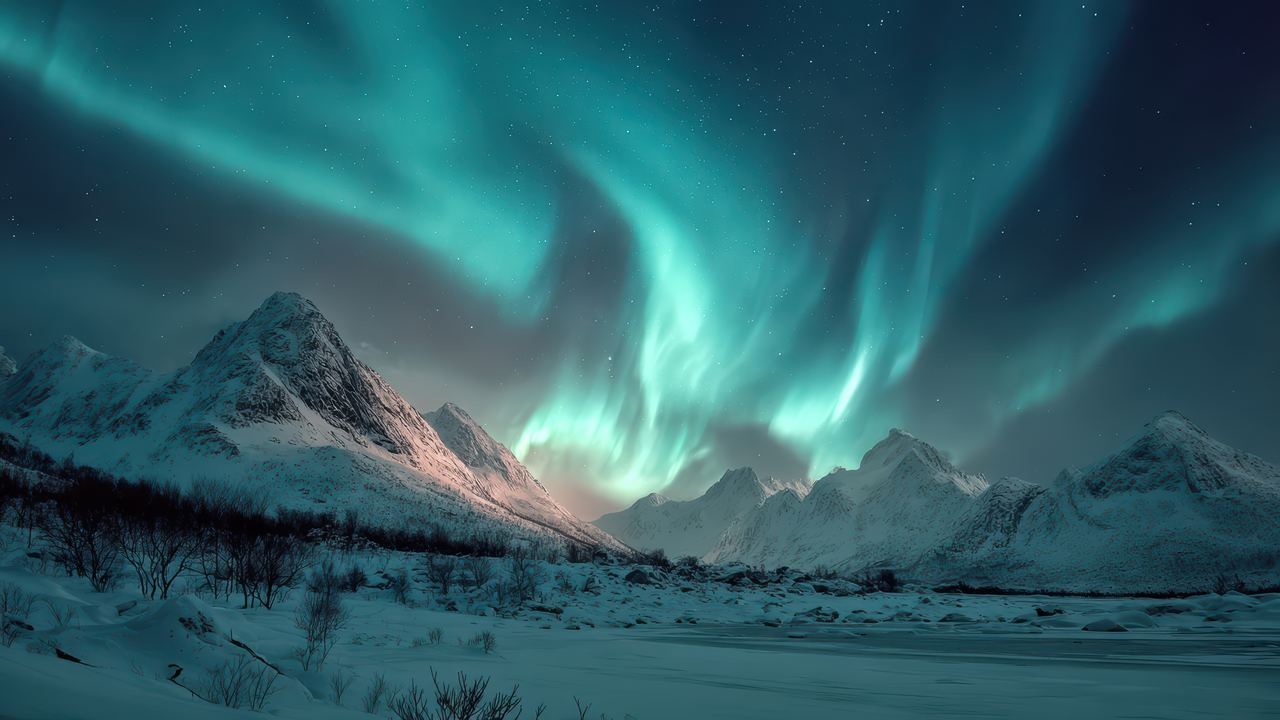
Abisko
The strongest reputation in aurora travel, and the numbers that do not confirm it
Abisko has the strongest reputation in aurora travel, and it rests on the blue hole: the Scandinavian mountains stand between this valley and the Atlantic, strip the moisture out of incoming weather, and leave a window of clear sky over Tornträsk when everything around it is shut. The geography is real and documented. The percentages attached to it, 70% clear nights, 80 to 90% success, come from the people selling tours here, and are published without a metric or a period.
So we counted. Eleven seasons of ERA5 reanalysis, nights with at least two hours of cloud cover at or below 50% between 18:00 and 02:00, the same method applied to every destination on this site. Abisko comes out at 18.7% across the season, the lowest of the fourteen places we measure. Kiruna, 90 kilometres east and the town both of these tours actually leave from, comes out at 38.8%.
That result needs handling carefully, and the careful version is more interesting than either headline. The blue hole is described as a window of 10 to 20 square kilometres. The ERA5 grid is about 28 kilometres across. If the window exists at that scale, our method cannot see it, and no number we produce can confirm or refute it. What we can see is the regional gradient, and the regional gradient runs the other way: the Tornträsk basin is markedly cloudier than the plain at Kiruna. The mountains that are supposed to produce the blue hole also produce orographic cloud, and at the scale we can measure, the second effect wins.
The honest position: we cannot tell you the blue hole is a myth, and nobody can tell you it is a fact. Settling it would take station observations, which SMHI publishes in Sweden and which nobody in this business has bothered to cite.
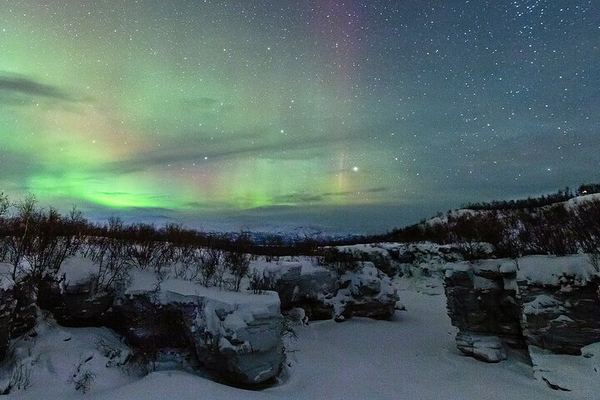
Abisko Aurora Tour from Kiruna with a Three Course Dinner
Sámi guides take you to Abisko, one of the most dependable aurora spots anywhere. The road crosses several weather zones, so a cloudy night still has gaps.
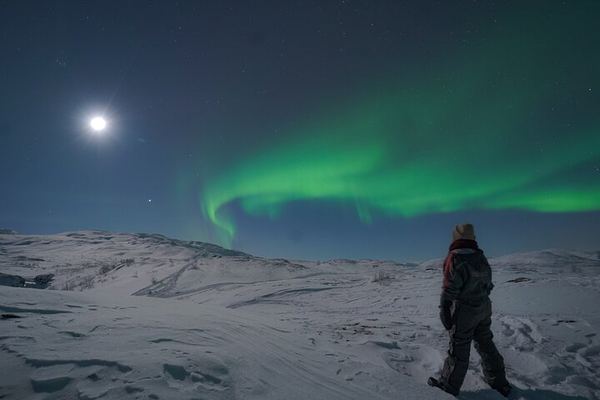
Northern Lights Tour from Kiruna to Abisko National Park
The mountains to the west wring the weather out of the incoming air, which is why this valley sees more clear nights than the coast. Winter gear included.
Ratings collected by Viator and Tripadvisor
The numbers, month by month
The first two columns do not depend on the catalogue and do not expire: cloud is a statistic over eleven seasons, darkness and moon are ephemerides, exact for years ahead. The thresholds are ours and they are stated under the table.
| Month | Usable-sky nights | Darkness per night | Moon-free nights | Expected usable dark hours |
|---|---|---|---|---|
| October | 19.4% | 6.5 h | 48% | 1.26 |
| February | 18.7% | 6.7 h | 54% | 1.25 |
| January | 14.2% | 7.9 h | 58% | 1.12 |
| December | 13.5% | 8.0 h | 58% | 1.08 |
| March | 25.5% | 4.0 h | 45% | 1.02 |
| November | 12.3% | 7.9 h | 50% | 0.97 |
| September | 27.3% | 2.3 h | 23% | 0.63 |
The thresholds, since they are choices rather than truths. Usable sky means at least two hours with cloud cover no greater than 50%, inside the 18:00 to 02:00 window when tours actually operate. Astronomical darkness means the Sun below 18 degrees, which is a standard definition and not ours. Nights without moon interference account for both the illuminated fraction and the Moon's height above the horizon.
The last column is where Abisko's real problem shows. Every month here sits between 0.63 and 1.26 expected usable dark hours. Kiruna, 98 km east, runs between 1.10 and 2.86: its worst month beats Abisko's best. There is no month that rescues this valley on the measurements we can make.
The two months with the best cloud figures, September at 27.3% and March at 25.5%, are fifth and seventh once darkness is counted, because there are 2.3 and 4.0 hours to use them in. October and February are the months, which is not what anyone recommends.
One limit, stated because it argues against the ranking: it measures how much dark clear sky a month contains, not the chance the aurora does something inside it. Geomagnetic storms are close to twice as frequent around the equinoxes, favouring September and March. Doubling September would lift it to the top of this particular row, which is worth saying plainly: at Abisko, unlike anywhere else, the equinox correction is large enough to matter to the ordering. It does not change the comparison with Kiruna, which is ahead in every month either way.

What this means in practice
Not that Abisko is a bad destination. Three concrete things.
First, the valley is not the shortcut its reputation suggests. If you are choosing where to spend three nights on the strength of the sky, our numbers put Kiruna ahead in all seven months, by between 12 and 24 points of cloud and roughly double once darkness is counted. It is also the base both of these excursions depart from.
Second, October and February are the months to prefer, not the equinoxes and not midwinter. October pairs the second-best cloud figure with six and a half hours of dark; February does much the same. November, which sounds like a sensible aurora month, is the worst on our count at 12.3% and 0.97 expected hours.
Third, the reputation has a price effect. The two departures here cost 164 and 252 EUR against 153 EUR for the cheapest in Kiruna. You are paying a premium for a promise no public data verifies.
The two departures
| Departure | Price | Leaves from | What it covers |
|---|---|---|---|
| Guided tour from Kiruna | 164 EUR | Kiruna, 98 km east | The round trip and guided time inside the national park |
| Guided tour with a three-course dinner | 252 EUR | Kiruna, 98 km east | The same drive, Sámi guides, dinner, and the country as well as the sky |
Both leave from Kiruna because that is where the airport, the beds and the operators are. With one night, buying the transfer makes sense: 98 km of Swedish winter road in the dark is not a job for a hire car and a phone map. With three nights and the aurora as the point of the trip, the Kiruna to Narvik railway stops in the village and the valley is dark the moment you step outside, where the Swedish right of public access does the work for you, free.
Why this page is written this way
A better headline would be "Abisko is the worst", and it would be a worse statement. Our count measures one specific thing at one specific scale, and on a 10 to 20 square kilometre window it declares its own blindness. Publishing the number without that limit would be the same error as the 70%, turned around.
What we can say with a straight face is this: the figure in circulation is not verifiable, ours is but does not answer the same question, and in the meantime the valley next door has better numbers at a lower price. Nobody selling those tours will ever publish any of those three sentences.
The Abisko season, on our numbers
| Month | 1 | 2 | 3 | 4 | 5 | 6 | 7 | 8 | 9 | 10 | 11 | 12 |
|---|---|---|---|---|---|---|---|---|---|---|---|---|
| AbiskoEvery month falls between 0.63 and 1.26 expected usable dark hours, and Kiruna's worst month beats Abisko's best. October and February are the least weak; November at 12.3% is the lowest cloud figure of all fourteen destinations. | 1 | 2 | 3 | 4 | 5 | 6 | 7 | 8 | 9 | 10 | 11 | 12 |
| Kiruna, 98 km eastSix of its seven months are within half an hour of each other, and all six beat anything Abisko offers. Cheaper, with six departures against two. | 1 | 2 | 3 | 4 | 5 | 6 | 7 | 8 | 9 | 10 | 11 | 12 |
Cloud: ERA5 via Open-Meteo, 11 seasons. Darkness and moon: ephemerides. Ranking by cloud multiplied by darkness; method in the site's data notes.
Abisko, without the sales pitch
Does the blue hole exist?
We do not know, and neither does anyone selling it. The rain shadow is a documented geographic fact. The window of clear sky supposedly produced by it is described as 10 to 20 square kilometres, and the reanalysis grid we use is about 28 km: if it exists at that scale, our instrument cannot see it. What we can see is the regional gradient, and that runs the other way.
When should I come?
October or February, which is not the answer anyone gives. Both pair the least-bad cloud figures with six and a half hours of real darkness. September and March have the best cloud records here and the least dark to use them in, and November, which sounds like a proper aurora month, is the weakest of all at 12.3%.
Then where does the 70% come from?
From people selling tours in Abisko, without stating how it is measured or over what period. That does not make it false, it makes it uncheckable, which in this trade is nearly the same thing.
Abisko or Kiruna?
On our numbers, Kiruna, in all seven months and at a lower price, and by roughly double once darkness is counted. With the caveat above: if the blue hole exists at the scale claimed, our measurement does not contradict it, it simply cannot see it. Kiruna also has six departures against two.
Is it worth sleeping in Abisko rather than Kiruna?
With three nights or more, yes: the Kiruna to Narvik train stops in the village, the valley is dark the moment you leave the building, and the Swedish right of public access lets you stand in a field at two in the morning without asking anyone. With a single night, buy the guided transfer.
Data verified on. Cloud: ERA5 via Open-Meteo, 11 seasons, method and thresholds stated on the page. Darkness and moon: ephemerides. Prices read from the catalogue on 10 August 2026.