

Kiruna
6 departures from the clearest sky in Europe, in a town that is famous for something else entirely
Kiruna is known for two things and neither of them is the sky. The first is that it is being moved: the iron ore body beneath the town is not a neat seam but a slab tilting down underneath it, and mining it has deformed the ground above, so since 2014 the centre has been relocating three kilometres east, building by building. The old wooden church went in 2025, whole, on a self-propelled trailer. The second is the Swedish Institute of Space Physics, here since 1957, which has been measuring the aurora above this town for nearly seventy years.
The third thing, which nobody advertises, is in our data. Counting nights with at least two hours of cloud cover at or below 50% between 18:00 and 02:00, across eleven seasons of ERA5 reanalysis, Kiruna comes out at 38.8% for the season. That is the highest figure of any European destination we measure, ahead of Reykjavík at 35.6%, Rovaniemi at 31.5% and Tromsø at 25.4%.
It is also more than double Abisko, 90 kilometres west, which sits at 18.7% and has the reputation this town does not. That gap is the single most useful thing on this page: the famous valley and the working mining town are an hour apart, and on the one variable that decides an aurora night, the mining town wins in all seven months.
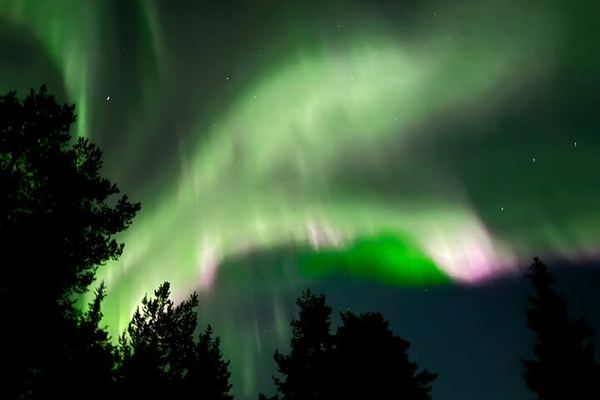
Husky Sled Ride and Northern Lights Tour from Kiruna
The guide drives, so your eyes stay on the sky for 13 km, with a teepee stop and a fire halfway. By late March it no longer goes properly dark on this run.
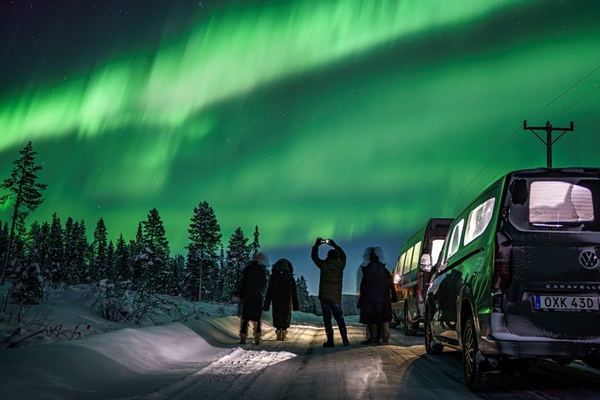
Kiruna Aurora Chase with a Street Food Dinner in a Tipi
Dinner by the fire in the Stejk Street Food tipi, then minivans into wilderness the coaches cannot reach. Lingonberry juice and fika outdoors at the stop.
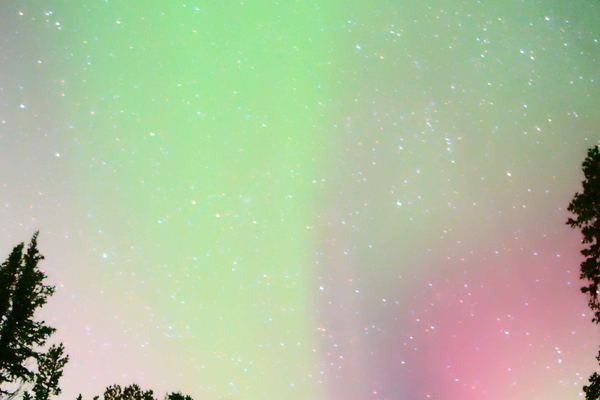
Kiruna Northern Lights Chase Through the Snowy Forests
Four hours by minibus into the forests outside town, wherever the sky can be seen through. Short enough for an early start, and for a slow night to end early.
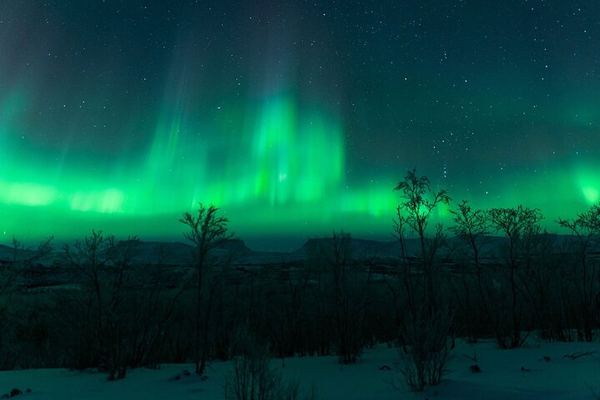
Kiruna Northern Lights Chase with a Photographer, Lights of Vikings
Abisko, the boreal forest, or anywhere with a gap in the cloud: this operator built its name on driving far for clear sky. Photographs sent within three days.
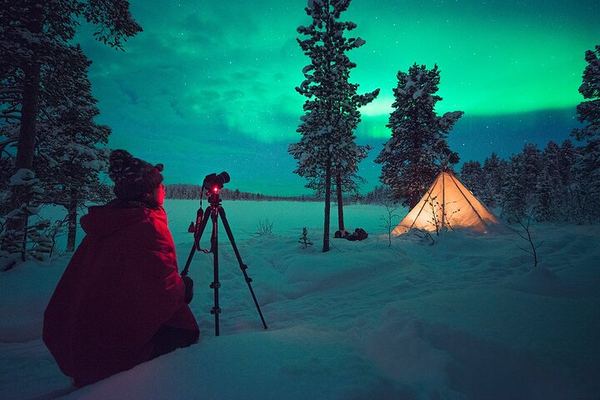
Northern Lights Photo Tour from Kiruna with Sami Photo Guides
Camera and tripod are lent to you, so a phone is enough to arrive with. Sámi photographers born here pick the spot from how weather moves, not from a map.
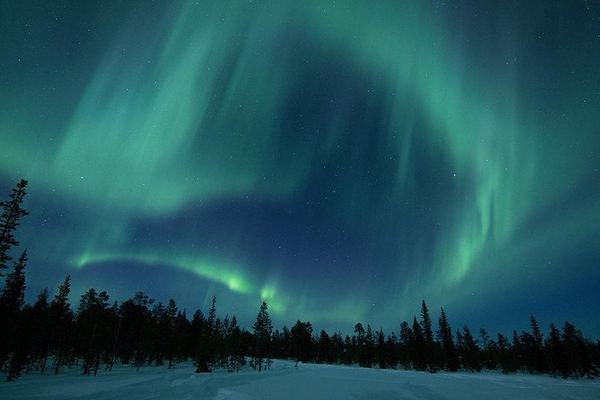
Snowmobile Aurora Expedition from Kiruna with a Lappish Dinner
Forest tracks, the frozen Torne River and frozen lakes from the saddle, then traditional Lappish food around an open fire in a forest hut. Two can share.
Ratings collected by Viator, Tripadvisor and Civitatis
The numbers, month by month
| Month | Usable-sky nights | Darkness per night | Moon-free nights | Expected usable dark hours |
|---|---|---|---|---|
| November | 35.7% | 8.0 h | 50% | 2.86 |
| February | 39.2% | 6.8 h | 54% | 2.67 |
| January | 31.6% | 7.9 h | 58% | 2.50 |
| October | 36.5% | 6.6 h | 48% | 2.41 |
| December | 30.0% | 8.0 h | 58% | 2.40 |
| March | 54.8% | 4.3 h | 52% | 2.36 |
| September | 44.0% | 2.5 h | 27% | 1.10 |
What makes Kiruna unusual is not any single month, it is that six of the seven are within half an hour of each other. Between November's 2.86 and March's 2.36 there is almost nothing to choose, and every one of those six beats the best month at Tromsø, Abisko, Akureyri or Saariselkä. This is the most reliable European base in this catalogue by a distance, and it is reliable in a way that matters: you do not have to pick the right month.
November is the technical winner, on 35.7% of nights and the full eight hours of astronomical darkness. February is second on the strongest combination of the two. March has by far the highest cloud figure anywhere in Europe at 54.8%, and 4.3 hours of dark drops it to sixth of seven, which is a good illustration of why the cloud column alone is not enough.
September is the only weak month, and it is the one the vertical recommends by reflex: 2.5 hours of darkness and 27% of nights free of moonlight put it at less than half of anything else here.
One limit on that ranking, stated because it argues against it. It measures how much dark clear sky a month contains, not the chance the aurora does something inside it. Geomagnetic storms are close to twice as frequent around the equinoxes, an effect described by Russell and McPherron in 1973, which favours September and March. Doubling September brings it level with the pack rather than ahead of it, and March moves up but does not reach November.
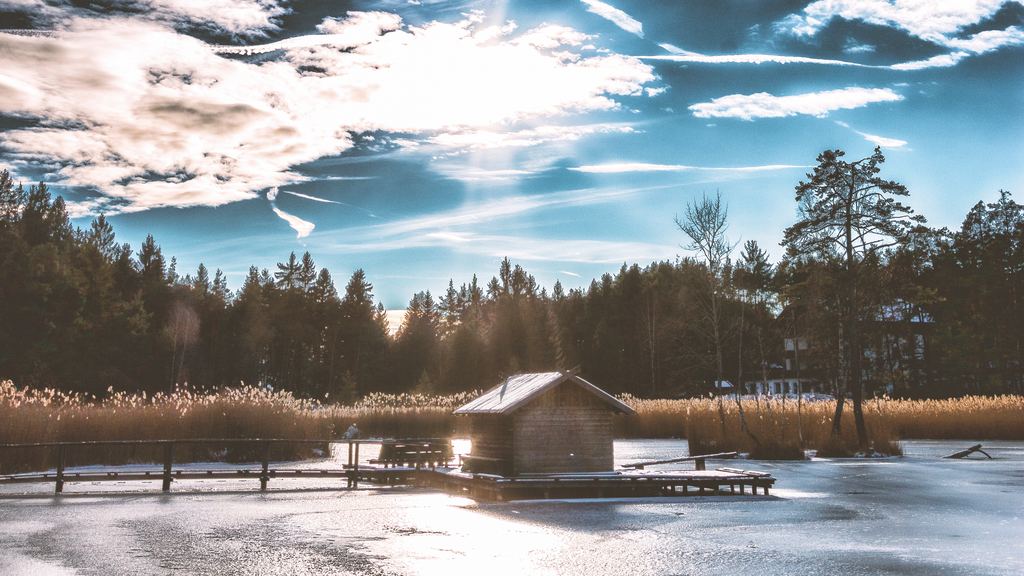
Why the observatory is here
In 1957, sixty-seven countries ran a coordinated programme of upper-atmosphere observations known as the International Geophysical Year, and one of the things it produced was a geophysical observatory at Kiruna. It is still going, now as the Swedish Institute of Space Physics, and it is one of the reasons the aurora is as well understood as it is.
Nine years later Esrange opened 40 km east and started firing sounding rockets straight up into the auroral zone to sample it from inside. It still does, alongside stratospheric balloon launches. There is also a receiving station here for the incoherent scatter radar network that maps the ionosphere across northern Scandinavia.
None of this changes what you will see on a Tuesday night. It does explain why so many guides here talk about the phenomenon with unusual precision. In Kiruna, space physics is a local industry, like the mine.
The six departures
The price band is unusually tight, 153 to 206 EUR with a median of 184, and there is no cheap seat in Kiruna at all: the lowest price here is more than double Rovaniemi's. Small market, few operators, no coaches. What you get for it is that every one of these is a small vehicle with a guide who chooses the destination on the night.
| Departure | Price | What makes it different |
|---|---|---|
| Minibus chase through the forests | 173 EUR | Four hours, meeting in town rather than hotel pickup. The straightforward version |
| Chase with a photographer | 153 EUR | The cheapest and by far the most reviewed: 816 reviews at 5.0. Will drive to Abisko if that is where the sky is |
| Chase with dinner in a tipi | 183 EUR | Dinner by the fire before you leave, then minivans to wilderness spots |
| Photo tour with Sámi guides | 186 EUR | Camera and tripod lent to you, so it works if you arrived with only a phone |
| Husky sled, about 13 km | 187 EUR | The guide drives the team, so your hands and eyes are free. Halfway stop at a teepee |
| Snowmobile over the frozen Torne | 206 EUR | Forest tracks, frozen lakes and a river solid enough to carry a machine |
One number there deserves attention. The cheapest departure carries 816 reviews at a perfect 5.0, and the operator's own description explains why: they will drive to Abisko, to the forests around Kiruna, or anywhere else with a hole in the cloud. In a small market, the operator willing to drive furthest wins.
Kiruna or Abisko?
The market answer is Abisko, on the strength of the blue hole: a window of clear sky said to sit over the valley when everything around it is shut. Our answer is Kiruna, and it is worth being precise about why, because the honest version has a caveat in it.
Our count puts Kiruna ahead of Abisko in all seven months of the season, by between 12 and 24 points, and roughly twice as far ahead once darkness is counted. But the blue hole is described as a window of 10 to 20 square kilometres, and the reanalysis grid is about 28 km across: at that scale our method is blind, and cannot confirm or refute it. What our number does show is the regional gradient, and the gradient runs against the story.
So: on everything we can actually measure, Kiruna is the better bet, and it is cheaper, and it has six departures against two. Several Kiruna departures drive to Abisko anyway when the forecast says to, which is the version that needs no argument at all.
Kiruna against its neighbour, on our numbers
| Month | 1 | 2 | 3 | 4 | 5 | 6 | 7 | 8 | 9 | 10 | 11 | 12 |
|---|---|---|---|---|---|---|---|---|---|---|---|---|
| KirunaSix of the seven months are within half an hour of each other, and every one of those six beats the best month at Tromso or Abisko. November wins on eight hours of darkness; September is the only weak month. | 1 | 2 | 3 | 4 | 5 | 6 | 7 | 8 | 9 | 10 | 11 | 12 |
| Abisko, 98 km west18.7% season average, the lowest of the fourteen destinations we measure, with November at 12.3%. The blue hole sits below the resolution of our method. | 1 | 2 | 3 | 4 | 5 | 6 | 7 | 8 | 9 | 10 | 11 | 12 |
Cloud: ERA5 via Open-Meteo, 11 seasons. Darkness and moon: ephemerides. Ranking by cloud multiplied by darkness; method in the site's data notes.
Kiruna in five dates
The origins
1900
A town built for ore
Kiruna is founded to work the iron deposit at Kiirunavaara, which turns out to be one of the largest bodies of iron ore ever found. Everything else here, including the airport that brings you, follows from that.
1909
Abisko becomes a national park
Sweden creates its first national parks, Abisko among them, protecting the valley 98 km west that would later acquire a reputation this town never sought.
The growth
1957
The observatory opens
During the International Geophysical Year a geophysical observatory is established at Kiruna, now the Swedish Institute of Space Physics. The aurora has been measured here continuously ever since.
1989
The first ice hotel
At Jukkasjärvi, 17 km away, a hall is built out of ice cut from the Torne River. It is rebuilt every winter and it turned Kiruna into somewhere people fly to on purpose.
Today
2014
The town starts moving
Deformation from the mine forces the relocation of the centre three kilometres east. The church made the journey in 2025, whole, on a trailer. The move is still under way.
Before you book from Kiruna
When should I come?
Almost any month except September, which is the useful answer here: six of the seven months are within half an hour of each other on our combined measure, and all six beat the best month at Tromsø. November is the technical winner on eight full hours of darkness. March has the highest cloud figure in Europe at 54.8% and the least darkness to use it in.
Is Kiruna really better than Abisko for the aurora?
On every number we can measure, yes: ahead in all seven months, roughly twice as far ahead once darkness is counted, cheaper, and with six departures against two. The caveat is honest: the blue hole is claimed at a scale our reanalysis grid cannot resolve, so we have not disproved it. We have shown that the wider region runs the other way.
Why is there no cheap tour here?
Six departures, a handful of operators and no coaches. Rovaniemi's 65 EUR seats exist because 81 departures compete for the same customers; Kiruna has no such pressure. What you get instead is a small vehicle with a guide making decisions rather than a bus on a fixed route.
Can I visit the mine or the moving town?
LKAB runs visitor tours into the mine, and the new centre with its relocated buildings is simply the town: you will be walking through it. It is a strange and genuinely interesting thing to see, and it costs nothing to look.
How cold does it get?
Inland Swedish Lapland runs colder than the Norwegian coast: minus 25 is an ordinary January night and minus 35 happens. That dry, cold, continental air is exactly why the sky here is clearer.
Data verified on. Cloud: ERA5 via Open-Meteo, 11 seasons. Darkness and moon: ephemerides. Prices and review counts read off the 6 departures on 10 August 2026.