
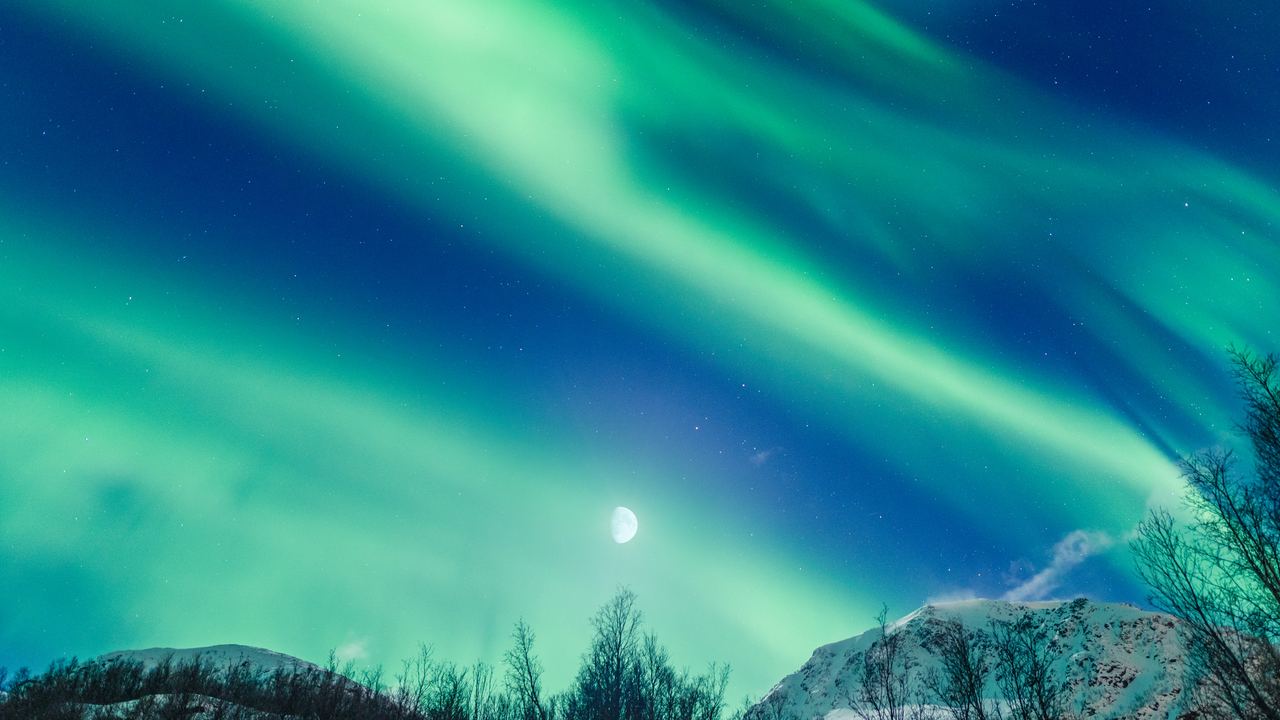
Every culture living under the aurora arrived at an explanation, and the explanations differ in a revealing way. Some are about the dead. Some are about animals. Almost all of them carry a warning attached, which tells you something about how the thing was regarded: not as scenery, but as something with intentions.
Sami: the light you can hear
The Sami of northern Scandinavia call the aurora guovssahas, which translates roughly as the light you can hear.
In Sami tradition the lights were connected with the souls of the dead and were treated with real caution. You did not whistle at them, wave, or otherwise draw attention to yourself while they were active. Doing so risked the lights noticing you, coming down, and taking you away. Children in particular were kept indoors during strong displays.
That name has been quietly interesting to researchers, because reports of sound accompanying the aurora have persisted for centuries and were mostly dismissed as imagination. Sound from something a hundred kilometres up should not reach the ground in any form we could hear.
Then in 2012 a team led by Unto K. Laine at Aalto University in Finland recorded the sounds and located their source at roughly 70 metres above the ground. A later paper linked them to a temperature inversion layer: charge accumulates in that layer on cold, calm nights, and geomagnetic activity discharges it, producing faint claps and crackles.
So the folklore was right about the fact and wrong about the mechanism. The sound is real. It just does not come from the aurora itself, it comes from the air just above your head.
Finland: the fox fires
The Finnish word for the aurora is revontulet, literally fox fires.
The story behind it is that an arctic fox runs across the fells at speed, and its tail strikes the snow, throwing sparks into the sky. In some versions the fox's fur brushes the mountainside and the friction sets the sky alight.
It is the most cheerful of the northern explanations, and it is still visibly present in Finnish branding and tourism. Of all the aurora words in use, it is the one that has aged best.
Inuit: a game with a walrus skull
Among some Inuit groups the aurora is aqsarniit, which has been translated as football players. The lights are the spirits of the dead playing a game in the sky, using a walrus skull as the ball.
There are versions in which the walrus is doing the kicking and the ball is a human skull, which is a considerably darker reading of the same sky.
The recurring element across Inuit traditions, as in Sami ones, is that the lights are the dead and that they can hear you. Whistling to call them closer appears in several accounts, sometimes as something children were told to do, sometimes as something they were warned against.
Norse: armour, and a bridge
Norse traditions gave the aurora two related readings. In one, the lights are reflections from the armour and shields of fallen warriors being escorted to Valhalla. In the other, they are Bifröst, the burning bridge connecting the world of people to the world of the gods.
Both are worth noticing for what they are not. There is no warning attached, and no suggestion that the lights are dangerous or that they might take you. Where the Sami and Inuit traditions treat the aurora as something to avoid provoking, the Norse version is closer to a military honour guard.
From omen to instrument
How the explanation changed, and how recently.
The origins
Antiquity onward
Written records without an explanation
Chinese and Japanese chronicles record unusual lights in the sky across many centuries, often read as omens. The observations are careful; the interpretations are political.
1619
The name arrives
The term aurora borealis, Roman goddess of dawn plus the Greek name for the north wind, enters use in Europe. The coinage is traditionally attributed to Galileo, though the attribution is disputed.
The growth
September 1859
The Carrington event
The strongest geomagnetic storm on record. Aurora seen as far south as the Caribbean, and telegraph operators between Boston and Portland disconnected their batteries and worked for two hours on the current the storm induced in the wires.
1896 to 1913
Birkeland is laughed at
The Norwegian physicist Kristian Birkeland proposes that the aurora is caused by charged particles from the sun guided down by earth's magnetic field, and demonstrates it with a magnetised sphere in a vacuum chamber. The idea is widely rejected.
1960s
Satellites settle it
Spacecraft measure the solar wind and the currents flowing in the magnetosphere directly. Birkeland turns out to have been right, roughly fifty years after he was dismissed, and decades after his death.
Today
January 2016
Amateurs find something new
A Facebook group of Alberta aurora photographers documents a mauve ribbon that behaves unlike any aurora. Working with researchers it is identified as a subauroral ion drift, named STEVE, and shown to be something instruments had measured but nobody had knowingly seen.
Why the old explanations are worth keeping around
It would be easy to treat all of this as charming and superseded. The Laine research is the argument against that. A belief that Europeans classified as superstition for centuries described a real acoustic phenomenon that nobody had bothered to measure, and it took until 2012 for anyone to check properly.
The people who lived under this sky every winter for thousands of years were observing carefully. Their models of what was happening were wrong. Their observations frequently were not, and the difference between those two things is worth holding onto.
Questions about the stories
Can you really hear the aurora?
Sometimes, faintly, on cold still nights, and the sound comes from about 70 metres up rather than from the aurora itself. Most people never hear it, and any tour promising sound is overselling.
Is it bad luck to whistle at the northern lights?
In Sami and several Inuit traditions, yes, and warnings not to draw attention to yourself are widespread. Whether you observe that is between you and the sky.
Did Galileo name the aurora borealis?
It is the traditional attribution and it is genuinely disputed, with Pierre Gassendi also credited. The name is from around 1619 either way.
Are there southern hemisphere legends too?
Yes. Maori tradition includes the aurora australis as fires lit by ancestors who travelled south, and Aboriginal Australian traditions in the south record it as well, often connected with fire or with spirits.
The written record, and what it is good for
Northern Europe told stories about the lights. East Asia wrote them down, with dates, and that turns out to be scientifically useful in a way nobody involved intended.
Chinese and Japanese court chronicles recorded unusual sky phenomena over many centuries, because such things were read as omens and omens were state business. The observations are often careful: colour, direction, duration, sometimes the shape. The interpretations are political rather than physical, but the interpretations are not the part that matters now.
Researchers have gone back through these chronicles specifically to extract auroral candidates, because a dated sighting from a known latitude is evidence about how far the oval extended, which is evidence about how strong the storm was. Combined with other proxies, this pushes the record of solar activity back well beyond the era of instruments.
It is not straightforward. A red glow in a chronicle might be an aurora, or a lunar halo, or a fire, and the papers spend much of their length arguing about which. But the principle is a good one, and it is the same principle this site works on at a much smaller scale: somebody wrote down what they saw, so we can check.
Europe has its own version. The Anglo-Saxon Chronicle and various medieval annals contain sky descriptions that read as auroral, usually alongside a firm view about what disaster they portended.
The other end of the world
The aurora australis happens simultaneously with the borealis, mirrored across the equator, and the cultures beneath it arrived at their own explanations.
In Māori tradition the southern lights have been connected with fires lit by ancestors who travelled south, a memory of voyagers in cold waters signalling home. Several Aboriginal Australian traditions in the south of the continent record the lights as well, commonly associated with fire, and in some accounts with spirits.
What is striking is how often the two hemispheres landed on the same two ideas independently: fire, and the dead. The Sami saw souls, the Inuit saw spirits playing, the Norse saw fallen warriors, and on the other side of the planet the associations run the same way.
That convergence is probably not coincidence. A silent, moving light in the sky that appears without warning and looks nothing like weather invites exactly two readings: something burning, or somebody there. Both were reasonable inferences from the available evidence, and it took until the twentieth century for the actual answer, which is stranger than either.
Sources
- Auroral sound research: Unto K. Laine, Aalto University, whose team located the source of auroral sounds at approximately 70 metres above ground level and linked them to discharges across a temperature inversion layer. Aalto University summary: the aurora borealis can be heard even when they cannot be seen.
- Sami, Finnish, Inuit and Norse traditions from published Nordic and Arctic folklore sources. The Sami term guovssahas and the Finnish revontulet (fox fires) are standard usage.
- Historical chronicles: auroral candidates have been catalogued from Chinese Song dynasty records and from the Japanese Rikkokushi chronicles, and used as evidence of past solar activity.
- Kristian Birkeland, whose 1896 theory and 1901 terrella experiments were rejected for decades and confirmed by spacecraft measurements in the 1960s. See our page on what causes the aurora.
- STEVE: MacDonald, E. et al. (2018), Science Advances, doi 10.1126/sciadv.aaq0030, following observations by the Alberta Aurora Chasers.
- Name origin: the term aurora borealis dates from around 1619 and is traditionally attributed to Galileo, an attribution that is disputed, with Pierre Gassendi also credited.
Data verified on. Folklore from published Nordic and Arctic sources. Auroral sound research: Laine, Aalto University, 2012 and 2016. Birkeland's rehabilitation is documented in the history of geophysics.
From old words to current ones
Forecasts have their own vocabulary, used freely and rarely defined. Here is what the terms mean and which ones matter.