
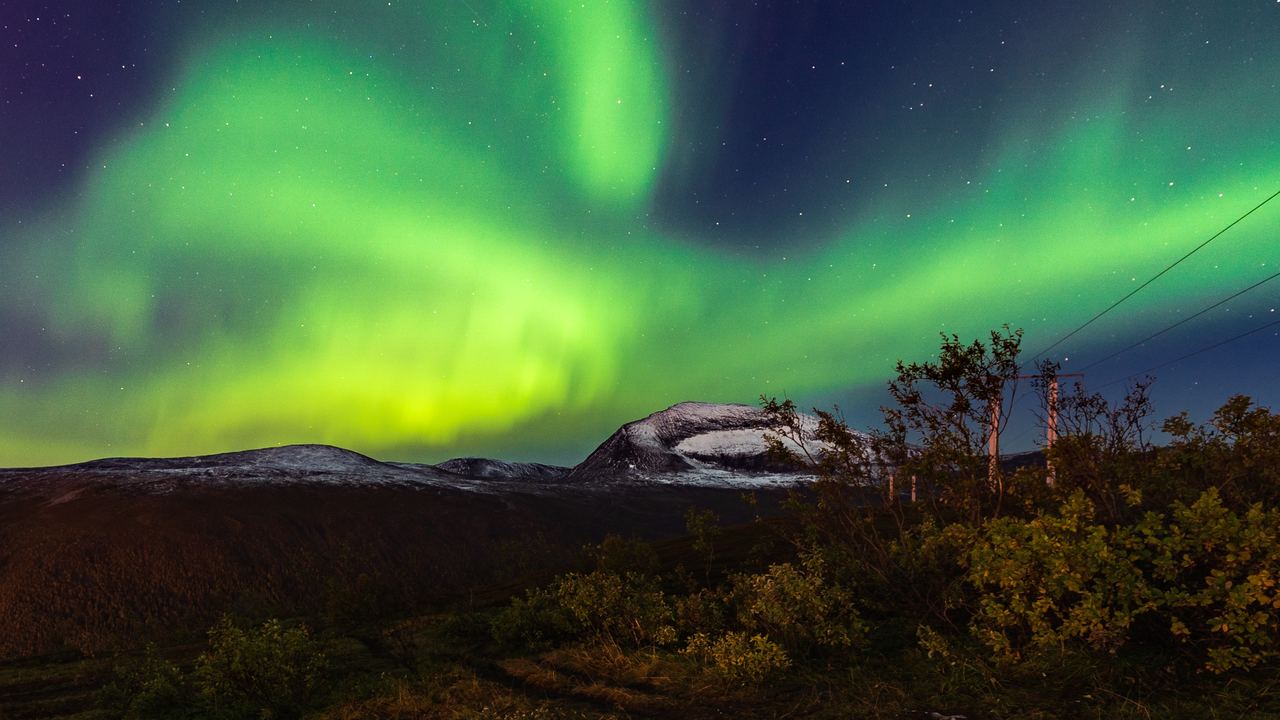
Tromso, Reykjavik and Rovaniemi get the traffic because they are easy to reach and have the deepest catalogue of tours. None of that makes them the best places to stand.
Three others come up repeatedly, and each has a real argument behind it rather than just marketing. They also all cost you an extra flight, which is the thing to weigh.
Abisko, and the hole in the clouds
Abisko sits in Swedish Lapland beside Lake Torneträsk, a long body of water running east to west between mountains. Weather systems arriving from the Norwegian coast have to climb those mountains, and they lose much of their moisture on the way up. What descends into the basin on the other side is drier air.
The result is said to be a persistent local clearing, the blue hole: a window of open sky over Abisko, usually described as 10 to 20 square kilometres, that stays clear while the region around it is overcast. The Aurora Sky Station, run by the Swedish Tourist Association, sits at around 900 metres above the village and is reached by chairlift; the height also puts you above valley-floor fog, which is a separate problem from cloud.
You will find figures attached to this: 70 percent clear nights, 80 to 90 percent success rates. They come from businesses selling tours there, and none of them says what was counted or over what period. So we calculated it ourselves, with the same ERA5 method used everywhere else on this site. The answer is more interesting than either a confirmation or a debunking.
Abisko comes out as the cloudiest place in our dataset, worse than Tromso in every month: 27.3% of usable nights in September, 12.3% in November, 18.7% averaged across the season, against 24.0% for Tromso and 35.5% for Reykjavik.
Before treating that as a debunking, we checked whether the method can see the thing being claimed. The blue hole is described as 10 to 20 square kilometres. ERA5 works on a grid of roughly 28 kilometres. So we ran the same calculation on five points around Abisko:
- Abisko village: 18.7% season average
- 25 km east, along the lake: 22.9%
- 25 km west, along the lake: 18.1%
- 25 km south, into the mountains: 15.5%
- 45 km north-west, towards Narvik: 30.1%
- 90 km east, at Kiruna: 38.8%
Two things follow, and both matter.
Within 25 kilometres the values are indistinguishable. If there is a clear-sky window a few kilometres across sitting over the village, ERA5 cannot resolve it, and no number we derive can confirm or deny it. This is the stated limitation of the method, meeting the one case where it genuinely bites.
At regional scale the gradient is real, and it runs the other way from the story. The Torneträsk basin is markedly cloudier than the plain around Kiruna 90 km east: 18.7% against 38.8%. The mountains that are supposed to produce the blue hole also produce orographic cloud, and at the scale we can measure, the second effect dominates.
So the honest position: the 70 percent figure finds no support in any public data we can check, and our number is not its refutation either, because it measures something else at another scale. Settling it would take station observations, which in Sweden are published by SMHI. Until someone does that, the rain shadow is a sound piece of geography and the percentages are advertising.
Fairbanks, Alaska
Fairbanks sits at around 65 degrees north and, more importantly, well inside the auroral oval. It is also deep in the interior, hundreds of kilometres from the ocean, which gives it a continental climate: colder, drier and clearer than anywhere on the Norwegian coast.
That combination is genuinely strong. What you pay for it is temperature. Minus 30 is an ordinary January night and minus 40 happens. Standing outside for hours at those temperatures is a different activity from doing it in Tromso, and the equipment requirements go up accordingly.
Fairbanks is also the most practical option for anyone travelling from North America, where flying to Alaska is often cheaper and simpler than crossing the Atlantic.
Yellowknife, Northwest Territories
Yellowknife sits under the oval on the shore of Great Slave Lake, with a flat horizon in most directions and very dry winter air. It has built a substantial aurora industry around heated viewing structures, which is a sensible response to the same cold problem Fairbanks has.
The heated facility model deserves a mention because it addresses the thing that actually ends most aurora nights, which is not cloud but people getting too cold to continue. Being able to warm up indoors and step back out when something starts changes how long you can stay out, and length of stay is a real variable in whether you see anything.
Getting there is the difficulty. Yellowknife is a long way from anywhere and the flights reflect it.
The pattern behind all three
Every one of these is inland or sheltered, and that is not a coincidence. Coastal aurora destinations are cloudy because oceans make clouds. Tromso is mild for its latitude thanks to the Gulf Stream, and pays for that mildness in overcast nights.
Move away from the water, or put a mountain range between yourself and it, and the sky opens up while the temperature drops. That is the trade running through this entire page: clear skies cost you warmth and accessibility.
It is also visible in our own data on a smaller scale. Rovaniemi, the most inland of the three main destinations, has the best late-season figures. Reykjavik, the most maritime, has the most consistent but never the highest. The pattern holds.
Is the extra flight worth it
For most people on a short trip, no. The gain in odds is real but modest, and an extra connection eats a day in each direction, which on a four-night trip is a quarter of your attempts.
It becomes worth it when you are staying longer, when you have already been to the obvious places, or when you are specifically chasing photographs and want the clearer, drier air. Abisko has the strongest case of the three, because the blue hole is a mechanism rather than just a latitude, and because it is reachable overland from Tromso in a few hours rather than requiring another flight.
Questions about the alternatives
Is Abisko really clearer than everywhere else?
Not at the scale we can measure. In our ERA5 calculation Abisko is the cloudiest location in the dataset, and the Torneträsk basin is markedly cloudier than the plain around Kiruna. But the blue hole is described as 10 to 20 square kilometres and the model grid is about 28 km, so a genuine local window would be invisible to this method. The rain shadow is sound geography; the percentages in circulation are unverified marketing.
So should I not go to Abisko?
That is not what the numbers say. They say nobody has published a verifiable figure either way, and that the regional weather is worse than the marketing implies. Abisko has a genuine dark-sky setting, a purpose-built viewing station above the valley, and it is reachable overland from Tromso, which makes it a reasonable addition rather than a guaranteed upgrade.
Can I do Abisko from Tromso?
Yes, it is a few hours by road, and operators cross that border routinely when the Norwegian coast is closed in. You can also reach it by train from Kiruna, which is also the clearest location in our calculation.
Is Alaska better than Scandinavia?
Drier and clearer inland, and much colder. If you are in North America the flights make the decision for you. From Europe the added journey rarely pays for itself on a short trip.
What about Svalbard or Greenland?
Svalbard is far enough north to sit inside the oval's ring rather than under its most active part on quiet nights, though it offers the unusual attraction of daytime aurora during the polar night. Greenland is spectacular and logistically demanding. Both are trips in their own right rather than aurora destinations you choose on odds.
Reaching Abisko, which is easier than it sounds
Abisko is the one on this page that does not require another long-haul flight, and that changes its case considerably.
It sits on the railway line between Kiruna in Sweden and Narvik in Norway, so it is reachable by train, and by road it is a few hours from Tromso. Norwegian operators cross to that side routinely when their own coast is closed in, which means you can benefit from the region without basing yourself there at all.
If you do base yourself there, the village is small and the accommodation limited, so it books up. The Aurora Sky Station above it is reached by chairlift and run by the Swedish Tourist Association; being at around 900 metres puts you above valley fog as well as closer to the weather that matters.
One practical note that falls straight out of our own calculation: Kiruna, 90 km east and the town most people pass through on the way, is the clearest location we measured in the whole region, at 38.8% against Abisko's 18.7%. That is a regional-scale figure and it does not account for any local window over Abisko itself. But if you are travelling between the two and the forecast is marginal, it is worth knowing which direction the odds improve in.
The others that come up
Beyond the three above, a handful of places appear regularly in this conversation and are worth placing quickly.
- Alta, Norway. Inland from the coast and drier than Tromso, with a long scientific association: the northern lights observatory on Haldde above the town was among the first in the world, built at the turn of the twentieth century.
- Kiruna, Sweden. Practical base with an airport, near Abisko, and the gateway most people use to reach it.
- Senja and Lofoten, Norway. Same weather problem as Tromso, considerably better landscapes. Chosen by photographers who want a foreground worth the trip.
- Yukon and the Northwest Territories beyond Yellowknife. Deep inside the oval, dry, cold, and remote enough that logistics dominate the decision.
- Svalbard. Poleward of the main oval, so nighttime displays are less reliable than the latitude suggests, but the only accessible place to see dayside aurora during the polar night.
The pattern from the main page holds throughout: the places with the clearest skies are inland, elevated or sheltered, and you pay for that clarity in temperature, accessibility, or both.
Sources
- Abisko figures: calculated by us from ERA5 reanalysis (ECMWF, Copernicus Climate Change Service) via the Open-Meteo historical archive, eleven seasons September 2015 to April 2025, same metric as our weather page. Coordinates used are listed above so the calculation can be repeated.
- The clear-sky and success percentages in circulation for Abisko come from commercial sources without a stated metric or period. They are not repeated here as fact.
- Station observations for Sweden, which are what would actually settle the blue hole question, are published by SMHI, the Swedish Meteorological and Hydrological Institute.
- Auroral oval position, which places Fairbanks and Yellowknife: NOAA Space Weather Prediction Center.
- Aurora Sky Station is operated by the Swedish Tourist Association (STF) above Abisko village.
- Haldde observatory above Alta was one of the earliest permanent auroral observatories, established at the turn of the twentieth century.
Data verified on. The Abisko rain shadow is well documented; the clear-sky percentages in circulation are commercial claims we have not verified and do not repeat as fact.
Before adding a flight, check the calendar
Moving your dates usually buys more than moving your destination, and it costs less.