
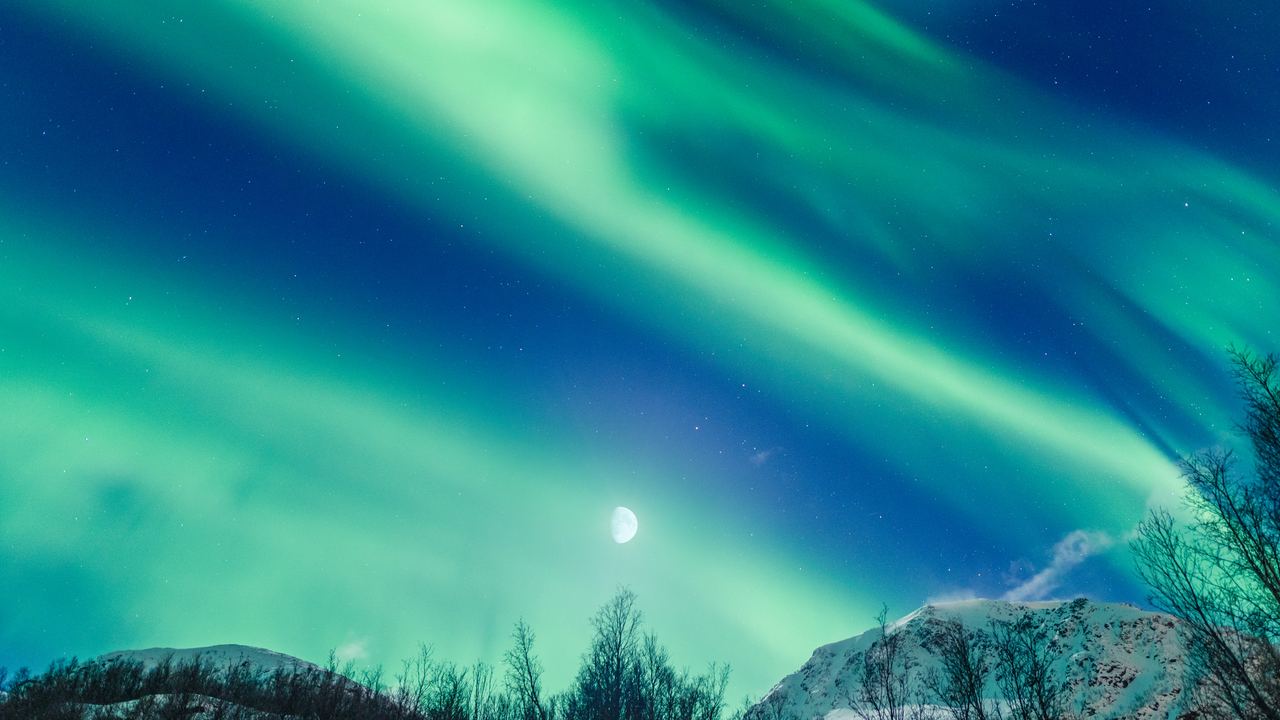
The cloud figures on our weather page are statistics: eleven seasons averaged, and next winter will only resemble them roughly. This page is different. Moon phases and darkness hours are ephemerides. They are exact, they are exact years in advance, and nothing about them will change between now and your trip.
Which makes them the easiest part of the planning to get right, and the part most people never look at. A full moon high in the sky washes out a weak aurora more thoroughly than a mediocre Kp reading does. It is entirely predictable, and it is free to avoid.
Every moon of the 2026-27 season
New moon is the night you want. Full moon is the night to spend somewhere else, or to accept knowing what it costs you.
| New moon (book these) | Full moon (avoid these) |
|---|---|
| 11 September 2026 | 26 September 2026 |
| 10 October 2026 | 26 October 2026 |
| 9 November 2026 | 24 November 2026 |
| 9 December 2026 | 24 December 2026 |
| 7 January 2027 | 22 January 2027 |
| 6 February 2027 | 20 February 2027 |
| 8 March 2027 | 22 March 2027 |
Two of those dates matter more than the rest. 11 September 2026 falls inside the September window, which has the best cloud odds of the season. 8 March 2027 falls inside the March window, which is where Rovaniemi records the single highest figure in our entire cloud dataset. If you are picking dates from scratch and have any flexibility at all, start from those two and work outwards.
A practical note on how wide that window is: you get roughly five workable nights either side of a new moon before the moon becomes a real nuisance. So the 11 September new moon really means about 6 to 16 September.
How much real darkness you actually get
Astronomical darkness means the sun is more than 18 degrees below the horizon. Above that, scattered sunlight still brightens the sky enough to interfere. This is a standard definition, not one we invented.
The table counts hours inside the same 18:00 to 02:00 window we use everywhere, in local standard time, without daylight saving. In September and March the civil clock runs an hour ahead of these figures.
| Destination | Sep | Oct | Nov | Dec | Jan | Feb | Mar |
|---|---|---|---|---|---|---|---|
| Tromso | 1.8 | 6.4 | 7.9 | 8.0 | 7.9 | 6.7 | 3.5 |
| Reykjavik | 2.7 | 5.1 | 6.4 | 6.9 | 6.3 | 5.1 | 3.5 |
| Rovaniemi | 2.8 | 6.1 | 7.6 | 8.0 | 7.5 | 6.2 | 4.3 |
The 8.0 figures are the ceiling: every hour of the window is fully dark. In Tromso in December that is the polar night, when the sun does not clear the horizon at all.
Now put that next to the cloud data. December in Tromso has the most darkness possible and the worst sky of the season, 16.8% of nights. The darkness is not the constraint. It never was.
September is the trap, and the trap is interesting
September has the best cloud odds. It also gives Tromso 1.8 hours of true darkness per night, the lowest number in the table, because at 69 degrees north the September twilight goes on and on and barely finishes before it starts again.
So the two constraints run in opposite directions across the season. Clear sky peaks when darkness is scarce. Darkness peaks when the sky closes. There is no month that maximises both, and any guide that recommends one month without mentioning the trade-off has only looked at half the problem.
Where they meet is the shoulder: October and February. Tromso in October has 31.9% cloud odds and 6.4 hours of darkness, which is a much better combined position than either extreme. It is not the answer to any single question, which is probably why nobody writes it on a landing page.
Nights the moon leaves alone
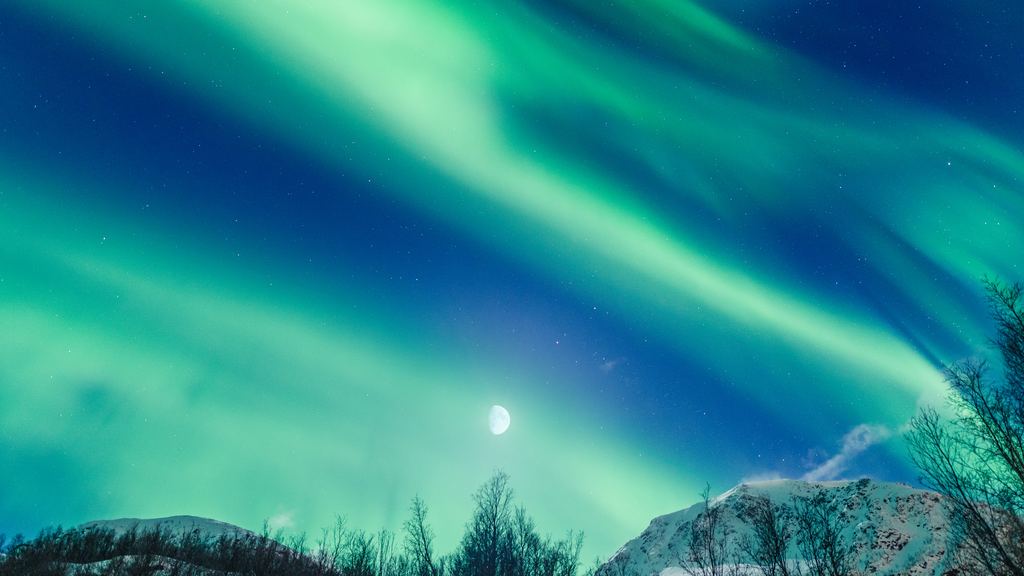
Being full is not the whole story. A full moon that has already set does no harm at all. What matters is whether the moon is above the horizon during your window, and how lit it is while it is up there.
So the figures below count nights with at least two hours of astronomical darkness where the moon is also low, thin, or absent. The 25% threshold on average lunar interference is our choice, and we would rather say so than present it as a natural fact.
| Destination | Sep | Oct | Nov | Dec | Jan | Feb | Mar |
|---|---|---|---|---|---|---|---|
| Tromso | 17 | 48 | 50 | 58 | 58 | 57 | 39 |
| Reykjavik | 40 | 48 | 50 | 55 | 58 | 57 | 61 |
| Rovaniemi | 37 | 48 | 53 | 58 | 58 | 57 | 61 |
Tromso in September drops to 17% for the same reason its darkness figure is 1.8 hours: there is so little true darkness that even a modest moon eats most of it. By midwinter every destination settles around 55 to 58%, which is close to what you would expect from the lunar cycle alone once darkness stops being the limiting factor.
March in Rovaniemi reaches 61%, alongside 50.0% cloud odds and a new moon on the 8th. That combination is the best single week in the whole season on paper, and it is shoulder season pricing.
What this does not settle
- Darkness is necessary, not sufficient. It tells you the sun has stopped interfering. It says nothing about whether there is an aurora.
- The times are local standard time. No daylight saving. In September and March the clock on your phone will be an hour ahead of these tables.
- The 25% moonlight threshold is ours. Like the 50% cloud threshold, it is a judgement call and it should travel with the number.
- A full moon does not cancel an aurora. A strong display is perfectly visible with the moon up. It is the faint ones that disappear, and most displays are faint. This table describes the ideal night, not the only possible one.
The three twilights, and why only one of them counts
Sunset is not darkness. Between the sun going down and the sky being genuinely dark there are three stages, each defined by how far the sun has sunk below the horizon, and they are standard definitions used by every meteorological and astronomical service.
| Stage | Sun below horizon | What you can see |
|---|---|---|
| Civil twilight | 0 to 6 degrees | Bright sky, brightest stars only. An aurora is invisible unless it is exceptional |
| Nautical twilight | 6 to 12 degrees | Horizon still distinguishable. Strong aurora starts to show |
| Astronomical twilight | 12 to 18 degrees | Sky looks dark to the eye but is not. Faint aurora still washed out |
| Astronomical darkness | more than 18 degrees | No solar interference at all. This is what our table counts |
We count only the last row, and that is a deliberately strict choice. Plenty of aurora is visible during astronomical twilight, especially a bright display. Counting the strict definition means the figures understate what you might actually see, which we prefer to the alternative.
It also explains the September problem precisely. At 69 degrees north in early September the sun spends most of the night between 6 and 18 degrees below the horizon, sliding through the twilight stages without ever clearing the last one for long. The sky looks dark. It is not.
The same geometry produces the opposite result two months later. Above the Arctic Circle in midwinter the sun does not rise at all, so it never climbs back into twilight range during the evening, and the entire window sits in full darkness.
Moonrise matters more than moon phase
The single most common planning mistake with the moon is treating it as a property of the date rather than of the hour.
The moon rises roughly 50 minutes later each day. Around new moon it travels with the sun and is absent from the night sky entirely. Around full moon it rises near sunset and stays up all night, which is the worst case. But in the intermediate phases it is up for part of the night and down for the rest, and which part matters enormously.
A waning gibbous moon, technically quite bright, may not rise until after midnight. That leaves you several completely dark hours in the early evening. A waxing crescent, technically very dim, sits low in the west right after sunset and is gone by 22:00, doing no harm at all.
So the practical rule is not avoid the full moon. It is: check what time the moon rises and sets on your dates, and plan the hours you go out around it. Our third table already does this arithmetic, which is why it counts the moon's altitude rather than only its phase, but if you are picking a specific evening it is worth looking up the actual moonrise time for your location.
There is one consolation for anyone stuck with a bright moon. Moonlight lights up the snow and the landscape, which for photography is often an advantage: a moonlit foreground with an aurora above it is a better picture than an aurora over a black void. It costs you the faintest displays and it improves the compositions.
Why these numbers do not expire
Almost everything else on this site carries an expiry date. Prices move, operators change their terms, and the cloud statistics are an average that next winter will only approximate.
This page is the exception. The moon's motion and the sun's position are the most predictable phenomena available to us: eclipse timings are routinely published centuries ahead, and the underlying algorithms are accurate to seconds over the span of a human lifetime. The dates in the first table were calculated rather than looked up, and they agree with published ephemerides.
Which is why a page like this can sit in a static build without going stale, and why it is the part of your planning worth locking down first. You cannot control the weather and you cannot forecast geomagnetic activity in advance. You can, entirely for free, avoid booking your only night on a full moon.
Common questions
How close to new moon do I need to be?
Roughly within five days either side and you will barely notice the difference. Beyond that the moon starts rising early enough, and bright enough, to matter. A quarter moon is a mild nuisance. A gibbous moon high in the sky during your window is a real one.
Is it worth planning the whole trip around the moon?
Only if the rest is already flexible. Cloud matters more than moonlight, and cloud is the thing you cannot plan around. If you have to choose, pick the month with better cloud odds and accept whatever moon you get.
Why do these tables use 18:00 to 02:00?
Because those are the hours tours actually run, and because using the same window everywhere means the cloud figures and the darkness figures can sit on the same line and be compared. Aurora activity does tend to peak around magnetic midnight, which usually falls inside that window.
Will these dates still be right next year?
The moon dates are exact and will not change. The darkness hours will not change either, since they depend only on latitude and the calendar. Only the cloud statistics carry uncertainty, and those live on a separate page for exactly that reason.
Does a full moon make it pointless to go out?
No. A strong display is perfectly visible with a full moon up, and the lit landscape often makes for better photographs. What you lose is the faint end of the range, which unfortunately is where most displays sit.
What is astronomical darkness exactly?
The sun more than 18 degrees below the horizon. It is a standard threshold, not one we chose. Above it, scattered sunlight is still bright enough to interfere with faint objects, even though the sky looks black to you.
Sources
- Moon phases and solar positions calculated with the algorithms in Jean Meeus, Astronomical Algorithms (2nd edition, Willmann-Bell, 1998), chapters 25, 48 and 49. The script is kept alongside this site's documentation and re-run when a destination is added.
- Twilight definitions follow standard usage: civil, nautical and astronomical twilight at 6, 12 and 18 degrees below the horizon respectively.
- Cross-check on lunar dates against published ephemerides for the 2026-27 season.
- Cloud statistics referenced on this page come from ERA5 (ECMWF, Copernicus Climate Change Service) via the Open-Meteo historical archive; see our weather page for the full method.
- Geomagnetic context, deliberately not covered here: NOAA Space Weather Prediction Center.
Data verified on. Moon phases and solar positions calculated with standard astronomical algorithms (Meeus). Independently checked against published new moon dates for September 2026 and March 2027.
Darkness is only half the calculation
The other half is cloud, and that one is a statistic rather than a certainty. It is also the variable that decides most nights.