
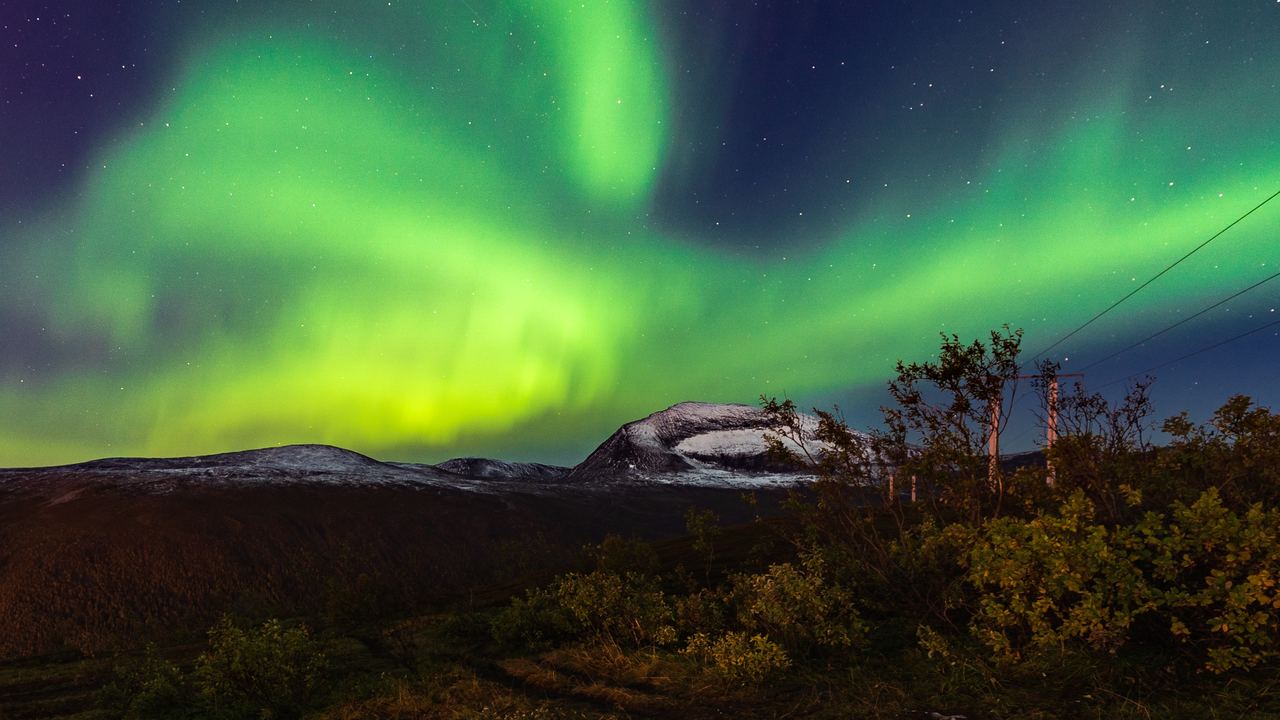
This question is usually answered by people describing how a place made them feel. That is not useless, but it does not travel: someone who had four clear nights in Tromso will tell you Tromso is the best place on earth, and someone who had four cloudy ones will tell you the opposite, and both are describing weather rather than destinations.
So here is the comparison on things that do not depend on whose week it was.
The comparison in one table
| Tromso | Reykjavik | Rovaniemi | |
|---|---|---|---|
| Geomagnetic latitude | about 66.8 deg | about 64.7 deg | about 63.0 deg |
| Position vs auroral oval | Inside it | At its edge | Below its quiet-time edge |
| Best month for cloud | Sep, 34.0% | Sep, 40.7% | Mar, 50.0% |
| Worst month for cloud | Dec, 16.8% | Feb, 31.1% | Nov, 20.0% |
| Season spread | 17.2 points | 9.6 points | 30.0 points |
| Darkness in December | 8.0 h, the full window | 6.9 h | 8.0 h, the full window |
| Darkness in September | 1.8 h | 2.7 h | 2.8 h |
| Moon-free nights, midwinter | about 58% | about 55-58% | about 58% |
Geomagnetic latitude is the part people get wrong
The aurora does not care about your latitude on a map. It cares about your position relative to the auroral oval, a ring centred on the magnetic pole rather than the geographic one, sitting roughly between 65 and 75 degrees geomagnetic latitude when things are quiet.
Tromso is at about 66.8 degrees geomagnetic, which puts it inside that ring on an ordinary night. Reykjavik is around 64.7, at the edge. Rovaniemi is around 63.0, which is below the quiet-time oval and needs a bit more activity before the display reaches overhead.
This is also why Oslo, which is unmistakably in northern Europe, almost never sees a good aurora while Tromso sees them routinely. Geography and geomagnetics are not the same map. Since the oval is anchored to the sun rather than to the ground, it also explains why there is a best time of night: the earth rotates you under the thickest part of the ring around magnetic midnight.
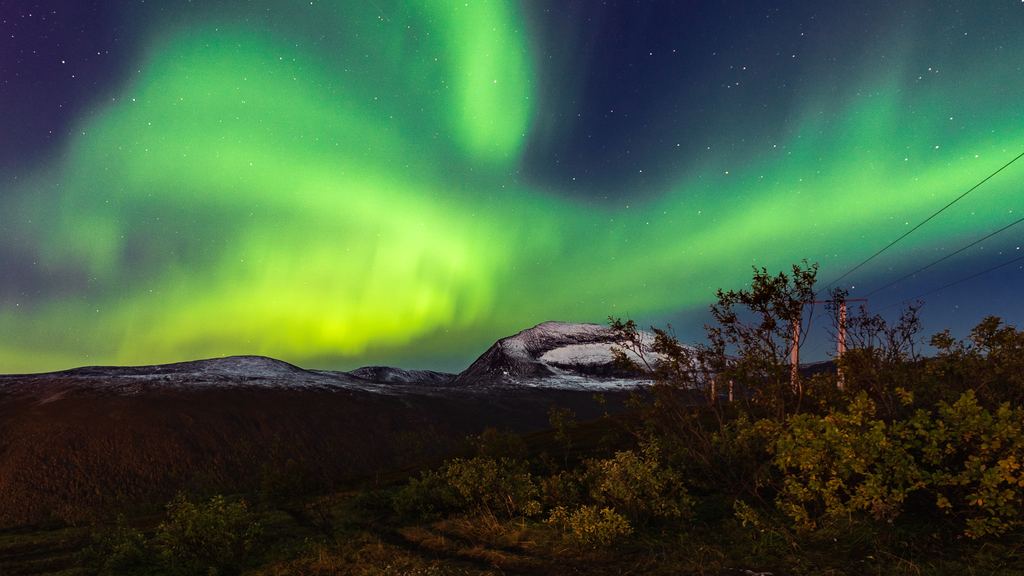
Tromso: best odds of activity, worst odds of seeing it
Being inside the oval is a genuine advantage, and it is the reason Tromso has the reputation it has. You do not need a storm. A quiet night with a Kp of 1 or 2 can still produce a display directly overhead, which at lower latitudes would put nothing above the horizon at all.
The problem is the Atlantic. Tromso is on an exposed coast and the same weather that keeps it unusually mild for 69 degrees north also keeps it cloudy. December sits at 16.8%, the worst figure in our dataset, and the season swings by 17 points end to end.
Tromso also has the deepest catalogue of tours, including the long chases that drive for hours to get out from under the cloud. Given the cloud statistics, that is not a coincidence: the chase exists because it has to.
Reykjavik: nothing spectacular, nothing terrible
Reykjavik never wins a month and never loses one badly. Its whole season fits inside a 9.6 point band, against 17.2 for Tromso and 30.0 for Rovaniemi.
Sitting at the oval's edge means a quiet night may leave the display low on the northern horizon rather than overhead, so Reykjavik rewards a bit more geomagnetic activity than Tromso does. In exchange you get the most predictable weather of the three, plus the shortest flights from most of Europe and North America and a city you can enjoy when the sky does not cooperate.
If you have one night and no ability to move it, this is the rational pick. It is a dull recommendation. Consistency usually is.
Rovaniemi: the biggest swing, and the best single month
Rovaniemi is the most volatile of the three and the most interesting for it. November is 20.0%, as bad as anything in the table. March is 50.0%, the best figure we have measured anywhere.
Being furthest from the oval, it wants more activity than Tromso does. Being inland and away from the Atlantic, it gets clearer skies in late season. Those two facts pull in opposite directions, and March is where the second one wins outright: half the nights usable, 4.3 hours of darkness, 61% of nights with no meaningful moonlight, and a new moon on 8 March 2027 sitting in the middle of it.
Rovaniemi is also where the guaranteed viewing language clusters most heavily, which is worth knowing before you read the listings. We cover what that phrase buys you on the guarantees page.
How to actually choose
- One night, fixed date, no flexibility. Reykjavik. You are buying consistency, and it is the only one selling it.
- Several nights and willing to sit in a minibus for hours. Tromso. Deepest in the oval, and the chase infrastructure exists precisely because the weather demands it.
- Flexible on dates and can travel in March. Rovaniemi. The March numbers are the best on this page and it is shoulder season.
- Travelling in December because that is when the holidays are. Any of them, but book more than one night. December is the weakest month in two of the three, and the strongest thing you can do about it is buy more chances rather than a better promise.
Questions people ask
Which has the highest chance of seeing the aurora overall?
Over a full season, Reykjavik has the best average cloud odds, and Tromso needs the least geomagnetic activity. There is no single winner, because the two factors do not combine into one number without us inventing weights, which we would rather not do.
Is Iceland really worse for aurora than northern Norway?
It is further from the oval, so a quiet night shows less. But it is also cloudier in Tromso than in Reykjavik for most of the season, and cloud beats everything. The two effects partly cancel.
Does Rovaniemi being furthest south rule it out?
No. It sits close enough that ordinary activity still produces displays, and its late-season weather is the best of the three. It is a worse bet in November and a better one in March.
What about somewhere else entirely?
Abisko in Sweden has a well documented local effect that keeps its sky clearer than its surroundings, and Fairbanks and Yellowknife sit deep inside the oval. They are covered on our page about going beyond the three classics.
Getting there, and what it costs you in nights
The comparison above treats the three as if you arrive at each with the same amount of time. You do not, and on a short trip the journey eats the thing that matters most, which is the number of nights you can be under the sky.
Reykjavik has the shortest flights from most of Europe and the eastern seaboard of North America, and Keflavik is a major hub with heavy competition on the route. For many people it is a single direct flight of three to five hours, which means you can land in the afternoon and be out looking that same night.
Tromso almost always needs a connection, usually through Oslo, and the connection is what costs you. A day each way is common, which on a four-night trip removes half your attempts.
Rovaniemi sits in between and swings hard with the season. Direct seasonal flights from several European cities appear for the Christmas period and thin out either side of it, so the same destination can be a single hop in December and two connections in February.
Put that next to the cloud figures and the arithmetic sometimes inverts. Reykjavik has the weakest position relative to the oval, and if its accessibility buys you two extra nights under the sky, those two nights are worth more than the difference in geomagnetic latitude. Nights beat everything.
What each place is like when the sky is shut
You are booking a trip where the main attraction may not appear. That makes what happens on the failed nights part of the decision, and it is the part comparisons never cover.
Reykjavik is a proper small city with the whole of southwest Iceland reachable as a day trip: the Golden Circle, the south coast, the geothermal pools. If the aurora never shows, you have had an Iceland holiday. This is the least risky of the three in the sense that matters to most people.
Tromso is a compact Arctic city with a genuinely good museum sector, whale watching in season, cable car views, and a bar culture that surprises people. It is small, and a week of solid cloud will feel long, but the daylight hours have real content in them.
Rovaniemi is built around Christmas tourism and the Santa Claus Village, plus husky and reindeer operations. If you are travelling with children that infrastructure is a genuine advantage and the aurora becomes a bonus rather than the point. If you are not, the town itself is thin.
The uncomfortable framing, which we would rather state than dance around: choose somewhere you would be content to have visited even if you see nothing. Given the cloud statistics on this site, that is not pessimism, it is arithmetic. At Tromso's December rate you have a real chance of exactly that outcome, and the people who come home happy anyway are the ones who did not stake the entire trip on one phenomenon.
Sources
- Cloud figures: ERA5 reanalysis, produced by ECMWF for the Copernicus Climate Change Service, queried through the Open-Meteo historical archive. Dataset documentation at the Copernicus Climate Data Store. Eleven seasons, September 2015 to April 2025. Method on our weather page.
- Darkness and moon figures: calculated from standard astronomical algorithms; method on our moon and darkness page.
- Auroral oval and geomagnetic activity: NOAA Space Weather Prediction Center. Geomagnetic latitudes are approximate and drift slowly as the magnetic pole moves.
- National meteorological services for forecasts on the night: MET Norway and the Icelandic Met Office, which publishes a dedicated aurora and cloud forecast.
Data verified on. Cloud figures from ERA5 (ECMWF), 2015-2025. Darkness and moon figures calculated from ephemerides. Geomagnetic latitudes are approximate and shift slowly over time.
Once you have picked a place, pick the month
The destination matters less than when you go. Cloud, darkness and moonlight all move across the season, and they do not move together.