
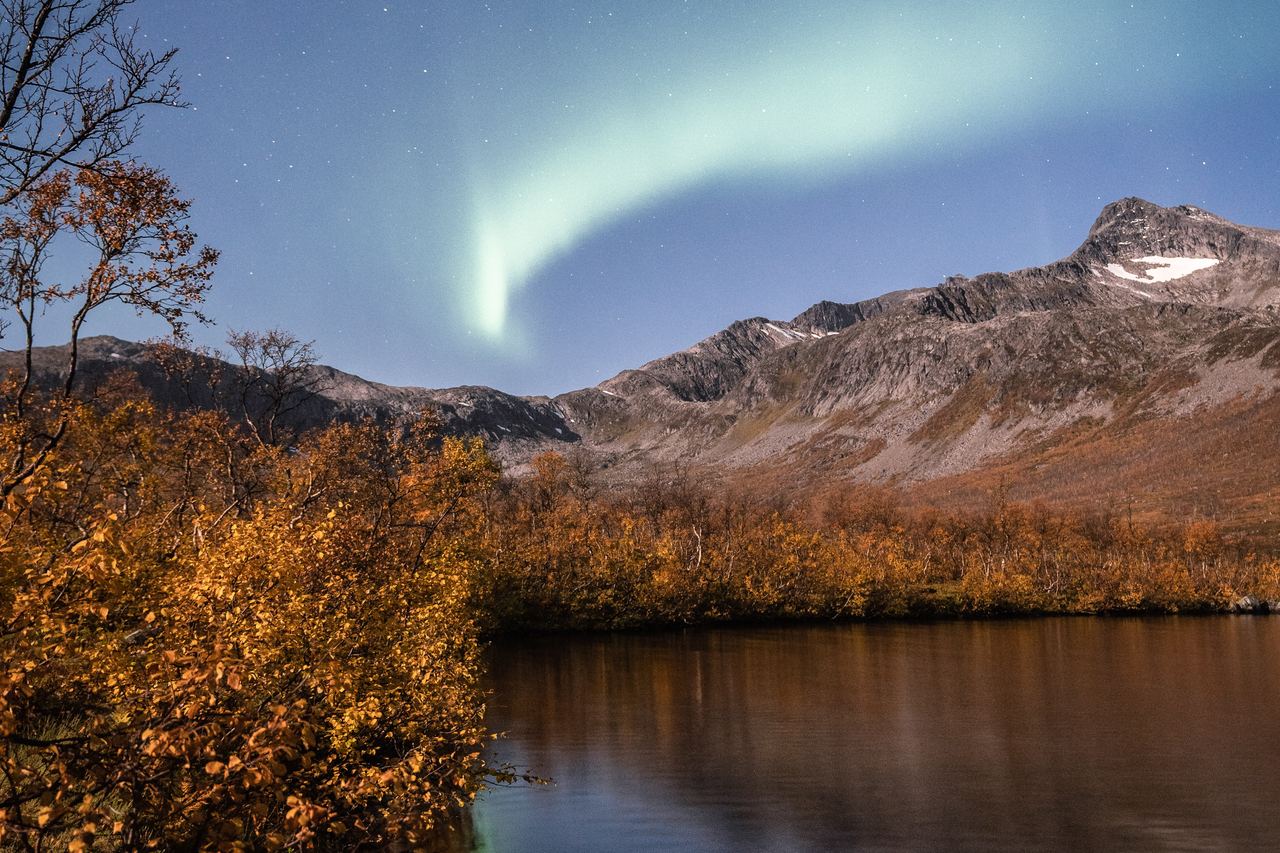
Saariselkä
3 departures from the northernmost base in Finnish Lapland, where the sun does not rise for a month
Saariselkä is the far end of Finnish Lapland in every sense that matters. The village sits at 68°25′N, three hundred kilometres north of Rovaniemi, at the edge of a national park the size of a small county, in a municipality bigger than several European countries and home to about seven thousand people. Darkness here is not something you have to drive to find. It is the default condition of the place.
That is the argument for coming, and the catch arrives immediately after it: there are three departures. Not thirty, not eighty. Three. If the cloud sits over Inari on the night you are here and none of the three is running, there is no fourth option to fall back on.
So this is a destination for people who are staying a while, or who are passing through on a longer Lapland route, rather than for a two-night aurora sprint. Ivalo airport is 25 km away and takes direct winter flights, which makes it more reachable than the map suggests, and Lake Inari, one of the largest lakes in Finland with something over three thousand islands in it, is up the road.
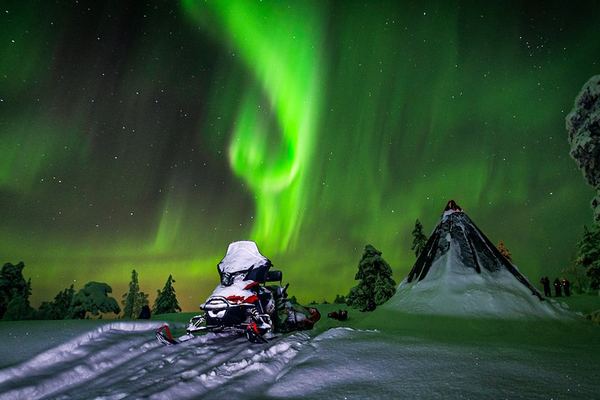
Night Snowmobile Safari from Saariselkä in Search of the Aurora
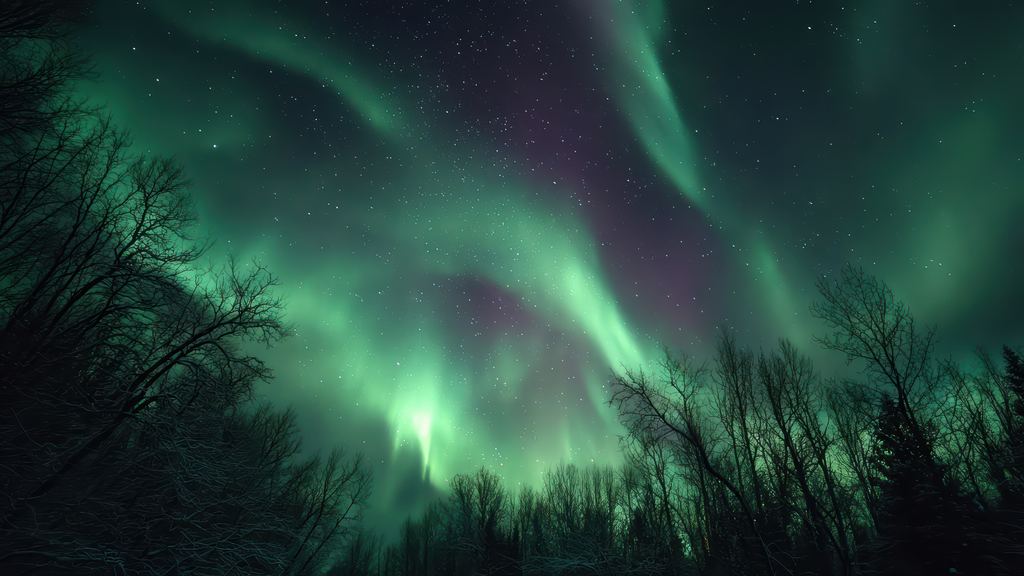
Saariselkä is far enough north, and from anything else, to make the dark genuinely dark. Frosted trees, then a clearing where the whole sky opens at once.
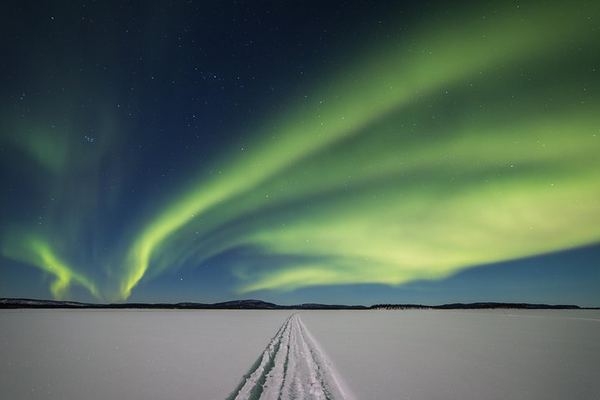
Northern Lights Trip from Saariselkä to Lake Inari with Dinner
A sleigh pulled by a snowmobile goes where no van does, out to the open horizon of Lake Inari. Reindeer to feed, dinner in a warm teepee, ten guests at most.
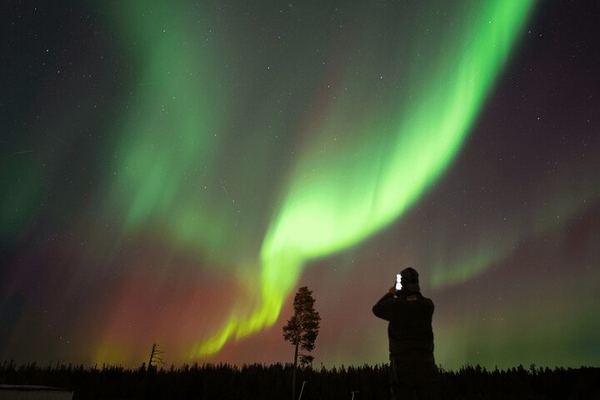
Three Hour Aurora Hunt by Minivan around Ivalo, Inari and Saariselkä
Three hours in a warm minivan working the spots most likely to deliver that night, with a fire stop for sausages, hot tea and homemade berry juice.
Ratings collected by Viator and Tripadvisor
Kaamos, and why the aurora turns up at three in the afternoon
Finns call it kaamos: the stretch of midwinter when the sun never clears the horizon at all. At this latitude it runs about a month, roughly from the first week of December to the first week of January, and it is not the black hole people imagine. What you get instead is several hours of deep blue twilight in the middle of the day, with the snow holding whatever light there is, and then a very long night on either side.
The practical consequence is one of the genuinely useful things about coming this far north in December. Aurora is a matter of darkness, not of clock time, and in kaamos it is dark enough by mid-afternoon. Displays that in September would demand you stay up until one in the morning can be watched at four in the afternoon with a coffee. The tours here still leave in the evening, because that is when the geomagnetic activity tends to peak, but a strong afternoon is not unusual and you do not need anyone's permission to look.
The emptiest place in this catalogue
Inari, the municipality Saariselkä belongs to, covers more than 17,000 square kilometres. That is larger than Kosovo, and about seven thousand people live in it. Urho Kekkonen National Park, which begins where the village ends, accounts for 2,550 of those square kilometres on its own and contains no permanent settlement, no street lighting and very few roads.
What that buys you is a quality of darkness that no amount of driving out of Rovaniemi will match. The nearest thing to light pollution is the village itself, and Kaunispää, the fell just south of it, has a road running to a 438-metre summit that sits above the treeline. A treeless top with a clear view north is the single most valuable feature a viewpoint can have, and here it is a ten-minute drive rather than an expedition.
What the three departures are
| Format | Price | Where it goes | Suits |
|---|---|---|---|
| Minivan hunt around Ivalo, Inari and Saariselkä | 150 EUR | Wherever the night's cloud allows, across three areas, with a fire stop | Anyone whose priority is actually seeing it |
| Sleigh behind a snowmobile to Lake Inari, with dinner | 179 EUR | One destination: the open horizon of a very large lake | An evening rather than a hunt; the horizon here is exceptional |
| Night snowmobile safari | 189 EUR | Trails through forest and low fell country away from the village | People who would rather ride than wait |
If you only book one, the minivan is the one that behaves like an aurora tour: it moves, it works three separate areas, and at 150 EUR it is also the cheapest. The Lake Inari sleigh is the one worth booking for its own sake. A lake of that size gives you a horizon with nothing on it at all, which is exactly what a low northern arc needs.
The Sámi north
Inari village, about 40 km up the road, is the centre of Sámi life in Finland. It is the seat of the Sámi Parliament, and the only place where all three of the Sámi languages used in this country are spoken: Northern Sámi, Skolt Sámi and Inari Sámi, the last of which has only a few hundred speakers and exists nowhere else on earth.
None of the three departures on this page is a Sámi cultural tour, and it is worth saying so plainly rather than borrowing the association. If that is what you want, the Siida museum at Inari is the place to start, and it is a serious institution rather than a gift shop with reindeer outside.
When to come, and what kaamos is actually worth
The polar night is the reason people choose this place over Rovaniemi, and it deserves a number rather than a mood. Darkness is only half of what makes a month good; the other half is how often the sky is open. Multiplied together, the Saariselkä season looks like this.
| Month | Usable-sky nights | Darkness per night | Moon-free nights | Expected usable dark hours |
|---|---|---|---|---|
| March | 48.7% | 3.7 h | 45% | 1.80 |
| October | 29.4% | 6.1 h | 48% | 1.79 |
| December | 20.6% | 8.0 h | 58% | 1.65 |
| January | 21.3% | 7.7 h | 58% | 1.64 |
| February | 23.3% | 6.3 h | 57% | 1.47 |
| November | 17.0% | 7.7 h | 50% | 1.31 |
| September | 34.7% | 2.1 h | 20% | 0.73 |
March and October are level at the top, and they are completely different trips. March gives 48.7% of nights with a usable sky and snow on everything, on 3.7 hours of darkness. October gives six hours of dark and a sky open on fewer than a third of nights.
Kaamos does less than its reputation suggests. December and January give the maximum eight hours of astronomical darkness available anywhere on earth, and the sky above them is open on about one night in five: 1.65 and 1.64 expected hours, behind both March and October. The polar night is a remarkable thing to experience and it is not, on these numbers, the best time to see the aurora here. That is worth knowing before building a trip around it.
November is the month to avoid, at 17.0% the weakest cloud figure in Finland. And September comes last by a distance: 2.1 hours of darkness and only 20% of nights free of moonlight.
One limit, stated because it argues against the ranking: it measures how much dark clear sky a month contains, not the chance the aurora does something inside it. Geomagnetic storms are close to twice as frequent at the equinoxes, favouring September and March. March wins either way; September stays last.
| 1 | 2 | 3 | 4 | 5 | 6 | 7 | 8 | 9 | 10 | 11 | 12 |
Four dates that made this corner of Lapland
The origins
1973
The first elected Sámi body
Finland establishes the Sámi Delegation, the first elected representative body for Sámi people in the country, based in Inari. It is the ancestor of the parliament that sits there today.
The growth
1983
Urho Kekkonen National Park
2,550 square kilometres of fell and forest east of Saariselkä are protected as a national park. No settlement, no roads to speak of and no lighting: it is why the darkness here is what it is.
1996
The Sámi Parliament
The modern Sámi Parliament of Finland begins work, with its seat at Inari, 40 km from the village. Its cultural centre, Sajos, opens there in 2012.
Today
October 2024
Solar maximum declared
NOAA and NASA confirm Solar Cycle 25 has peaked. Activity stays elevated for a year or two either side, which is the window the current seasons fall inside.
Before you come this far north
Is the polar night the best time to come?
It is the most remarkable time and not the best on our numbers. December and January give eight hours of astronomical darkness, the maximum available anywhere, and the sky above Saariselkä is open on about one night in five in those months. March and October both come out ahead. Come in kaamos for the experience of it, with your eyes open about the odds.
Is three departures enough for a trip?
Only if you have several nights, or if the aurora is one reason among others for being here. With two nights and three tours, a bad weather system leaves you with nothing to switch to. Rovaniemi has 81 departures for exactly this reason; Saariselkä offers darkness and emptiness instead of options.
Do I need a tour at all?
Less than almost anywhere else in this catalogue. The village is small, the surrounding country is unlit, and Kaunispää has a road to a treeless summit ten minutes away. A tour buys you a guide reading the forecast and somewhere warm between looks.
What is the polar night actually like?
Blue rather than black. For a month the sun stays below the horizon, but the middle of the day is several hours of deep twilight with the snow reflecting whatever light exists. It is disorienting for about two days and then quite beautiful.
How cold does it get?
Colder than Rovaniemi, routinely below minus 25 in January and occasionally a great deal worse. Every operator supplies thermal overalls and boots. Layers, two pairs of gloves, and spare camera batteries kept against your body.
Data verified on. Cloud: ERA5 via Open-Meteo, 11 seasons. Darkness and moon: ephemerides. Prices read off the 3 departures on 10 August 2026.