

Alta
The town that calls itself the Northern Lights City, and has the observatory to back it
In 1899 Kristian Birkeland built the world's first permanent aurora observatory on Haldde, the mountain above Alta, and spent several winters up there testing an idea everyone else thought was wrong: that the aurora is caused by charged particles from the Sun, guided into the atmosphere by the Earth's magnetic field. He proved it in the laboratory with a magnetised sphere and a vacuum chamber, published between 1908 and 1913, and died before the theory was accepted. Norway later put him on the 200-krone note.
Every guide in this country is retelling Birkeland's argument, usually without saying so, and in Alta they are doing it a few kilometres from where he worked. The town calls itself Nordlysbyen, the Northern Lights City, and it is the one place in this catalogue with a historical right to the name.
The sky supports it, modestly. Across eleven seasons of reanalysis Alta gets a usable sky on 29.3% of season nights, second in Norway behind Bodø and ahead of Tromsø in every month of the season. The reason is position: Alta sits at the head of a long fjord with mountains behind it, far enough from the open Atlantic that weather arrives having already dropped some of its water. Local operators quote seasonal success rates of 80 to 90 per cent, which is their own figure measured their own way, and worth reading next to ours rather than instead of it.
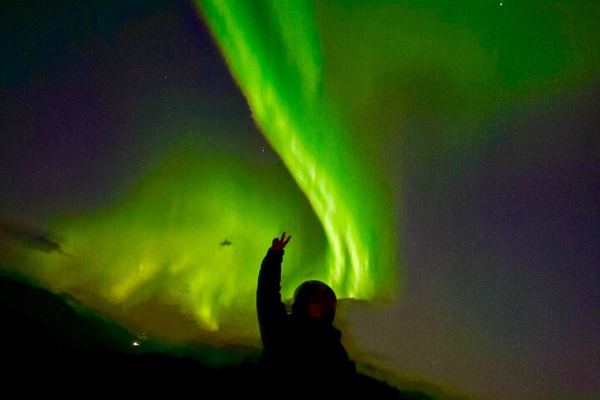
Evening ATV Ride and Northern Lights Sightseeing in Northern Norway
An aurora hunt on four wheels along the coast from Kviby, in warm gear and a helmet. An ATV reaches viewpoints no coach can, and keeps you in open air.
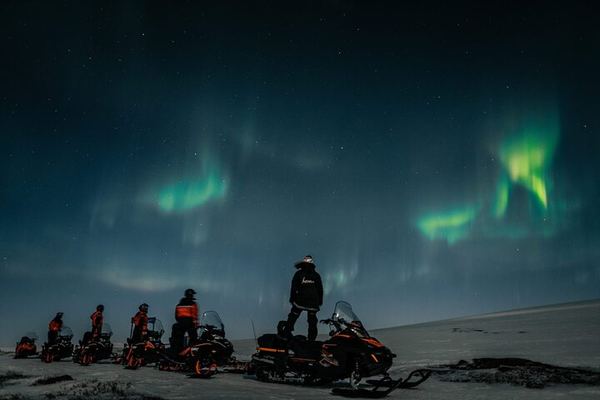
Northern Lights Adventure by Snowmobile from Alta
Follow the old postal road to the edge of Finnmarksvidda, where the only light is the sky's own. Alta's dry climate gives it some of the best odds anywhere.
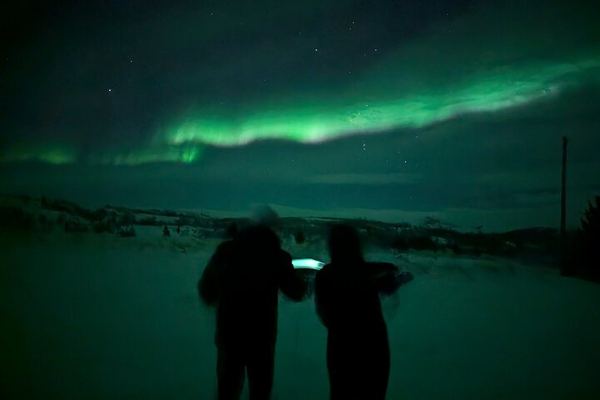
Northern Lights Minibus Chase, Maximum 16 People per Group
Four hours by minibus with a bonfire, hot drinks and snacks at the stop. Warm clothing is not provided: bring layers for standing still below freezing.
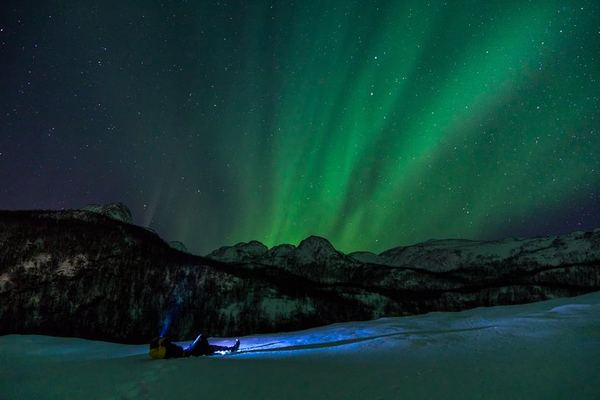
Northern Lights Tour Around the Altafjord with Alta Adventure
Guiding here since 2007, with an 80 to 90% success rate in a normal season. A camp and fire when there is time, a shorter stop when the driving is long.
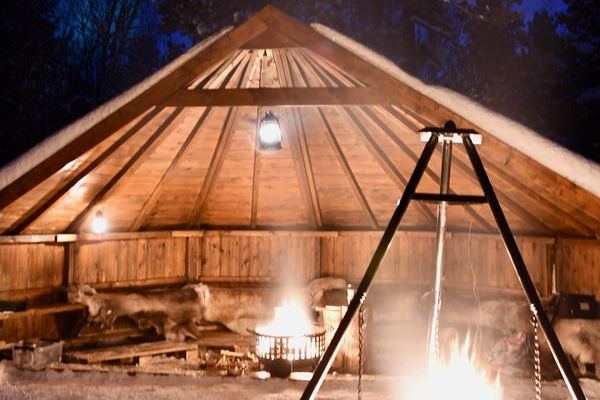
Sleigh Ride Under the Northern Lights Along the Alta River
The slow version of an aurora night: through the forest at walking pace to a wilderness shelter, where a late dinner is served round the fire. Stay put.
Ratings collected by Viator and Tripadvisor
The numbers, month by month
| Month | Usable-sky nights | Darkness per night | Moon-free nights | Expected usable dark hours |
|---|---|---|---|---|
| October | 32.9% | 6.7 h | 48% | 2.20 |
| December | 26.8% | 8.0 h | 58% | 2.14 |
| January | 25.8% | 8.0 h | 58% | 2.06 |
| February | 29.3% | 6.9 h | 54% | 2.02 |
| November | 23.0% | 8.0 h | 50% | 1.84 |
| March | 31.6% | 3.5 h | 39% | 1.11 |
| September | 36.0% | 1.7 h | 13% | 0.61 |
Three rows deserve stopping on. November, December and January all give the full eight hours of astronomical darkness inside the tour window: at 69°58′N the Sun does not come near the horizon, and no destination in this catalogue does better.
September has the best cloud figure of the Alta year and is the worst month by a distance. There are 1.7 hours of real darkness in it, and 13% of its nights are free of moon interference, which is the lowest figure of any month at any of the fourteen destinations we measure. Two constraints failing at once.
October is the month. Nearly as much sky as September with four times the darkness, and the light is still soft enough that the fjord and the mountains read in a photograph. December and January follow, and they are where Alta's inland position earns its reputation: a drier sky than the coast, with the longest nights available anywhere.
One limit on that ranking, stated because it argues against it. It measures how much dark clear sky a month contains, not the chance the aurora does something inside it. Geomagnetic storms are close to twice as frequent around the equinoxes, an effect described by Russell and McPherron in 1973, which favours September and March. Even doubling September leaves it well behind October here.

The five departures
Small market, no cheap seats: the lowest price here is 187 EUR, more than double Tromsø's coach. The median is 242 EUR, the highest of the nine destinations where we have enough departures to calculate one. What that buys is that every departure is a small operation with a guide who decides where to go on the night.
| Departure | Price | Reviews | What sets it apart |
|---|---|---|---|
| Minibus chase, max 15 | 187 EUR | 18 | Four hours with a bonfire stop. The straightforward version, and the cheapest here |
| Small-group hunt around the Altafjord | 204 EUR | 129 | The most reviewed. An operator guiding here since 2007; no two departures take the same route |
| Evening ATV ride | 242 EUR | 33 | Four wheels out to Kviby, with warm clothing and a safety briefing before you ride |
| Sleigh along the Alta River | 289 EUR | 19 | Walking pace through forest to a wilderness shelter. The slow version, and the one that suits a bad forecast |
| Snowmobile adventure | 294 EUR | 44 | The fastest way to leave the town lights behind, and the most expensive night here |
The sleigh is the interesting one once you have read the table above. At walking pace, ending at a shelter with a fire, it is designed around the assumption that most of an aurora night is waiting. In November, at 23.0% usable sky, that assumption is correct more often than not.
Local operators quote seasonal success rates of 80 to 90 per cent. That is their own figure, measured their own way: it counts trips on which the aurora was seen after driving to find clear sky, generally including displays a camera registers. Ours counts nights when the sky above the town was open for at least two hours. Both can be true at once, and only one of them states its method.
The rock carvings, and how long people have been watching this
Just outside town are thousands of figures cut into rock between roughly 5,000 and 2,000 BC, a UNESCO World Heritage site since 1985 and one of the largest collections of prehistoric rock art in northern Europe. The people who made them lived under this sky every winter of their lives. Nobody knows what they thought it was, and none of the carvings obviously depicts it, which is itself a small mystery worth sitting with.
It makes Alta the only place in this catalogue where you can see the first scientific attempt to explain the aurora and seven thousand years of people who had no explanation at all, within a few kilometres of each other.
When to come
Alta against the other Norwegian bases
| Month | 1 | 2 | 3 | 4 | 5 | 6 | 7 | 8 | 9 | 10 | 11 | 12 |
|---|---|---|---|---|---|---|---|---|---|---|---|---|
| AltaOctober is the best month, and December and January are close behind on eight full hours of darkness. September has the best cloud figure of the year and the worst moonlight of any month anywhere here, at 13%. | 1 | 2 | 3 | 4 | 5 | 6 | 7 | 8 | 9 | 10 | 11 | 12 |
| BodøThe best Norwegian sky at 32.9% and the flattest, never below 26.1%. November is unusually strong at 36.3%. Three departures. | 1 | 2 | 3 | 4 | 5 | 6 | 7 | 8 | 9 | 10 | 11 | 12 |
| TromsøBehind Alta on cloud in all seven months, with December at 16.8%. Seventy-four departures and a 300 km working radius are the compensation. | 1 | 2 | 3 | 4 | 5 | 6 | 7 | 8 | 9 | 10 | 11 | 12 |
Cloud: ERA5 via Open-Meteo, 11 seasons. Darkness and moon: ephemerides. Ranking by cloud multiplied by darkness; method in the site's data notes.
Before you book from Alta
When should I come?
October, with December and January close behind on the strength of eight full hours of darkness. Avoid September despite its excellent cloud figures: 1.7 hours of real darkness and 13% of nights free of moonlight make it the weakest month of the Alta year, and the worst pairing anywhere in this catalogue.
Is Alta better than Tromsø?
On the sky above the town, yes, in every month of the season. On everything else, no: five departures against seventy-four, no cheap option, and no operator willing to drive 300 km on your behalf. With three nights it is the better base; with one, Tromsø's machinery is worth more than four percentage points.
What about the 80 to 90 per cent success rate?
It is the operator's own figure and it is not measuring what our 29.3% measures. Theirs counts trips on which the aurora was seen, after driving to find clear sky, and generally includes displays a camera registers. Ours counts nights when the sky above the town was open for at least two hours.
Is it worth going up Haldde?
The observatory buildings are still there and the walk up is a serious one, better suited to summer than to an aurora trip. In winter what you get from town is the same sky Birkeland was measuring, which is arguably the point.
How cold does it get?
Colder than Tromsø: Alta sits at the head of a fjord with inland Finnmark behind it, and it behaves like the interior rather than the coast. Minus 20 is normal in January. That dry inland air is also why the sky here is clearer than on the open coast.
Data verified on. Cloud: ERA5 via Open-Meteo, 11 seasons. Darkness and moon: ephemerides. Prices and review counts read off the 5 departures on 10 August 2026.