
Bodø
The most open sky in Norway, and three departures under it
Bodø is the answer to a question nobody in this business asks. It sits at 67°17′N, two degrees south of Tromsø, on the same Atlantic coast, and across eleven seasons of reanalysis it gets a usable sky on 32.9% of season nights against Tromsø's 25.4%. It is ahead in every single month, and in November the gap is not subtle: 36.3% against 20.0%.
Nobody markets it that way because the aurora industry follows the flights and the beds, and those are in Tromsø. Bodø is a working town of fifty thousand that most travellers pass through on the way to Lofoten, and it has three aurora departures. That is the trade this page has to be honest about: the best starting sky in the country, and almost nothing running under it.
The latitude is the part people worry about and it is the part that matters least. At 67°17′N Bodø is inside the auroral oval; a Kp of 2 puts the display overhead here as it does further north. What two degrees actually costs you is darkness at the shoulders of the season, and even that is modest: 7.8 hours in November against Tromsø's 7.9.

Bodo eBike Northern Lights Tour to Ausvika Beach with Bonfire
Eight kilometres by eBike and a 1.5 km coastal walk to a beach bonfire. It only runs when conditions are already favourable, with a full refund if not.
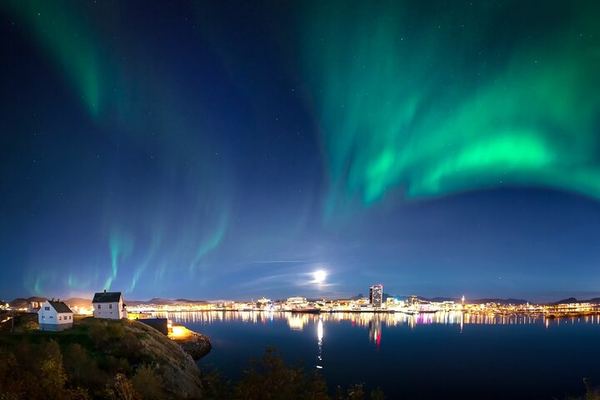
Bodo Northern Lights Safari by 4WD Van with an 85% Hit Rate
No fixed turnaround time: when the sky still has a chance of clearing, the van stays out, some nights until 2 AM. Six guests maximum, hotel drop-off after.
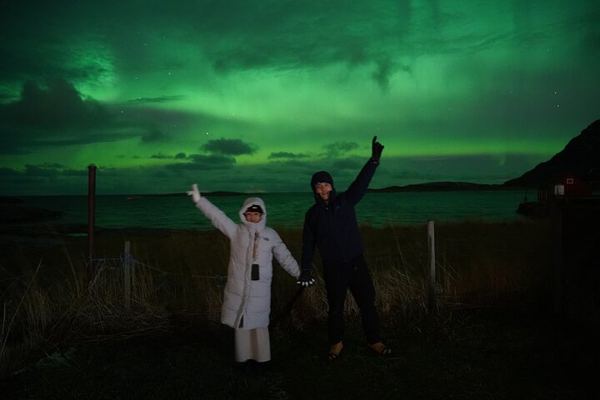
Northern Lights Safari from Bodo with Rampen
A briefing at the Rampen Adventure Hub, then out by car to whichever spot has the odds. Bodø is coastal, so the aurora often appears over open water here.
Ratings collected by Viator and Tripadvisor
The numbers, month by month
| Month | Usable-sky nights | Darkness per night | Moon-free nights | Expected usable dark hours |
|---|---|---|---|---|
| November | 36.3% | 7.8 h | 50% | 2.83 |
| October | 34.5% | 6.3 h | 48% | 2.17 |
| January | 27.7% | 7.8 h | 58% | 2.16 |
| December | 26.1% | 8.0 h | 58% | 2.09 |
| February | 32.5% | 6.4 h | 57% | 2.08 |
| March | 35.8% | 4.3 h | 55% | 1.54 |
| September | 37.7% | 2.6 h | 33% | 0.98 |
November at Bodø is the single best month at any Norwegian base, and it is a month that collapses almost everywhere else: 36.3% of nights with a usable sky over 7.8 hours of darkness. At Tromsø, two hundred kilometres north, November falls to 20.0%. Whatever the Vestfjord does to incoming Atlantic weather in late autumn, it works.
The remarkable thing about the first column is how flat it is. Bodø never drops below 26.1%, where Tromsø falls to 16.8% and Abisko to 12.3%. For a traveller with one or two nights and no ability to chase the weather, consistency is worth more than a high peak, and on that measure this is the best base in Norway by a clear margin.
September is the exception and the trap. It has the best cloud figure of the Bodø year at 37.7% and 2.6 hours of astronomical darkness to use it in, with only a third of nights free of moonlight. It comes out last, at roughly a third of November.
One limit on that ranking, stated because it argues against it. It measures how much dark clear sky a month contains, not the chance the aurora does something inside it. Geomagnetic storms are close to twice as frequent around the equinoxes, which favours September and March. Even doubling September leaves it behind October and November here.
The three departures
| Departure | Price | Reviews | What it is |
|---|---|---|---|
| eBike to Ausvika beach with a bonfire | 158 EUR | 6 | 8 km on an eBike and a 1.5 km coastal walk to a beach, where the guides build a fire. Nothing else in this catalogue looks like it |
| Safari with Rampen | 205 EUR | 7 | A briefing at the adventure hub on what the night is likely to do, then by car to whichever spots have the sky |
| 4x4 van safari | 210 EUR | 115 | The volume option here and the most reviewed. Route chosen from cloud cover and the geomagnetic forecast |
One of these advertises an 88% hit rate. Set that against our 32.9% and the two numbers are not in conflict, they are answering different questions: ours counts nights when the sky above the town was open enough, theirs counts trips on which somebody saw something, after driving to wherever the sky was and including displays a camera picked up. Both are honest; only one states its method.
The eBike departure deserves a note of its own. Eight kilometres of pedalling and a coastal walk is not how anyone else in this catalogue reaches a viewpoint, and it puts you on a beach with an unbroken northern horizon and no vehicle noise. It also means weather and fitness both have to cooperate, and in November, the best month here, it means cycling in the dark at close to freezing.
Why you would come here at all
Not for the aurora market, which barely exists. For the coast. Bodø is the gateway to Lofoten, the ferries leave from here, and thirty kilometres east is Saltstraumen, where four hundred million cubic metres of water force through a strait four hundred metres wide every six hours and produce the strongest tidal current in the world. It was European Capital of Culture in 2024, which brought it a level of attention its aurora industry never has.
So the sensible shape of a Bodø trip is a wider northern Norway route with three or four nights here, using the sky as a bonus rather than the itinerary. On the numbers that is also, quietly, a better aurora strategy than two nights in Tromsø in December.
When to come
Bodø against the other Norwegian bases
| Month | 1 | 2 | 3 | 4 | 5 | 6 | 7 | 8 | 9 | 10 | 11 | 12 |
|---|---|---|---|---|---|---|---|---|---|---|---|---|
| BodøNovember at 36.3% over 7.8 hours of darkness is the best month at any Norwegian base, and it is a month that collapses elsewhere. September has the best cloud figure here and 2.6 hours of dark: it comes out last. | 1 | 2 | 3 | 4 | 5 | 6 | 7 | 8 | 9 | 10 | 11 | 12 |
| Alta29.3% season average, second in Norway, with eight full hours of darkness from November to January. | 1 | 2 | 3 | 4 | 5 | 6 | 7 | 8 | 9 | 10 | 11 | 12 |
| Tromsø25.4% and last of the three, with November at 20.0% against Bodo's 36.3%. Seventy-four departures are the compensation. | 1 | 2 | 3 | 4 | 5 | 6 | 7 | 8 | 9 | 10 | 11 | 12 |
Cloud: ERA5 via Open-Meteo, 11 seasons. Darkness and moon: ephemerides. Ranking by cloud multiplied by darkness; method in the site's data notes.
Before you book from Bodø
When should I come?
November, which is unusual enough to be worth repeating: it is the best single month at any Norwegian base, 36.3% of nights with a usable sky over 7.8 hours of darkness, and it is a month that falls apart almost everywhere else. October and January follow. September has the best cloud record here and almost no darkness in it.
Is Bodø really better than Tromsø?
For the sky above the town, yes, in all seven months and by a wide margin in November. For the trip as a whole it depends on how many nights you have: Tromsø's seventy-four departures and 300 km chases can reach clear sky that Bodø's three cannot. With three or four nights here the base rate wins; with one night, the machinery does.
Is three departures a problem?
It is the main risk. If none of the three runs on your night, there is no fourth to switch to, and two of them carry fewer than ten reviews between them. Plan several nights, or treat the aurora as one reason among others for being on this coast.
What about the 88% success rate?
It is an operator's own figure and almost certainly counts something different from our 32.9%: trips on which something was seen, after driving to find it, including faint displays a camera records. Neither number is wrong. Ours states its method; theirs does not.
Can I combine it with Lofoten?
That is the normal reason to be here. The ferries and the flights to the islands go from Bodø, and Saltstraumen is half an hour east. A route that spends three nights here on the way through gets the best Norwegian sky in this catalogue without building a trip around it.
Data verified on. Cloud: ERA5 via Open-Meteo, 11 seasons. Darkness and moon: ephemerides. Prices and review counts read off the 3 departures on 10 August 2026.