

Anchorage
3 departures from the southernmost base in this catalogue, all of which begin by driving out of it
Anchorage is where you land in Alaska, not where you watch the aurora, and the honest thing to do is say that before anything else. At 61°13′N the city sits south of the auroral oval on an ordinary night. Fairbanks, 570 km north, is under the ring almost permanently and needs no particular solar activity at all; Anchorage needs the oval to expand southward, which happens when the geomagnetic index climbs to around 3 or 4. Those nights are common enough to build three tours on and rare enough that the tours are structured around waiting for them.
On top of the latitude sits the second problem: 290,000 people, roughly 40 per cent of everyone in Alaska, and the largest light dome in the state. Every one of these three departures begins by driving out from under it, usually north up the Glenn Highway toward the Matanuska and Knik valleys, where the mountains block the city glow and the sky opens.
None of which makes them a bad purchase. It makes them a different purchase. If you are in Anchorage for other reasons, in the season, on a night with activity, these are a good way to spend the evening with someone who knows where to stand. If the northern lights are the reason you are flying to Alaska, buy a ticket to Fairbanks instead: 45 minutes by air, twelve hours by rail, and an entirely different set of odds at the far end.
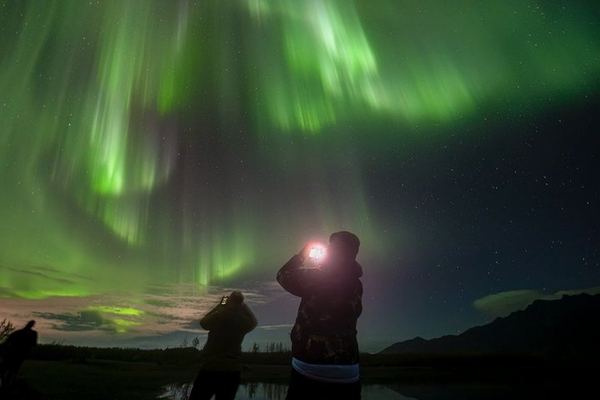
Anchorage Aurora Photo Tour with a Professional Photographer Guide
The longest running aurora photo tour here, going out only when the forecast gives a real chance. Book several nights, pay 48 hours ahead, free make-up tour.
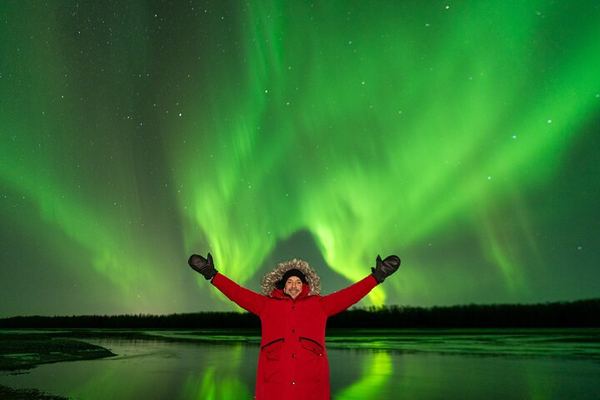
Anchorage Northern Lights Tour with Portraits and Photo Instruction
You pay only if the tour runs, and it runs only on nights with a reasonable chance. Their 90% success rate means more because the cancelled nights are out.
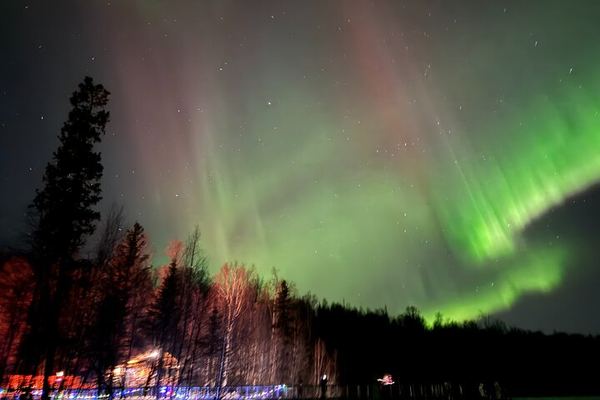
Untamed Northern Lights Sightseeing from Anchorage, Alaska
Departure is set each evening to match the hours the aurora is forecast to be active, and the guides share the Kp data with the group rather than keeping it.
Ratings collected by Viator and Tripadvisor
The three departures
Small market, and the three are genuinely distinct rather than variations. One of them uses a payment model that ought to be more common than it is.
| Departure | Price | Reviews | What sets it apart |
|---|---|---|---|
| Untamed sightseeing search | 154 EUR | 22 | Guides work from the Kp index and cloud tracking and share the data openly with the group. Departure time set on the night |
| Photo tour with a professional photographer | 277 EUR | 171 | The longest-running aurora photo tour in the area, running August to late April. Covers the science as well as the technique |
| Portraits and photo instruction | 313 EUR | 134 | You only pay if the tour runs, and it only runs on nights the forecast justifies. The operator absorbs the risk of a wasted evening |
That third arrangement is worth more than it looks in a place like Anchorage. Where the aurora is only visible on the more active nights, the biggest risk to a traveller is paying for an evening that was never going to work, and an operator willing to cancel rather than drive a full van into a hopeless sky has aligned its interests with yours. It is the equivalent of the money-back guarantees Finnish operators use, arrived at from the opposite direction.

Where they actually drive
North, in almost every case. The Glenn Highway runs up the Matanuska Valley past Palmer, with the Chugach mountains on one side and the Talkeetnas on the other, and within an hour of the city you are somewhere genuinely dark with an open northern horizon. The Knik River flats and the country around Hatcher Pass are the other regular destinations.
What the guides are solving for is the same everywhere in this business: a clear sky, no light, and nothing standing between you and the north. Anchorage makes the third of those harder than it sounds, because the city is hemmed in by mountains on the landward side, and a view north from the wrong spot is a view of a ridge. This is the main reason to buy a guided night rather than driving yourself, particularly on a first visit.
When to come, and the month that is not December
Two things decide how much aurora time a month contains: how often the sky is usable, and how many hours of real darkness there are to use it in. At 61°13′N the darkness column is shorter than anywhere else in this catalogue, which changes the answer.
| Month | Usable-sky nights | Darkness per night | Expected usable dark hours |
|---|---|---|---|
| November | 35.0% | 6.8 h | 2.38 |
| October | 39.4% | 5.7 h | 2.25 |
| February | 38.5% | 5.6 h | 2.16 |
| March | 49.4% | 4.2 h | 2.07 |
| January | 29.0% | 6.7 h | 1.94 |
| December | 24.5% | 7.3 h | 1.79 |
| September | 39.3% | 3.8 h | 1.49 |
Anchorage is the flattest North American row in our data and the answer is correspondingly soft: November, October and February are the best three, within a quarter of an hour of each other, with March close behind on the strength of the best cloud figure of the year at 49.4%.
December is the month to avoid, at 24.5% the weakest sky of the Anchorage year, and the one with the most darkness in it. It is also the reverse of Fairbanks, 570 km north, where December and January are the two best months. The two Alaskan bases do not share a season, which is worth knowing if you are combining them.
September is last, as it is everywhere, though by a narrower margin here than further north: 3.8 hours of darkness is the highest September figure of any destination we measure, because this is the southernmost base in the catalogue.
One limit, stated because it argues against the ranking: it measures how much dark clear sky a month contains, not the chance the aurora does something inside it. That caveat bites hardest here. At 61°13′N you also need the oval to expand south to reach you, and geomagnetic storms are close to twice as frequent around the equinoxes, which favours September and March. March in particular is probably better than its fourth place suggests.
Anchorage against Fairbanks
| Month | 1 | 2 | 3 | 4 | 5 | 6 | 7 | 8 | 9 | 10 | 11 | 12 |
|---|---|---|---|---|---|---|---|---|---|---|---|---|
| AnchorageThe flattest North American row: November, October and February within a quarter of an hour of each other. December is the weakest at 24.5%, and at 61 degrees north the oval has to expand south to reach the city at all. | 1 | 2 | 3 | 4 | 5 | 6 | 7 | 8 | 9 | 10 | 11 | 12 |
| FairbanksThe opposite season: January at 58.1% is the best month, and the worst month here beats the best month of most European bases. The two Alaskan bases do not share a calendar. | 1 | 2 | 3 | 4 | 5 | 6 | 7 | 8 | 9 | 10 | 11 | 12 |
Cloud: ERA5 via Open-Meteo, 11 seasons. Darkness: ephemerides. Ranking by cloud multiplied by darkness; method in the site's data notes.
A city built by transport, twice
Anchorage exists because of a railway. In 1915 a tent camp went up at the mouth of Ship Creek to build the line north to Fairbanks, and the camp became the city. It grew a second time because of geography that has nothing to do with Alaska: on a great-circle route, Anchorage is within about nine and a half hours' flying of most of the industrialised northern hemisphere, which turned its airport into one of the busiest cargo hubs on earth. That is why there are direct flights, and why an aurora trip to Alaska so often starts here whether or not it should.
The other date that shaped the place was 27 March 1964, when a magnitude 9.2 earthquake, the most powerful ever recorded in North America, struck 120 km east. Parts of the city slid into Cook Inlet. What stands today is largely what was rebuilt afterwards.
Anchorage, honestly
When should I come?
November, October or February, which are within a quarter of an hour of each other on our combined measure, with March close behind and probably better than it looks because the equinox lifts activity. Avoid December: it has the weakest sky of the Anchorage year at 24.5%, which is the opposite of Fairbanks 570 km north.
Can I see the northern lights from Anchorage?
On an active night, yes, once you are out of the city. On a quiet night, no, because the oval is sitting several hundred kilometres to the north of you. That is the fundamental difference from Fairbanks, where a quiet night is usually enough.
Should I go to Fairbanks instead?
If the aurora is the reason for the trip, yes. It is 45 minutes by air or twelve hours on the Aurora Winter Train, and Fairbanks has 41 departures against three, deeper position under the oval, far drier air and a usable sky on 48.9% of nights against 36.4%.
Is a tour necessary, or can I drive myself?
You can drive, and the Glenn Highway north is straightforward. What you are buying with a guide is knowing which spots have an open northern horizon, because Anchorage is ringed by mountains and half the obvious pull-offs are looking at a ridge.
What is a good Kp to look for?
Around 3 or 4 puts the oval far enough south to be worth going out for from here; 5 and above is a good night at this latitude. The forecast from the Geophysical Institute in Fairbanks covers the whole state and is free to read. Then check the cloud separately.
Data verified on. Cloud: ERA5 via Open-Meteo, 11 seasons. Darkness: ephemerides. Prices and review counts read off the 3 departures on 10 August 2026.