
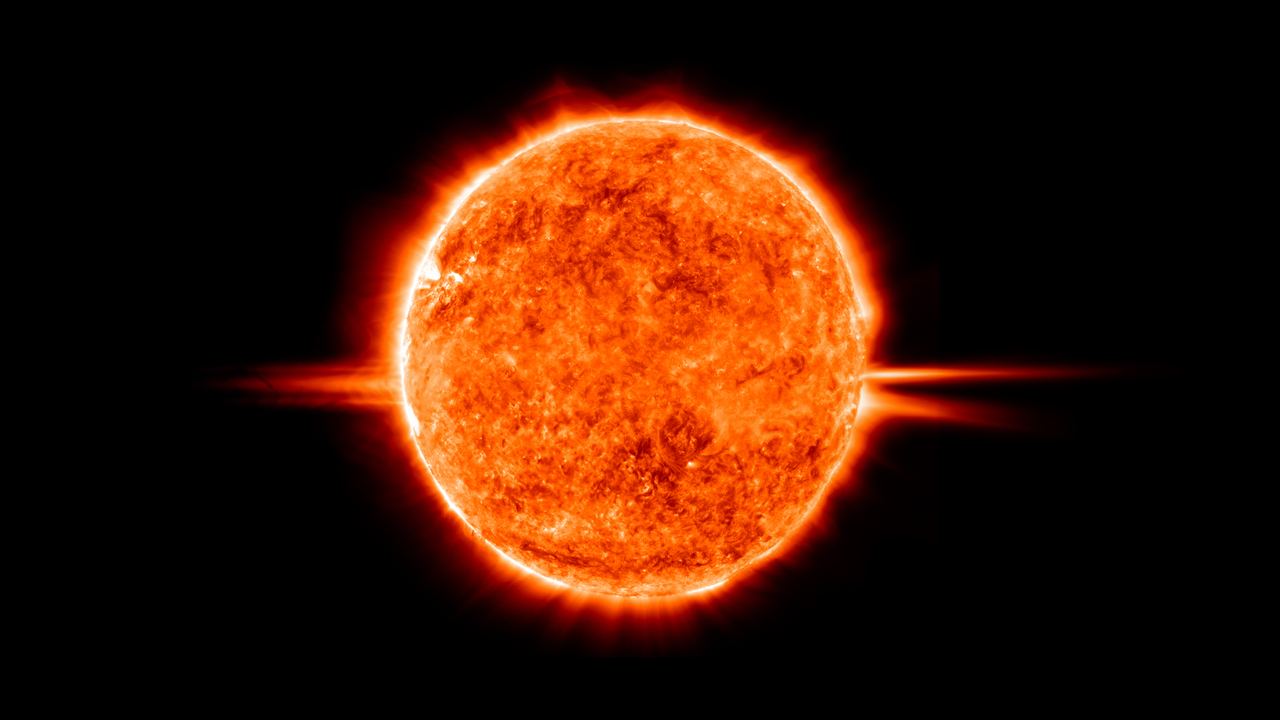
The sun runs on an eleven-year cycle of magnetic activity, and where you are in that cycle changes how often the aurora appears. Cycle 25 has passed its maximum, which means the next few seasons are on the downslope.
The obvious reading is that you have missed the good years. That reading is wrong, or at least too simple, and the reason is worth understanding before you decide whether to go this winter or wait.
Where Cycle 25 has got to
The cycle from its quiet start to the phase we are in now.
The origins
December 2019
Cycle 25 begins
The minimum between cycles 24 and 25. Sunspot counts near zero, and long stretches of blank sun. Aurora activity at high latitudes continues, driven by coronal holes rather than eruptions.
2020-2023
The rise, faster than forecast
The official prediction panel had expected a modest cycle peaking around 115, similar to the weak Cycle 24. Sunspot numbers ran consistently ahead of that forecast from early on.
The growth
October 2024
Maximum, and it was not modest
NASA and NOAA announced the sun had reached solar maximum. The smoothed sunspot number peaked at 160.8, well above the forecast 115. This is the period that produced the widely photographed mid-latitude displays.
2025
The plateau
Activity stays high. Solar maxima are not single points but broad, uneven periods, often with more than one peak, and the strongest individual storms do not necessarily land on the highest month.
Today
March 2026
The poles flip, confirming the descent
The sun's magnetic poles complete their reversal, which is the reliable marker that the cycle has turned. Spotless days start reappearing.
2026-2028
The declining phase
Sunspot numbers fall, but geomagnetic activity does not fall in step. This is the stretch where coronal holes take over as the main driver, and it is historically good for aurora at high latitude.
Around 2030
The next minimum
Cycle 26 begins. Between now and then the trend is downward, which is the honest argument for going sooner rather than later.
Why declining does not mean quiet
Two different things cause geomagnetic storms, and they peak at different points in the cycle.
Coronal mass ejections are eruptions. They need complex magnetic fields to power them, so they track the sunspot count, and they dominate around maximum. These produce the dramatic, unpredictable, sometimes enormous events.
Coronal holes are the opposite: regions where the magnetic field opens up and lets the solar wind escape at high speed. They become large and long-lived during the declining phase, and the fast stream they release, running into slower wind ahead of it, produces its own kind of storm.
So the drivers hand over rather than switch off. The declining phase is well known for producing strong recurrent activity, and studies of extreme events find that while the biggest storms at maximum come from eruptions, the declining phase gets its share from these high-speed streams.
The 27-day thing, which is genuinely useful
Coronal holes can persist for several solar rotations. The sun turns roughly once every 27 days as seen from earth. Which means the same hole that pointed a fast stream at us this week can point at us again about 27 days later, and again after that.
This is the only genuinely repeating pattern in aurora forecasting. If there was a good run of activity a month ago and no eruption has intervened, the same window is worth watching again. It is not reliable enough to book a flight on, but it is the closest thing to a schedule that this phenomenon has.
The equinox effect, which stacks with everything else
There is a seasonal pattern layered on top of the solar cycle. Geomagnetic storms are close to twice as common around the equinoxes as around the solstices, and this has been understood since Russell and McPherron explained it in 1973.
The mechanism is geometry. Earth's magnetic axis is tilted, and around the equinoxes it lines up in a way that makes it easier for the solar wind's field to connect with ours. Easier connection means more energy transferred, which means more aurora.
Now put that beside the weather. September and March are also the months with the best cloud statistics in our ERA5 data, and Rovaniemi's best month by a wide margin is March. Two independent effects, one atmospheric and one magnetic, both pointing at the equinoxes. That is the single most actionable thing on this page.

So should you go this season or wait
Go sooner. Not because next winter will be bad, but because the trend from here is downward and does not reverse until around 2030.
The 2026-27 and 2027-28 seasons should still sit comfortably above what anyone experienced between 2017 and 2023, when the sun was quiet. Waiting three years means arriving near the minimum. There is no cliff, just a slope, and the slope only goes one way for the rest of the decade.
The caveat worth stating: the solar cycle sets the odds over a season. It does not tell you anything about a specific night, and it matters far less to your trip than whether it is cloudy. A clear week near solar minimum will beat an overcast week at maximum every time.
Questions about the cycle
Was 2024 the best year, and is it over?
2024 and 2025 were the peak by sunspot number. But the declining phase has its own strengths, especially at high latitude where you do not need an exceptional storm to see something. The best years for mid-latitude viewing are probably behind us; the best years for Tromso are more forgiving.
How reliable are solar cycle predictions?
Only moderately. The official panel forecast a maximum of about 115 for this cycle and it reached 160.8, roughly 40% higher. Predicting the shape of a cycle in advance remains genuinely difficult, which is worth remembering when you read confident claims about the years ahead.
Does the 27-day pattern mean I can plan a trip?
Not really. It is a tendency, not a timetable, and a coronal hole can decay between rotations. It is useful for deciding which week to watch forecasts more closely, not for booking flights six months out.
Is it worth waiting for Cycle 26?
Cycle 26 will not reach maximum until the mid 2030s. If the question is this decade, the answer is that the odds are declining from here, and going in the next two or three seasons is better than waiting.
How the cycle is measured, and why the forecast missed
The cycle is tracked by counting sunspots, which is the longest continuous scientific record we have of anything on the sun: systematic counts go back to the mid-eighteenth century, which is why cycles are numbered at all and why the current one is the twenty-fifth.
The number quoted is a smoothed monthly value, averaged over about thirteen months. That smoothing is the reason solar maximum is always announced late: you cannot know a smoothed peak has happened until you have the months either side of it. When NASA and NOAA confirmed maximum in October 2024, they were confirming something the sun had already done.
The forecast for this cycle was notably off. The official prediction panel expected a modest cycle peaking around 115, similar to the weak Cycle 24. The smoothed number reached 160.8, roughly forty percent higher, and it got there earlier than expected.
That gap is worth holding onto whenever you read confident claims about the seasons ahead, including on this page. Solar cycle prediction is genuinely difficult: the models disagree with each other, and the panel that produces the official forecast was wrong by a wide margin on the most recent test. Anyone telling you exactly how good 2028 will be is guessing with more confidence than the field supports.
What is solid is the shape rather than the height. Cycles rise, peak, decline over roughly eleven years, and the polarity of the sun's magnetic field flips at maximum. That flip completed in March 2026, which is the observation that confirms where in the cycle we are, independent of anyone's forecast.
What a Carrington-class storm would do now
The largest storm on record, in September 1859, is remembered for aurora over the Caribbean and for telegraph operators working on induced current. It is also the reference case for how bad space weather can get, and the reason the G scale has a level 5 at all.
The 1859 world had almost nothing electrical to damage. Ours does. A storm of that class today would induce currents in long conductors, which now means high voltage transmission lines and pipelines rather than telegraph wires. The plausible consequences are transformer damage, regional blackouts, satellite disruption, degraded GNSS positioning and high frequency radio blackouts on the sunlit side of the earth.
This is why space weather is monitored operationally by national agencies rather than only by researchers, why grid operators have procedures for it, and why the Met Office and NOAA both run space weather services alongside their ordinary forecasting.
It is also worth stating plainly, since aurora marketing occasionally drifts toward the apocalyptic: none of this is dangerous to you standing in a field. The particles stop more than a hundred kilometres overhead. A severe storm is a problem for infrastructure and an unusually good night for anyone outside looking up.
Storms of that size are rare and are not confined to solar maximum. The largest events of a cycle can land during the declining phase, which is where this one now is, and that is a reasonable argument for going in the next couple of seasons rather than waiting.
Sources
- NOAA Space Weather Prediction Center — solar cycle progression, the official record of sunspot number and its forecast, and the NOAA space weather scales.
- NASA — solar cycle background and the October 2024 announcement that Cycle 25 had reached maximum: nasa.gov.
- Met Office — space weather service and commentary on the declining phase: metoffice.gov.uk.
- Russell, C. T. and McPherron, R. L. (1973), on the semiannual variation of geomagnetic activity, Journal of Geophysical Research, doi 10.1029/JA078i001p00092 — the equinox effect described above.
- Sunspot number is a smoothed value, conventionally averaged over about thirteen months, which is why solar maximum can only be confirmed in retrospect.
Data verified on. Cycle figures from NASA and NOAA announcements and SWPC solar cycle progression data. Polar reversal reported March 2026. Equinox effect from Russell and McPherron, 1973.
The cycle sets the odds for a season
It says nothing about a specific night, and it matters far less than whether it is cloudy where you are standing.