
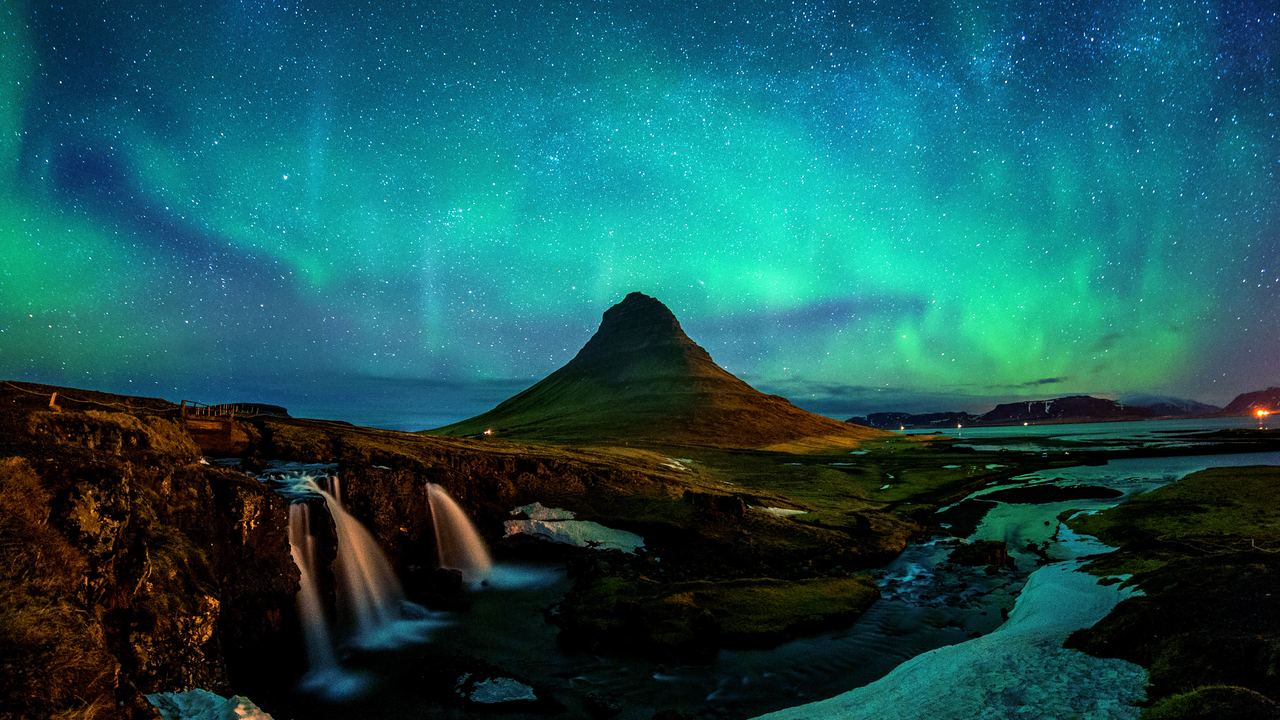
Oslo is at 60 degrees north. Tromso is at 69. Both are in Norway, both get properly dark in winter, and one of them sees the aurora most clear nights while the other sees it a handful of times a year.
The gap is not really about the 9 degrees. It is about the fact that the aurora follows a different map from the one on your wall.
A ring, not a cap
The aurora forms an oval: a ring around the magnetic pole, typically sitting between about 65 and 75 degrees geomagnetic latitude when conditions are quiet. Not a disc covering the pole, a ring around it. The magnetic north pole itself is often a poor place to watch from, because it can sit inside the hole in the doughnut.
Geomagnetic latitude is what matters, and it does not match geographic latitude, because the magnetic pole is not at the geographic one. It also drifts: the magnetic pole has been moving across the Arctic at tens of kilometres a year, which slowly changes these numbers over decades.
| Place | Geographic latitude | Geomagnetic latitude | Position |
|---|---|---|---|
| Tromso | 69.6 N | about 66.8 | Inside the quiet-time oval |
| Reykjavik | 64.1 N | about 64.7 | At the edge |
| Rovaniemi | 66.5 N | about 63.0 | Just below the quiet-time edge |
| Oslo | 59.9 N | about 57 | Well outside. Needs a large storm |
Look at Reykjavik and Rovaniemi. Rovaniemi is more than two degrees further north on a map, and nearly two degrees further south in the terms that matter. That inversion is the whole point of this page.
The ring is anchored to the sun, not to the ground
Here is the part that surprises people. The oval does not rotate with the earth. It stays roughly fixed with respect to the sun, thickest and brightest on the night side, and the earth spins underneath it.
So your town passes through the most active part of the ring once every 24 hours, around magnetic midnight, which is when your location is furthest from the sun in magnetic terms. That is usually somewhere between 21:00 and 01:00 local time depending on where you are and how far your magnetic longitude sits from your civil time zone.
This is why guides talk about a best time of night at all. It is not folklore and it is not about darkness. You are being rotated into the busiest part of a structure that is sitting still.

What happens when a storm arrives
During a geomagnetic storm the oval expands, pushing towards the equator. This is why big events produce aurora over Britain, Germany, or in exceptional cases much further south still.
It also means high activity is not uniformly good news. If you are standing inside the oval already, a large storm can push the brightest band south of you, leaving you underneath the quieter interior while people a thousand kilometres away get the display of the decade. From Tromso, a moderate event overhead often looks better than a severe one that has moved on.
The practical version: at high geomagnetic latitude you want activity to be adequate. At lower latitude you want it to be exceptional. Those are different bets, and they are the reason the same Kp number means opposite things in Tromso and in Edinburgh.
Why the oval is where it is
The ring traces where the magnetic field lines that particles travel down actually meet the atmosphere. Field lines from the outer magnetosphere and the stretched magnetotail come down in a band, not everywhere, and the band is the oval.
Field lines that close near the equator carry nothing useful. Field lines from the very centre of the polar cap are open and connect to interplanetary space rather than to the reservoir of particles. What is left is a ring, and the ring is the aurora.
Questions this answers
Should I go as far north as possible?
No. Past about 75 degrees geomagnetic you start moving into the middle of the ring, where there is less activity overhead on a quiet night. Svalbard is a fascinating destination for other reasons, but going further north than Tromso does not automatically improve your odds.
What time should I be outside?
Around magnetic midnight, which usually falls between 21:00 and 01:00 local time. That is why most serious tours run late and why a tour ending at 22:00 is selling you the edge of the window rather than the middle of it.
Can I see the aurora from Oslo or Stockholm?
Occasionally, during strong storms, low on the northern horizon. It happens a few times a year rather than a few times a week. Planning a trip around it is not realistic.
Does the oval exist during the day?
Yes, continuously. There is a daytime portion, it is just invisible against sunlight. The aurora does not switch on at dusk, you simply become able to see it.
The magnetic pole is moving, and it has picked up speed
Everything on this page rests on where the magnetic pole is, and the magnetic pole does not stay put.
It was located in the Canadian Arctic when it was first reached in the early nineteenth century. It has been drifting ever since, and over the twentieth century that drift accelerated markedly, carrying it out of Canada, across the Arctic Ocean and towards Siberia at speeds that reached several tens of kilometres a year.
The practical consequence is small on the timescale of your trip and real on the timescale of a guidebook. Geomagnetic latitudes shift. The oval sits slightly differently over the map than it did a few decades ago, and the figures on this page carry an implicit date. That is why we say approximately 66.8 degrees for Tromso rather than quoting it to two decimals as if it were a fixed property of the town.
It also means the standard reference model has to be updated periodically. The World Magnetic Model, maintained jointly by NOAA and the British Geological Survey and used by everything from aviation to your phone's compass, is revised on a five-year cycle, and one revision had to be issued early because the pole moved faster than the previous model predicted.
None of this changes where you should stand this winter. It is a reminder that the map underneath the aurora is itself in motion, slowly, and that any source quoting geomagnetic coordinates without a date is quoting a snapshot.
Daytime aurora, and the strange case of Svalbard
The oval has a daytime side. You cannot normally see it, because the sun is up, but there is one place where that stops being true.
At the very high latitudes there is a feature called the cusp: a funnel in the magnetosphere on the sunward side where solar wind particles can reach the atmosphere directly, rather than by way of the stretched tail on the night side. It produces its own aurora, usually fainter and often with more red in it than the classic nighttime display, because the particles arrive with less energy and deposit it higher up.
During the polar night at Svalbard, at roughly 78 degrees north, the sun never rises. Which means the sky is dark at local noon, and observers can watch the dayside cusp aurora around the middle of the day. It is one of the few places on earth where this is possible, and it is why Svalbard hosts serious auroral research despite sitting too far north for reliable nighttime displays.
For a traveller this is a curiosity rather than a recommendation. Svalbard is expensive, logistically demanding, and, being poleward of the main oval, often has the display south of it rather than overhead. But it answers a question people ask constantly, which is whether the aurora is happening during the day. It is, continuously, and in one place you can go and look at it over lunch.
Sources
- NOAA Space Weather Prediction Center — auroral oval, its position and the live nowcast: aurora overview and the 30-minute forecast, which shows the oval's current position rather than a single index value.
- World Magnetic Model, maintained by NOAA NCEI and the British Geological Survey, which defines the geomagnetic reference frame these latitudes are quoted in and is revised every five years.
- Geomagnetic latitudes quoted on this page are approximate and reflect the current epoch; they shift as the magnetic pole drifts.
- Cusp aurora: dayside auroral emission observed during the polar night at very high latitudes, notably from Svalbard, where it is the subject of ongoing research.
Data verified on. Oval geometry and geomagnetic latitudes from NOAA SWPC and standard references. Geomagnetic coordinates are approximate and change slowly as the magnetic pole drifts.
So what number should you watch instead?
Your position in the oval decides how much activity you need. The index everyone quotes does not know where you are standing.