

Photography
5 departures in the town where the shape of an aurora display was first worked out, in 1964
Fairbanks is where the anatomy of an aurora display was worked out. In 1964, Syun-Ichi Akasofu, working at the Geophysical Institute here, described what he called the auroral substorm: the sequence a display actually follows, rather than the gradual brightening people imagine. A quiet arc lies across the north for an hour, sometimes two. Then, in the space of a minute or so, it breaks up, floods westward, throws out rays and folds, and fills the sky. Then it fades back.
Everything about photographing the aurora follows from that. It explains why guides here refuse to publish a departure time until the afternoon, why five of the five departures on this page include the photographs at no charge, and above all why the most common way to miss the northern lights in Fairbanks is to decide at eleven o'clock that nothing is going to happen.
The other thing Fairbanks gives a photographer is geometry. At 64°50′N and about 65° magnetic, this town sits deep inside the auroral oval rather than looking at it from the side. The consequence is coronas: displays directly overhead, where the rays appear to converge on a point because you are looking straight up a set of parallel curtains. That is a different photograph from the classic Scandinavian arc over a fjord, and it needs a different lens and a different instinct.
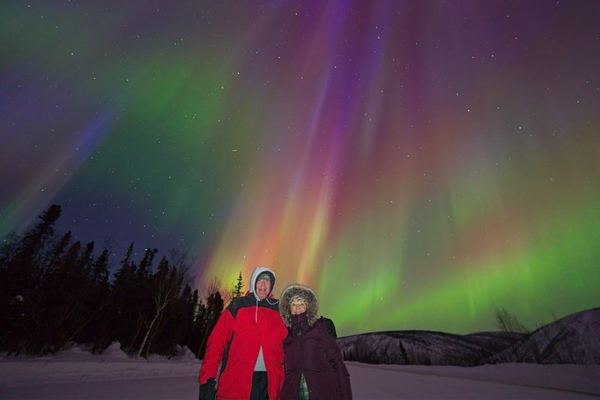
Arctic Night Tours Fairbanks Aurora Chase with Free Photos
Both the distance and the timing shift with the aurora forecast rather than a fixed schedule, which is the only sensible way to run this. Photography included.
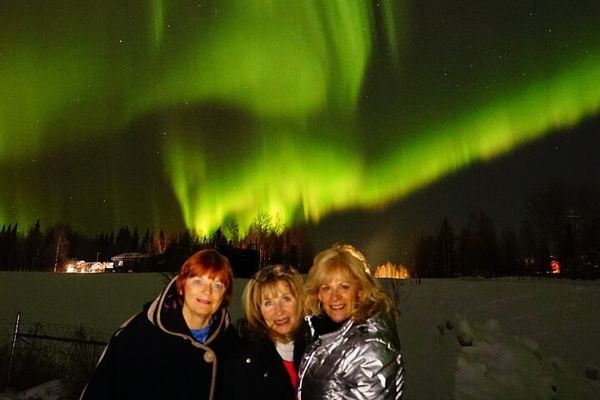
Fairbanks Aurora Chasing with a Free Photo Service
The season runs 20 August to 30 April, longer than most assume: the lights are always active, what changes is whether the sky goes dark. Free JPG files.
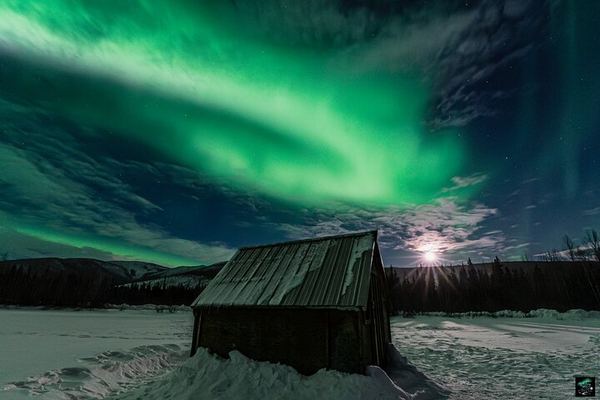
Half Night Personalised Aurora Chase and Photography from Fairbanks
For an awkward flight, one gap in the schedule, a marginal forecast, or a second go after a full night came up empty. Still built around finding clear sky.
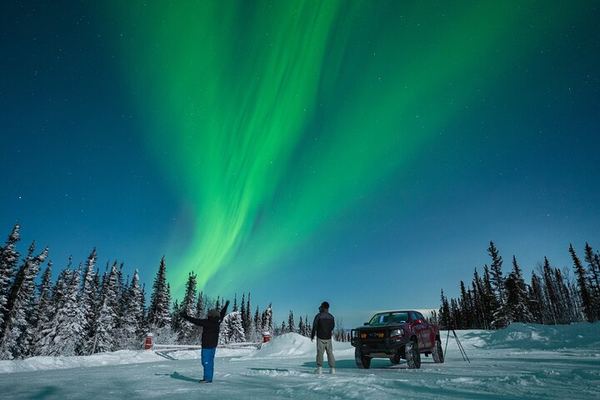
Private Northern Lights Photography Tour in Fairbanks, Max Three Guests
Three guests a night, viewpoints the coach tours do not use, and 5 to 8 hours of chasing with a working photographer. Group portraits included.
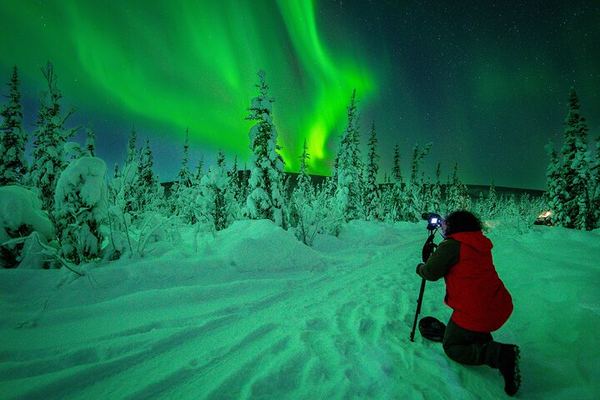
SkyChase Northern Lights Experience from Fairbanks with Free Photography
A winterised Sprinter, a mobile aurora lodge and a campfire meal at twilight. Read the guarantee closely: a camera-only sighting counts as fulfilled.
Ratings collected by Viator and Tripadvisor
What actually fails at minus 35
Aurora photography in Alaska is less about settings than about equipment surviving the night. Every item below has ended somebody's evening, and only one of them is expensive to solve.
| What fails | Why | What to do |
|---|---|---|
| Batteries | Cell chemistry slows in deep cold; a fully charged battery can read empty within twenty minutes | Carry two or three spares in an inside pocket against your body and rotate them. A cold battery recovers once warm |
| The rear screen | LCD refresh slows and the image smears or ghosts as you pan | Compose before the display starts, then judge exposure from the histogram rather than the preview |
| The lens, once you go indoors | Warm moist air condenses on cold glass, including inside the barrel, and can take hours to clear | Seal the camera in a plastic bag before entering the vehicle or the lodge, and let it warm up inside the bag |
| Tripod legs | Bare metal at these temperatures sticks to skin | Foam wrap or tape on the upper section, and thin liner gloves you never take off |
| Autofocus | There is nothing with enough contrast to lock onto | Switch to manual at the start of the night, magnify a bright star on live view, focus once and leave it |
The condensation one is the failure people do not see coming, because it happens after the photography is over. A camera that has been at minus 30 for three hours will fog inside the lens the moment it meets a heated van, and there is nothing to be done once it has. A freezer bag costs nothing and prevents it entirely.
The five departures
Three of these carry more than 500 reviews each, which for a category of five tours is remarkable and says something about how Fairbanks competes: not on price, but on what you leave with.
| Departure | Price | Reviews | What sets it apart |
|---|---|---|---|
| Half-night personalised chase | 163 EUR | 11 | Part of a night rather than all of it. Built for awkward flight times and single free evenings |
| Aurora chasing with free photo service | 166 EUR | 522 | Files delivered as JPGs, no upsell. The operator is direct about the odds rather than optimistic |
| Arctic Night chase with free photos | 189 EUR | 544 | Both the distance and the start time move with the forecast rather than a timetable |
| SkyChase in a winterised Sprinter | 295 EUR | 777 | The largest operation here, tracking cloud and solar activity in real time to decide where to be |
| Private tour, maximum two guests | 317 EUR | 14 | As private as this gets. Lesser-known locations, chosen so you are not sharing with three coaches |
Two structural things are worth noticing. First, every one of the five includes photographs at no extra cost, which is not true in Rovaniemi or Reykjavík, where the picture is usually the upsell. In a market where a seat costs 163 EUR rather than 65, operators compete on deliverables instead of price. Second, the half-night format exists nowhere else in this catalogue, and it solves a genuine problem: a flight that lands at nine in the evening, or a schedule with exactly one usable window and no appetite for a six-hour commitment.
Where the guides get their forecast
The aurora forecast that half the world reads comes from the Geophysical Institute at the University of Alaska Fairbanks, established here in 1946. Thirty miles up the Steese Highway is Poker Flat, opened in 1969, the only university-owned rocket range in the world, which fires instrumented rockets directly into active aurora to measure it from inside.
It is a strange thing about this town that the people driving you to a viewpoint and the people launching rockets into the same sky are part of the same small community. It also means the language on Fairbanks listings tends to be more precise than elsewhere: when a guide here talks about substorm onset or the Kp index, they are usually using the terms correctly.
When to go, and why we changed our answer
This page previously recommended the shoulder months, on the reasoning that works everywhere in Scandinavia: equinox activity, temperatures a camera survives, avoid midwinter. Having run the numbers for Fairbanks specifically, that advice was wrong, and it is worth showing the working rather than quietly changing it.
Two things decide how much aurora time a month actually contains: how often the sky is usable, and how many hours of real darkness there are to use. Multiply them and you get the expected usable dark hours per night.
| Month | Usable-sky nights | Darkness per night | Expected usable dark hours |
|---|---|---|---|
| January | 58.1% | 6.9 h | 4.01 |
| December | 47.4% | 7.5 h | 3.55 |
| February | 53.0% | 5.7 h | 3.02 |
| November | 41.3% | 7.0 h | 2.89 |
| October | 46.5% | 5.7 h | 2.65 |
| March | 51.9% | 3.9 h | 2.02 |
| September | 44.0% | 3.1 h | 1.36 |
September, which we had recommended, is the worst month of the Fairbanks season by this measure and by a wide margin: a mediocre sky over barely three hours of darkness. January is nearly three times better. The Scandinavian rule does not cross the Atlantic, because in Fairbanks the cold and the clear sky are the same dry continental air.
For photography specifically, February is the month we would book. It gives 3.02 expected hours against January's 4.01, which is a real loss, and it hands back something the table cannot show: fifteen to twenty degrees. At minus 35 the failures in the table above stop being inconveniences and start ending the night, and the difference between a battery lasting twenty minutes and an hour decides how much of the substorm you actually photograph. January if you have Arctic experience and spare bodies; February if this is your first time.
Two limits on the cloud figure, stated because they cut against us. Our window covers September to March, so the April end of the operators' season is outside it and we say nothing about it. And below roughly minus 35 the Tanana valley fills with ice fog, a shallow local effect that a reanalysis on a 28 km grid will under-resolve: the 58.1% describes the regional sky, which is what a tour driving up onto Cleary Summit or Murphy Dome actually gets, and it overstates what somebody standing downtown sees in a deep cold snap.
| 1 | 2 | 3 | 4 | 5 | 6 | 7 | 8 | 9 | 10 | 11 | 12 |
Why the science of this happened in Fairbanks
The origins
1946
The Geophysical Institute
Congress establishes a geophysical institute at the University of Alaska Fairbanks. Its aurora forecast is now read worldwide, including by every guide on this page.
1964
The substorm is described
Syun-Ichi Akasofu, working here, sets out the sequence an auroral display actually follows: a quiet arc, a sudden breakup, then recovery. It is why guides tell you to stay out.
The growth
1969
Poker Flat opens
A rocket range 30 miles up the Steese Highway begins firing instrumented rockets into active aurora. It is still the only launch range in the world owned by a university.
Today
October 2024
Solar maximum declared
NOAA and NASA confirm Solar Cycle 25 has peaked. Activity stays elevated for a year or two on either side, which is the window the current seasons fall inside.
Before you book a photography night
When should I actually come?
February for photography, January if the sky matters more to you than your equipment. January has the best combination of clear sky and darkness in the whole Fairbanks season; February gives up about a quarter of that and hands back fifteen to twenty degrees, which at these temperatures is the difference between working and packing up. September, which most guides recommend by reflex, is the worst month here.
How long should I stay out?
Longer than you want to. A display can sit as a dull arc for two hours and then break up completely in the space of a minute, and that breakup is the part worth being there for. Tours whose end time moves with the sky are more expensive for exactly this reason, and they are worth it.
Which lens for Alaska specifically?
Wider than you would take to Scandinavia. Fairbanks sits deep inside the oval, so displays often go directly overhead and converge into a corona above you. Something in the 14 to 20 mm range gives you a chance of framing that; a 24 mm will feel tight when it happens.
Do I need a camera at all?
No. All five departures include photographs at no extra charge, which is unusual and is how Fairbanks operators compete. Bring a camera if you want to be taught or to work the corona yourself; otherwise the guide's files are the product.
What about my phone?
A recent phone with night mode will record a strong display and struggle with a fast one, because the stacking it relies on assumes the subject holds still. It will also lose its battery in about fifteen minutes at these temperatures. Keep it in an inside pocket and take it out for the corona.
Data verified on. Cloud: ERA5 via Open-Meteo, 11 seasons. Darkness: computed ephemerides. Prices, inclusions and review counts read off the 5 departures on 10 August 2026.