Aurora Season 2026-27: What the Numbers Actually Say
The season opens in September. Here is what eleven seasons of cloud data, calculated darkness hours and a sun past its peak say about the months ahead, including the month everyone recommends and probably should not.
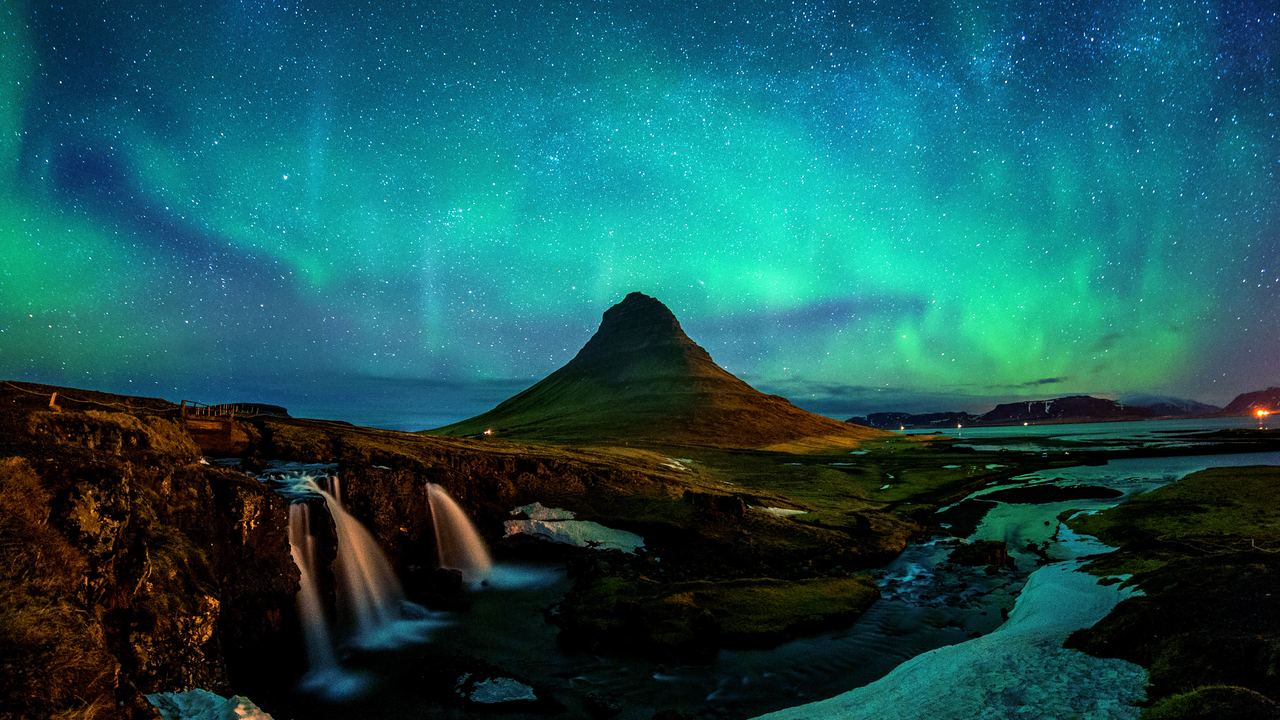
The aurora season opens in a few weeks, and the advice circulating about it is roughly the same as last year, and the year before: go in winter, watch the Kp index, book a guaranteed tour.
We spent the summer calculating instead. What follows is the season as the data describes it, with the numbers and the method attached so you can check them.
The sky, month by month
These are nights, not hours: the share of nights with at least two hours of cloud cover below 50% between 18:00 and 02:00, across eleven seasons of ERA5 reanalysis.
| Destination | Sep | Oct | Nov | Dec | Jan | Feb | Mar |
|---|---|---|---|---|---|---|---|
| Tromso | 34.0 | 31.9 | 20.0 | 16.8 | 23.5 | 23.3 | 28.4 |
| Reykjavik | 40.7 | 34.5 | 37.0 | 38.7 | 33.9 | 31.1 | 33.5 |
| Rovaniemi | 41.7 | 33.2 | 20.0 | 22.3 | 22.9 | 30.4 | 50.0 |
| Abisko | 27.3 | 19.4 | 12.3 | 13.5 | 14.2 | 18.7 | 25.5 |
The headline is the same one we have been making all summer, and it survives every way we have tried to check it: December in Tromso is the worst month of the season, at roughly one usable night in six, and it is when prices peak.
The Abisko row needs a warning attached, and we would rather give it than let the number travel alone. It is the cloudiest line in the table, which contradicts everything written about the place. But the blue hole that Abisko is famous for is described as 10 to 20 square kilometres, and the ERA5 grid is about 28 km, so a genuine local window would be invisible to this method. We tested it: five points within 25 km of Abisko all return much the same figure, while Kiruna 90 km east jumps to 38.8%. The model sees the regional gradient and cannot see a local hole. Our number does not refute the blue hole; it shows the basin around it is cloudier than the marketing says.
The trade nobody mentions
Clear sky and darkness do not peak together. They run in opposite directions across the season, and this is the part missing from almost every guide.
| Destination | Sep | Oct | Nov | Dec | Jan | Feb | Mar |
|---|---|---|---|---|---|---|---|
| Tromso | 1.8 | 6.4 | 7.9 | 8.0 | 7.9 | 6.7 | 3.5 |
| Reykjavik | 2.7 | 5.1 | 6.4 | 6.9 | 6.3 | 5.1 | 3.5 |
| Rovaniemi | 2.8 | 6.1 | 7.6 | 8.0 | 7.5 | 6.2 | 4.3 |
| Abisko | 2.3 | 6.5 | 7.9 | 8.0 | 7.9 | 6.7 | 4.0 |
December in Tromso has the most darkness physically possible and the worst sky of the season. The hours were never the constraint.
September gives Tromso the best sky of its year and 1.8 hours of true darkness a night. December gives it eight hours out of eight, because the sun does not rise at all, and the worst sky in the dataset.
Where the two meet is the shoulder. October and February are the months nobody recommends, and they hold a reasonable sky together with six or seven hours of dark. They are also cheaper than the Christmas fortnight.
The sun, which is past its peak
Solar Cycle 25 reached maximum in October 2024, with a smoothed sunspot number of 160.8, well above the 115 the official panel had forecast. In March 2026 the sun's magnetic poles completed their reversal, which is the marker that confirms the cycle has turned.
That sounds like bad news and mostly is not. The declining phase changes what drives the activity rather than switching it off: coronal mass ejections give way to fast solar wind streams from coronal holes, which are large and long-lived at this point in the cycle and recur roughly every 27 days as the sun rotates. Strong storms are entirely normal in this phase.
The honest framing for this winter: better than any year between 2017 and 2023, not as good as 2024, and declining from here until around 2030. If you have been putting the trip off, the argument for going sooner is real and it is not urgency for its own sake.
Two windows worth building a trip around
Early to mid September 2026. New moon on the 11th, the best cloud odds of the season, and the autumn equinox nearby. Near the equinoxes geomagnetic storms are close to twice as common as at the solstices, an effect described by Russell and McPherron in 1973. The cost is darkness: a short window each night, and in Tromso a very short one.
Early March 2027. New moon on the 8th, the spring equinox approaching, and Rovaniemi's 50.0%, the highest figure anywhere in our data. Darkness back to a usable 4.3 hours there. On paper this is the strongest week of the season, and it is shoulder-season pricing.
Both beat December on the numbers. December has school holidays, which for a lot of people decides it, and there is no arguing with that. If you are going then, the useful response is not a better tour: it is more nights.
What we are not telling you
- None of this forecasts a specific night. Climatology describes the odds over a month. Weather forecasts work three to five days out, and geomagnetic forecasts about an hour.
- The thresholds are ours. Cloud below 50%, at least two hours, an 18:00 to 02:00 window. Move them and the numbers move.
- ERA5 is a reanalysis on a roughly 28 km grid, not a station. The Abisko case above is what that limitation looks like in practice.
- Clear sky is not aurora seen. It says the sky was open, not that anything was happening in it.
Data verified on. Cloud figures recalculated from ERA5 (ECMWF) via Open-Meteo, 2015-2025. Darkness and moon figures calculated from ephemerides. Solar cycle status from NOAA and NASA.
Sources
- ERA5 reanalysis (ECMWF, Copernicus Climate Change Service), queried via the Open-Meteo historical archive. Dataset at the Copernicus Climate Data Store.
- Solar cycle status: NOAA solar cycle progression and NASA; declining phase commentary from the Met Office.
- Equinox effect: Russell, C. T. and McPherron, R. L. (1973), Journal of Geophysical Research, doi 10.1029/JA078i001p00092.
- Forecasts for the night itself: MET Norway and the Icelandic Met Office.
- Full method, including thresholds and limitations: our weather page and moon and darkness page.
The month matters more than the destination
Cloud, darkness and moonlight all move across the season, and they do not move together. This is where they overlap.