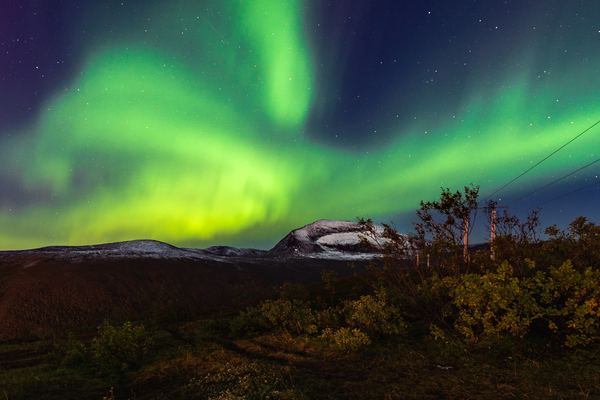
Abisko's Blue Hole Is Where Our Own Method Stops Working
The clear-sky window Abisko is sold on is smaller than anything our gridded cloud data can resolve: five sample points within 25 km do not separate. What would settle it is thirty-nine years of hourly cloud observations in SMHI's open archive, recorded in the village itself.
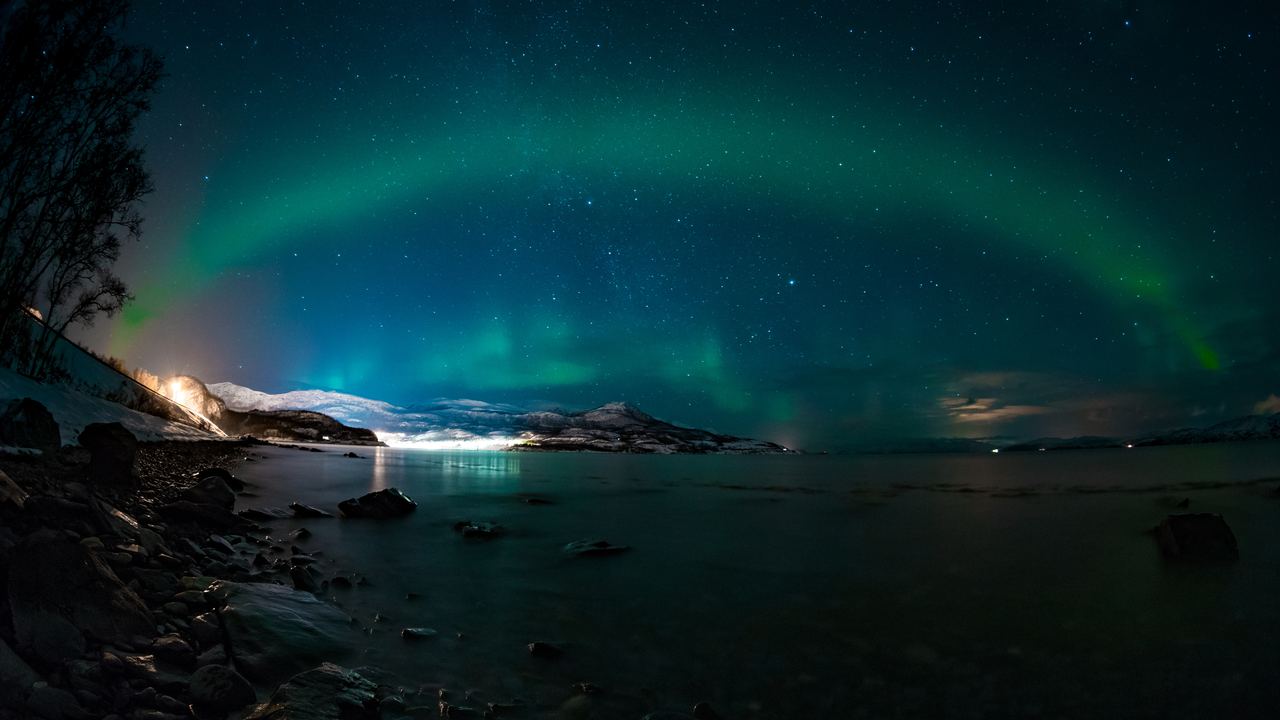
Abisko's chairlift started carrying people up Mount Nuolja after dark on 19 October, and it will keep doing it until 27 March. That is the season the Aurora Sky Station publishes on its own site, and it is roughly the window in which the Abisko blue hole gets sold: the patch of clear sky supposed to sit over this one valley in Swedish Lapland while the weather closes in around it.
Our cloud table gives Abisko the thinnest row of the fourteen places we track. Across the season, 18.7 per cent of its nights meet the threshold we use for a usable sky, against 38.8 per cent at Kiruna, ninety kilometres down the railway. It is an easy headline and we are not going to write it, because before using a number to knock something down we checked whether the measurement can see the thing it is supposed to be knocking down.
It cannot. What it can see points the other way, which is a different and more interesting result. And the observations that would actually settle the question have been sitting in a public archive for thirty-nine years, recorded at the same coordinates our own sample point uses, and nobody in this industry appears to have opened them.
What the blue hole claim actually says
The mechanism is real geography. Abisko sits in the lee of the Scandinavian mountains. Air coming off the Atlantic has to climb the Norwegian side first, drops most of its water there, and arrives over the Torneträsk basin drier than it started. Rain shadows exist, they do this, and nobody disputes the physics.
What never gets examined is the size of the claim built on top of it. The figures that circulate for Abisko are clear-night shares and success rates somewhere between sixty and ninety per cent. They come from businesses selling nights in Abisko. Not one of the ones we have found states what was counted, over what period, or by whom.
The Aurora Sky Station's own night visit page, read on 28 October 2026, is more careful than its resellers. It describes Abisko as offering the best conditions in the world for watching the aurora, and then says plainly: "we cannot guarantee that you will see the Northern Lights." Both sentences sit on the same page. The second one is the honest one.
Abisko National Park
A national park in Swedish Lapland, on the south shore of Lake Torneträsk in the far north of Sweden, beside the village and research station of the same name.

Our own number gives Abisko the thinnest row of the fourteen
Here is where our figure comes from, because a number without its method is the thing we spend most of our time complaining about.
The historical hourly cloud cover series was obtained through Open-Meteo, ten September-to-March seasons, 1 September 2015 to 30 April 2025. The original request did not pin a weather model, so we cannot claim the values come from one reanalysis product, and we cannot describe them as sitting on a single grid of a stated size. A night counts as having a usable sky when at least two hourly samples between 18:00 and 02:00 local time show cloud cover at or below 50 per cent. Those samples need not be consecutive, and the rule does not establish two unbroken hours of clear sky.
Fifty per cent, two samples, that time window: all three are our choices, and changing any of them changes the table. The method is set out on our guide page about when the sky actually opens.
| Month | Nights with usable sky | Darkness per night | Cloud–darkness index | Three axis index | Nights without moon |
|---|---|---|---|---|---|
| September | 27.3% | 2.3 h | 0.63 | 0.74 | 23% |
| October | 19.4% | 6.5 h | 1.26 | 1.40 | 48% |
| November | 12.3% | 7.9 h | 0.97 | 0.93 | 50% |
| December | 13.5% | 8.0 h | 1.08 | 0.86 | 58% |
| January | 14.2% | 7.9 h | 1.12 | 0.97 | 58% |
| February | 18.7% | 6.7 h | 1.25 | 1.28 | 54% |
| March | 25.5% | 4.0 h | 1.02 | 1.23 | 45% |
November reads 12.3 per cent, and that is the lowest single cell anywhere in our fourteen-destination table, below December in Tromsø. Abisko's best month on the combined cloud and darkness score is October at 1.26, which is also the lowest best-month figure of the fourteen. Weighted by monthly geomagnetic activity the same month reads 1.40. Both are comparative scores. Neither counts observing hours and neither is a probability of seeing anything.
Before calling that a refutation, we tested whether the method can see the thing
A gridded weather product is a smoothed picture. The blue hole, as it gets described, is local: our own method note puts the window at somewhere between ten and twenty square kilometres. If a feature is smaller than the sampling, the dataset returns a valley average whether or not the feature exists.
So we ran the same metric, over the same period, at five points around Abisko and one at Kiruna.
| Sample point | From Abisko village | Seasonal mean, nights with usable sky | Difference |
|---|---|---|---|
| Abisko village (68.35, 18.83) | — | 18.7% | — |
| Torneträsk, east (68.30, 19.45) | 25 km E | 22.9% | +4.2 |
| Torneträsk, west (68.42, 18.20) | 25 km W | 18.1% | −0.6 |
| Mountains to the south (68.13, 18.70) | 25 km S | 15.5% | −3.2 |
| Towards Narvik (68.44, 17.60) | 45 km NW | 30.1% | +11.4 |
| Kiruna (67.85, 20.23) | 90 km E | 38.8% | +20.1 |
Read the first four rows. Move 25 km east and the figure rises four points. Move 25 km west and it falls by half a point. Climb 25 km into the mountains to the south and it drops three. The whole spread across a 50 km box is 7.4 points, which is smaller than the gap between two neighbouring months in the same row.
What you are looking at is a dataset failing to resolve something. If a clear-sky window a few kilometres across sat over the village, these five numbers would not tell us, and no arithmetic performed on them will. This is the published limit of our method, meeting the one case where it bites hardest.
Our figure is not evidence that the blue hole does not exist. It is evidence that this instrument is not the one to ask.
At regional scale the gradient is real, and it runs the other way
Widen the frame and the picture changes, because now we are comparing things the dataset can actually distinguish.
Kiruna, 90 km east and off the mountains, comes out at 38.8 per cent against Abisko's 18.7 across the season. The point towards Narvik, 45 km northwest, reads 30.1. On the monthly table Kiruna is ahead of Abisko in all seven months of the season, by between 16 and 29 percentage points.
Those are gaps a smoothed dataset can see, and they say something the sales copy does not. The Torneträsk basin, taken as a basin, is cloudier than the flat country to the east. Mountains that wring water out of incoming air also lift it, and lifted air makes cloud. The range does both jobs.
There is a third possibility our table cannot rule out: that both things are true at once, that the basin is generally cloudier and that a small part of it is unusually clear. Nothing in these numbers excludes it. Abisko is one of the three places we look at on the guide page about going beyond the classic destinations, and this is the part of its reputation we have never been able to check.
The measurements that would settle this exist, and nobody has used them
This is the part that surprised us.
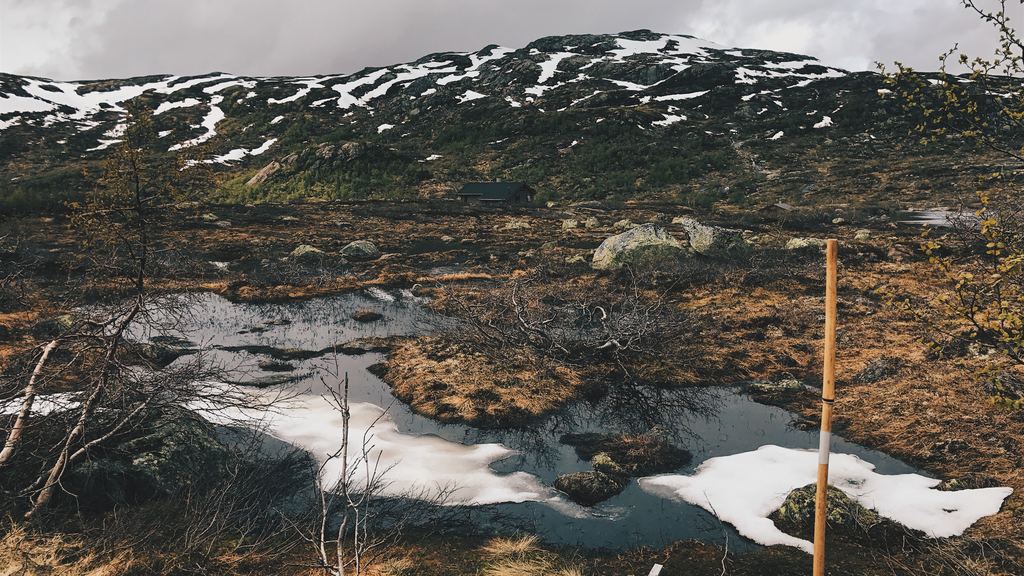
Abisko runs one of the longest weather records in the European Arctic. A research station was built at Katterjokk, about 35 km west, in 1903. It burned down in 1910. The replacement went up at Abisko, where meteorological observations started in 1913, and the Swedish Polar Research Secretariat says the measuring site has not moved since. In 2021 the World Meteorological Organization named it a Centennial Observing Station.
The Secretariat's own two pages disagree about when: the station page says June 2021, the news release says autumn 2021. We have gone with June, as the more specific of the two, and we are flagging the disagreement rather than quietly picking one.
The variables the Secretariat lists for that century-long record are wind, air, snow depth, precipitation, ground temperature and radiation. Cloud amount is not among them.
Cloud amount is in the SMHI open data archive instead. Parameter 16, total cloud cover, station 188790, Abisko Aut, owned by the Polar Research Secretariat, latitude 68.3538, longitude 18.8164, 392 metres above sea level. The record opens on 1 January 1987. When we queried it on 28 October 2026 it was current to 02:00 UTC that morning. No key, no registration, and three download periods including a quality-controlled archive.
Those coordinates are, to three decimal places, the point our own grid sample uses for Abisko village. The measurement that would tell you whether the sky over Abisko behaves differently from the sky the models put there has been recorded at that spot, hourly, for thirty-nine years, by the research station itself, and it is free to download.
We have not processed it. That is a gap in our own work and we would rather say so than imply a coverage we do not have. It is the obvious next thing to do on this subject, and until somebody does it, every percentage published about Abisko's clear nights, ours included, is answering a slightly different question from the one being asked.
The Abisko record, and the gap in it
Dates from the Swedish Polar Research Secretariat's own pages and from SMHI's open data index, both read on 28 October 2026.
The origins
-
1903
A station at Katterjokk
The Secretariat dates the first research station in this area to 1903, about 35 km west of today's Abisko.
-
1910
It burns down
The Katterjokk building is destroyed by fire, and the replacement is sited at Abisko instead.
-
1913
Observations begin
Meteorological observations start at Abisko. The Secretariat says the measuring site has not moved since.
The growth
-
1987
Cloud cover enters the open archive
SMHI's open series for total cloud cover at station 188790, Abisko Aut, opens on 1 January 1987, and was still reporting when we queried it.
Today
-
2021
A WMO Centennial Observing Station
The World Meteorological Organization recognises the Abisko record. The Secretariat's station page says June, its news release says autumn.
-
2026
Still unused for this question
Thirty-nine years of hourly cloud observations at the coordinates the blue hole argument is about, and no published analysis of them that we can find. Ours included.
What the operator's own page says, read today
The Aurora Sky Station runs night visits from 19 October 2026 to 27 March 2027. The evening runs from 20:30 to no later than 01:00, up the chairlift to 900 metres on Mount Nuolja. The page also states that no refunds are made if the weather stops the lift running.
That clause is worth reading twice before booking. A night here can fail in two separate ways. The sky can be shut, which is the risk everybody has already thought about, and the lift can be shut, which is a different risk with a different answer, and on this page the answer is no money back. Our guide page on refunds and cancellations covers how that distinction varies between operators.
None of this is sharp practice. Cable cars stop in wind, and saying so on the booking page is better behaviour than most of the market manages. It is simply not what somebody picturing the best conditions in the world is thinking about.
How many nights, if you are going anyway
Cloudy nights arrive in runs rather than independently, so the familiar arithmetic of one minus the miss rate cubed is wrong, and it is wrong in the optimistic direction. At Abisko the unconditional share of usable nights is 18.7 per cent. After a usable night it is 34.8; after a closed one, 15.0. Weather has memory, and in a narrow mountain valley it has rather a lot of it.
Fitted to a two-state chain, that persistence gives the model estimates below for at least one night meeting our cloud threshold. We worked through the same calculation in more detail when we asked how many nights you actually need in Tromsø.
| Destination and period | 1 night | 3 nights | 5 nights | 7 nights | Nights for a 90% estimate |
|---|---|---|---|---|---|
| Abisko, whole season | 18.7% | 41.2% | 57.5% | 69.2% | 14 |
| Abisko, December | 13.5% | 35.2% | 51.4% | 63.6% | 16 |
| Tromsø, whole season | 25.4% | 51.2% | 68.0% | 79.1% | 11 |
| Kiruna, whole season | 38.8% | 71.2% | 86.4% | 93.6% | 6 |
| Kiruna, December | 30.0% | 62.4% | 79.8% | 89.1% | 8 |
Fourteen nights at Abisko to reach a 90 per cent model estimate across the season, sixteen if you go in December, six at Kiruna. These describe our cloud threshold being met, not an aurora being seen, and they describe a fixed point rather than a tour that drives.
That last caveat does more work at Abisko than anywhere else in our table, and it is the practical conclusion of the whole piece. If the valley floor does have a clear window in it, a guide who knows where it is will use it, and a statistic computed at a fixed point will never see that happen.
| 1 | 2 | 3 | 4 | 5 | 6 | 7 | 8 | 9 | 10 | 11 | 12 |

If you have already booked Abisko
Go, and ask different questions when you get there. The useful ones are about movement: does the operator stay in the valley or cross towards Kiruna when the basin closes, and who makes that call on the night.
Nothing in our data argues against Abisko as a place to spend a few nights. What it argues against is paying a premium for a percentage that nobody has published a method for.
What these numbers do not say
Every figure above has an edge, and the edges belong in the body rather than in a footnote.
A night meeting our cloud threshold is not an aurora seen. Something has to be happening on the magnetometers, and somebody has to be looking up at the right moment. The threshold is not a ceiling on sightings either: a ten-minute break in the cloud can deliver a good display on a night our two-sample rule throws away.
The cloud figures come from a gridded historical weather service rather than a weather station at the spot. The original request did not pin a model, so neither exclusive provenance nor a specific resolution is established. The published values are retained here without recalculation.
The six-point comparison is a test of resolution, not a survey of Abisko's microclimate. It runs the same coarse product at six locations and establishes only that the product does not separate them within 25 km.
The combined cloud and darkness figures multiply a nightly frequency by a monthly mean. They do not measure the overlap between clear sky and darkness, so they are not expected observing hours, and weighting them by monthly geomagnetic activity does not turn them into a probability.
And none of it covers the moon, the temperature, or how long a person can actually stand on a mountain at 900 metres in February.
Departures that decide where to go on the night
Our catalogue carries two Abisko-labelled departures, both leaving from Kiruna, and both state the clear-sky claim as settled fact, so they are not in this selection. These are the three most reviewed Kiruna departures that pick their destination from the weather, Abisko included when the valley is the open part. Ordered by number of reviews.
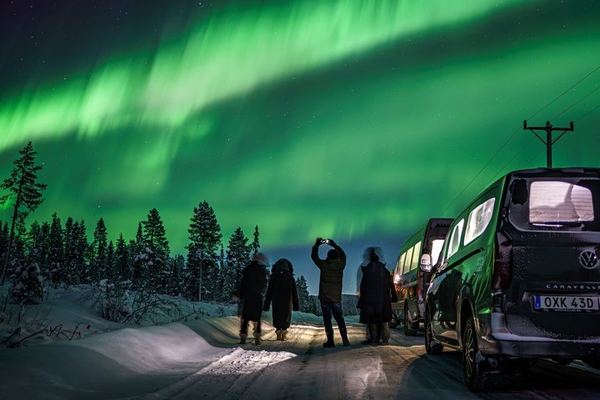
Kiruna Northern Lights Chase with a Photographer, Lights of Vikings
Abisko, the boreal forest, or anywhere with a gap in the cloud: this operator built its name on driving far for clear sky. Photographs sent within three days.
Kiruna Aurora Chase with a Street Food Dinner in a Tipi
Dinner by the fire in the Stejk Street Food tipi, then minivans into wilderness the coaches cannot reach. Lingonberry juice and fika outdoors at the stop.
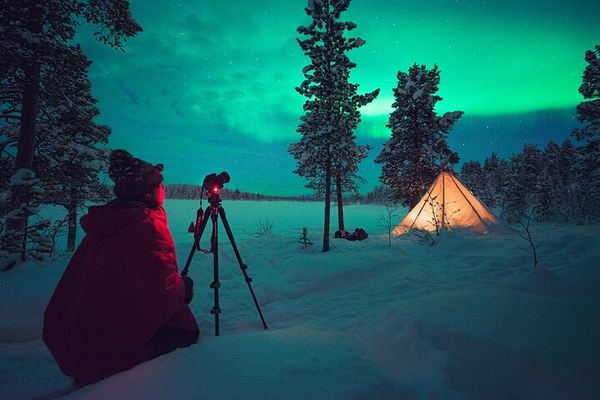
Northern Lights Photo Tour from Kiruna with Sami Photo Guides
Camera and tripod are lent to you, so a phone is enough to arrive with. Sámi photographers born here pick the spot from how weather moves, not from a map.
Ratings collected by Viator and Tripadvisor
Questions people ask about Abisko and its clear skies
Does the Abisko blue hole exist?
We cannot tell you, and neither can anyone publishing a percentage about it. The rain shadow supposed to produce it is ordinary geography and nobody disputes it. The size of the clear-sky window claimed on top of it, somewhere between ten and twenty square kilometres, is smaller than anything our gridded cloud data can resolve: five sample points within 25 km of the village differ by only 7.4 percentage points in total.
What does the 70 per cent clear nights figure for Abisko mean?
Nothing that can be checked. Figures in that range circulate widely and come from businesses selling nights in Abisko, and none of the ones we have found states what was counted, over what period, or by whom. A number without a method is not a measurement. That applies to ours as well, which is why the threshold and the time window sit under every table on this page.
Is Abisko really the worst place in your table?
It has the thinnest row on our indicator: 18.7 per cent of nights with a usable sky across the season, and 12.3 per cent in November, which is the lowest single cell in the fourteen-destination table. That measures a gridded product at a fixed point over ten seasons. It does not establish that Abisko is the worst place to go, and the mobility of a good guide is exactly what the measurement cannot see.
Is Kiruna a better base than Abisko for the northern lights?
On our cloud figures Kiruna is ahead in all seven months of the season, 38.8 per cent against 18.7 on the seasonal mean. It also has more departures in our catalogue, most of which will drive to Abisko when the valley is the clear part. If the blue hole is real, basing yourself at Kiruna lets you use it on the nights it appears without betting the whole trip on it.
How many nights should I book in Abisko?
More than most people plan for. Three nights give a 41.2 per cent model estimate of at least one night meeting our cloud threshold across the season, and 35.2 per cent in December. Reaching a 90 per cent estimate takes fourteen nights, or sixteen in December. Those are estimates about cloud, not about sightings, and they assume you stay put.
When does the Aurora Sky Station open for night visits?
The season published on its own night visit page, read on 28 October 2026, is 19 October 2026 to 27 March 2027, with the evening running from 20:30 to no later than 01:00. The same page says there are no refunds if weather stops the chairlift, which is a separate risk from the sky being cloudy and worth pricing in before you book.
Where can I check Abisko's cloud data myself?
SMHI's open data archive, parameter 16 for total cloud cover, station 188790, Abisko Aut, owned by the Polar Research Secretariat and sited in the village at 68.3538, 18.8164. The record starts on 1 January 1987 and there is no key or registration. If you work through it before we do, you will know more about this question than anyone currently selling nights there.
Sources
Four outbound links, all opened and checked on 28 October 2026. The rest is named precisely enough to find.
- Season dates and terms: the Aurora Sky Station night visit page, which gives 19 October 2026 to 27 March 2027, the 20:30 to 01:00 window, and the refund clause.
- Station cloud record: SMHI open data, parameter 16, station 188790, queried on 28 October 2026 and current to 02:00 UTC that morning.
- Station history: the Swedish Polar Research Secretariat's pages about the Abisko station and on over a hundred years of measurement there. The two disagree on the month of the WMO designation, June against autumn 2021, and we have said so above rather than picking silently.
- Cloud: historical hourly total cloud cover obtained through Open-Meteo, ten seasons from 1 September 2015 to 30 April 2025. The original request did not pin the model, so exclusive provenance and grid size are unverified, and the published figures have not been recalculated for this article.
- Darkness and moon: computed from standard ephemeris algorithms, Meeus chapters 25 and 49. No external data source; exact rather than statistical.
- Geomagnetic activity: the Kp and ap series published by GFZ Potsdam, 1932 to 2026. Monthly departures are measured on mean monthly ap, which matters, because the same question answered on the frequency of disturbed intervals gives a different ratio.
One limit we cannot close from here. Everything above describes cloud over a point, and the thing being argued about is cloud over a valley a few kilometres wide. The only instrument in this article capable of telling those apart is the one in the village, and it has not been read.
Data verified on . Ten seasons via Open-Meteo, model unpinned; indices are comparative, not observing hours. SMHI station 188790 and the operator and research-station pages opened 28 October 2026. About This Site
How we measure when the sky opens
Fourteen aurora destinations, month by month, with every threshold and every limit printed next to the number.