
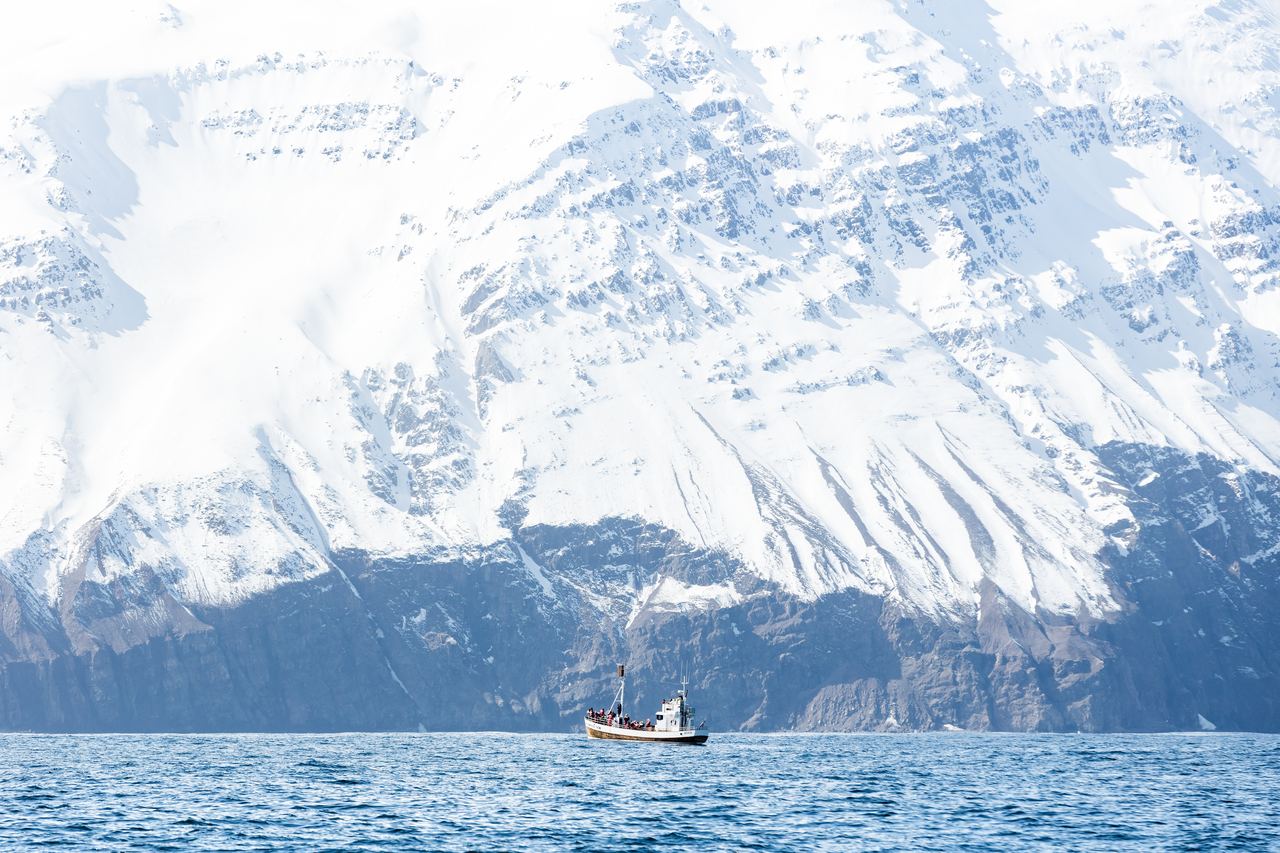
By Boat
Five boats that trade the ability to chase for the one thing land cannot give you: an open horizon
Tromsø's fjords do not freeze. The Gulf Stream runs this far north and keeps the sea open all winter, warmer than the air above it for most of the season, which is the reason boats can work here in January at all. In the same latitude band in Canada or Russia, the water is solid.
That gives the town something no inland aurora destination has: a viewing platform with no landscape in the way. It also takes something away. A minibus that finds cloud over Kvaløya can be in a different weather system within the hour; a boat is committed to the fjord it sailed into.
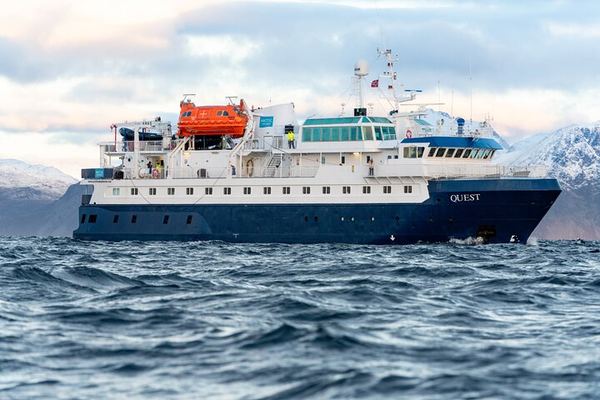
24 Hour Northern Lights and Whale Watching Cruise from Tromso
Sail across the auroral oval in the evening, sleep in a cabin while the ship moves, and wake on the whale grounds. Three-course dinner and lecture on board.
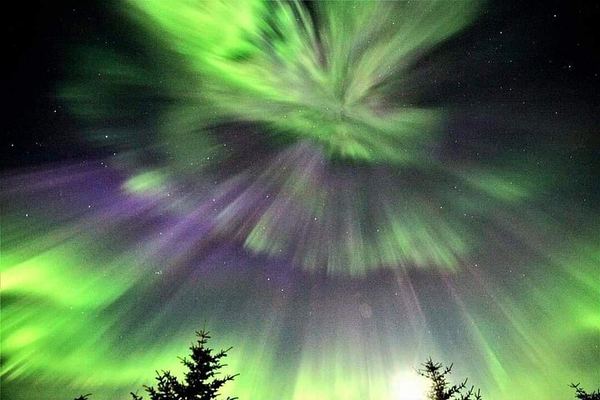
Northern Lights Cruise by Luxury Catamaran from Tromsø, Up to 6 per Booking
Northern Yachting's catamaran Arctic Eagle sails about 6 nautical miles into the fjord. Warm suits, local snacks and a deck net to lie on and watch the sky.
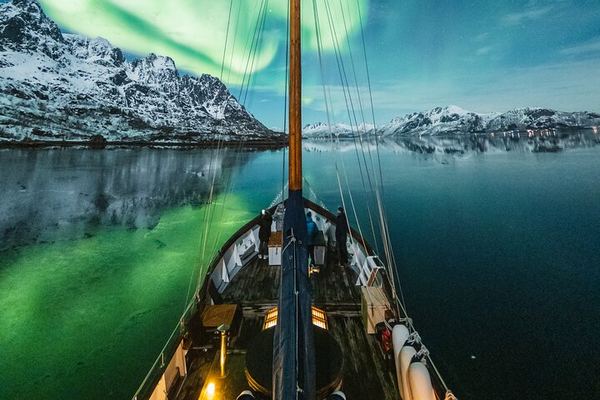
Northern Lights Yacht Cruise with Hot Tub from Tromso, 12 Guests
Four hours on a 33 metre sailing yacht with an outdoor hot tub, one way to watch the aurora at minus ten. Reindeer soup, blankets and endless hot drinks.
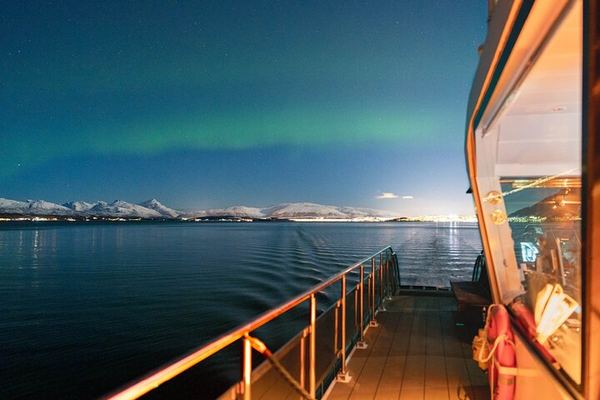
Tromso Aurora Cruise with a Three Course Dinner on Board
Dinner from a Tromsø restaurant served on board between 19:00 and 22:30, the window the aurora most often uses. If nothing shows, you have still eaten well.
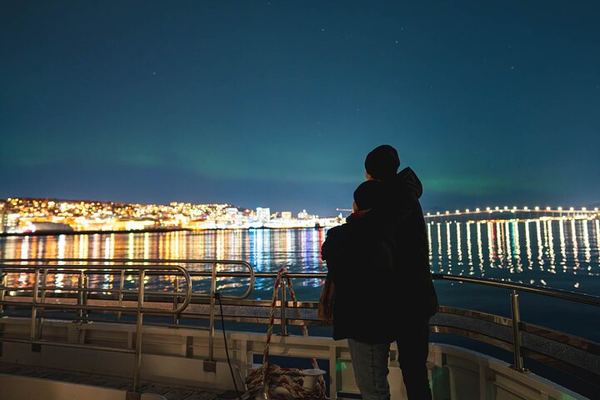
Tromso Electric Boat Northern Lights Cruise on the Fjords
A near-silent electric ship into the polar night, with heated lounges to wait in and no diesel throb under the deck while you are looking up at the sky.
Ratings collected by Viator and Tripadvisor
Why the horizon is the whole argument
The aurora forms in a ring around the magnetic pole, and Tromsø sits under it. When activity is high the ring expands overhead and you can see the display anywhere with a clear sky. When activity is ordinary, which is most nights, the band sits to the north and low, sometimes only ten or fifteen degrees above the horizon.
Ten degrees is roughly the height of a fist held at arm's length. In a fjord ringed by 1,000 metre peaks, that entire slice of sky can be behind rock. People standing on a road in Ramfjord genuinely miss displays that somebody on the water is photographing at the same moment. This is not a marketing claim, it is geometry, and it is the single best reason to consider a boat.
The reflection is a bonus rather than the point, but it is a real one. Still water doubles a display, and the photographs that come back from these trips tend to have something in the foreground that a roadside shot does not.
The five boats, and what separates them
| Boat | Length of night | Group | Price | The distinguishing feature |
|---|---|---|---|---|
| Electric boat | evening | shared | from 120 EUR | A near silent engine: no diesel throb under the deck while you are looking up |
| Catamaran | evening | shared | from 149 EUR | The trampoline net between the hulls, where you lie on your back with water moving underneath |
| Dinner cruise | 19:00 to 22:30 | shared | from 186 EUR | Three courses from a Tromsø restaurant, eaten inside the prime aurora window |
| 33 m sailing yacht | 4 hours | max 12 | from 298 EUR | An outdoor hot tub on deck, and a saloon with unlimited hot drinks |
| Expedition ship | 24 hours | small group | from 700 EUR | A cabin, dinner, a lecture, and whales the following morning |
The price spread here is wider than in any other Tromsø category, and it is not a quality ladder. The 120 EUR electric cruise and the 700 EUR expedition ship are answering different questions. One asks how to spend three hours of a winter evening; the other replaces a night's accommodation and a whale trip as well.
The whale overlap, and why it moves
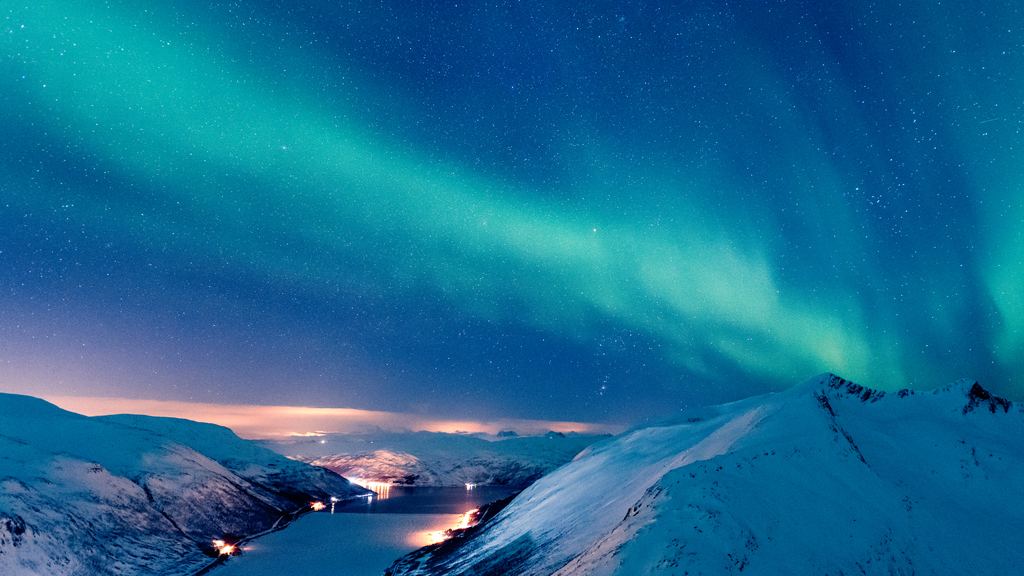
For part of the aurora season the fjords around Tromsø also hold herring, and where the herring go, orcas and humpbacks follow. That overlap is what makes a 24-hour voyage sellable: the aurora at night, whales the next morning, and the ship doing the travelling while you sleep.
Worth knowing before you plan around it: the herring do not use the same fjord every winter. Their wintering grounds have shifted over the past two decades, which is why whale departures from this coast have changed base more than once. Any operator promising whales on a specific date is promising something they do not control. Treat the aurora as the reason to book and the whales as the possible bonus, not the other way round.
When these boats run, and when they are worth it
The limiting factor is darkness, not ice: these fjords stay open all winter. But the month matters more for a boat than for anything else in Tromsø, and it took running the numbers to see why.
A minibus that meets cloud can drive out from under it, up to 300 km. A boat is committed to the fjord it sailed into. So the base rate, the share of nights on which the sky above Tromsø is simply usable, is close to the whole story here, where on land it is only part of it.
| Month | Usable-sky nights | Darkness per night | Moon-free nights | Expected usable dark hours |
|---|---|---|---|---|
| October | 31.9% | 6.4 h | 48% | 2.04 |
| January | 23.5% | 7.9 h | 58% | 1.86 |
| November | 20.0% | 7.9 h | 50% | 1.58 |
| February | 23.3% | 6.7 h | 57% | 1.56 |
| December | 16.8% | 8.0 h | 58% | 1.34 |
| March | 28.4% | 3.5 h | 39% | 0.99 |
| September | 34.0% | 1.8 h | 17% | 0.61 |
October is the month to be on the water. It has the second-best sky of the Tromsø year, six and a half hours of real darkness, half the month free of moonlight, and the fjords are still comparatively mild. September, which is widely recommended and which this page previously endorsed, comes out last: its excellent cloud figure sits on 1.8 hours of astronomical darkness, and only 17% of its nights are free of moonlight, the worst pairing of any destination we measure.
December deserves a specific warning in this category. It is the month people book, the sea is calmest-feeling because you are sheltered, and it has the worst cloud record of the Tromsø year at 16.8%. On land that is survivable because the guide drives. On a boat it is not.
One limit on the ranking, because it argues against us: it measures how much dark clear sky a month contains, not the chance the aurora does something inside it. Geomagnetic storms are close to twice as frequent at the equinoxes, which favours September and March. Even doubling September leaves it behind October here.
| 1 | 2 | 3 | 4 | 5 | 6 | 7 | 8 | 9 | 10 | 11 | 12 |
Practical things nobody mentions until you are on board
You will be colder than on land. Standing still on an open deck with wind over the bow is the most efficient way to lose heat available in the Arctic. Most of these boats have a heated saloon and several lend thermal suits; check which, because the difference between a three-hour cruise you enjoy and one you spend inside is entirely about clothing.
The fjords are sheltered. Tromsø's aurora cruises stay inside the island system rather than heading for open sea, so the motion is usually mild. The 24-hour voyage is the exception: it sails beyond the fjord, and that is a different proposition for anyone prone to seasickness.
Long exposures on a moving deck do not work. A tripod is useless on a boat; the hull transmits every vibration and the vessel itself is turning. Photographers who care about sharp images generally prefer land for that reason, and the boats compete instead on what you see with your own eyes. If pictures are the priority, the photography departures are the better category.
Common questions
Which month should I pick for a boat?
October. It combines the second-best sky of the Tromsø year with six and a half hours of real darkness, and the month matters more on water than on land because a boat cannot drive out from under cloud. January is the winter alternative. Avoid December, which has the worst cloud record of the year, and September, which has almost no darkness in it despite the good cloud figures.
Is a boat better than a minibus for seeing the aurora?
Better on a clear night, worse on a cloudy one, and the gap is wider than it looks: with a usable sky on roughly a quarter of Tromsø nights, the ability to drive is worth a great deal. The boat wins the horizon and loses the chase. If you only have one night and the forecast is mixed, take the vehicle.
Do these cruises cancel in bad weather?
They cancel for sea state rather than for cloud, which is a different threshold from land tours. A boat may sail under a completely overcast sky if the water is calm, so check the operator's own position on refunds before booking a marginal night.
Can I see the aurora from the fjord in September?
Yes, from around the third week, and it is not the month we would choose. September has the best cloud figures of the Tromsø year and only 1.8 hours of astronomical darkness to use them in, with 17% of nights free of moonlight. On our combined measure it is the weakest month of the season here.
Which boat suits a family?
The dinner cruise, generally. It has a fixed end time of 22:30, a warm interior, and food built into the evening, which are the three things that make a long wait workable with children.
Data verified on. Cloud: ERA5 via Open-Meteo, 11 seasons. Darkness and moon: ephemerides. Prices, durations and capacities read from the 5 boat departures on 10 August 2026.