
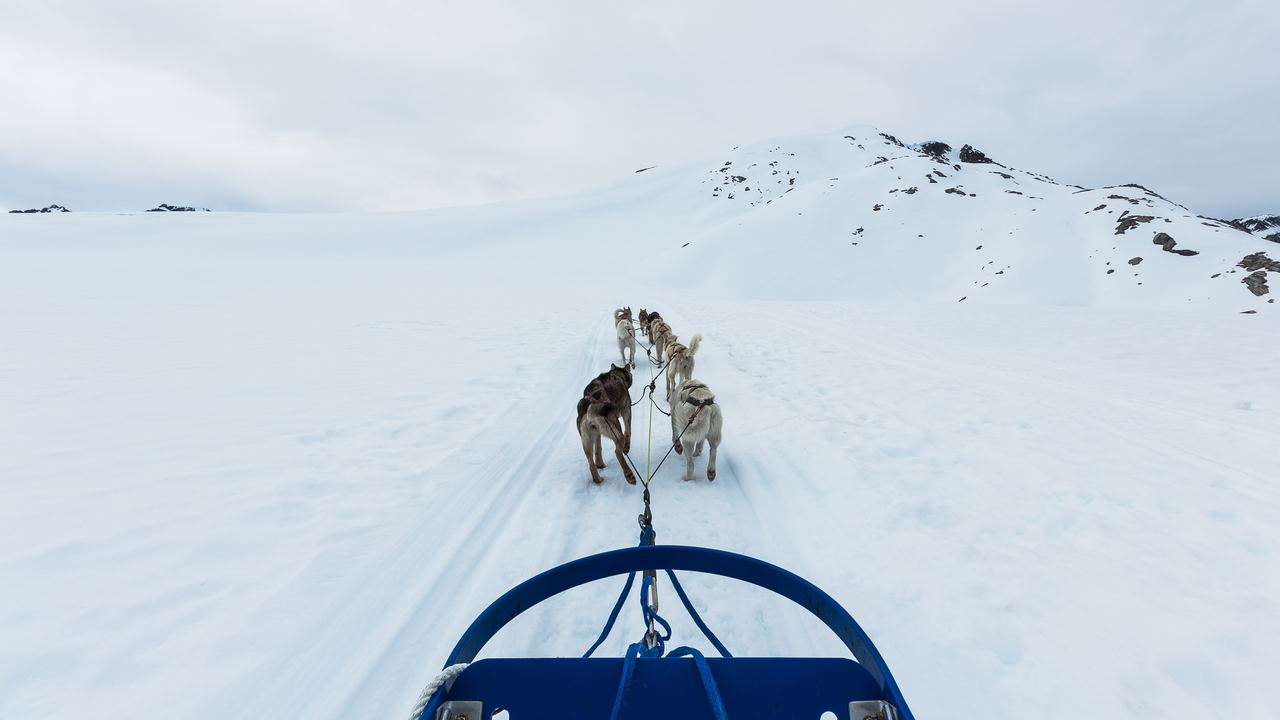
Husky Sledding
5 departures built around the state sport of Alaska, in the months when the dogs work best and the sky does too
Start with the animals, because most listings do not. An Alaskan husky is not a breed. There is no registry, no standard and no show ring: it is a working crossbred type, put together out of whatever produces speed, appetite and feet that hold up over a thousand miles, which is why a team on a Fairbanks trail contains dogs of five different colours and three different sizes. The Siberian Husky you have seen in photographs is a separate, registered breed and a much rarer sight in an Alaskan racing kennel.
The second thing worth knowing is that the cold is for the dogs, not for you. A team pulling hard overheats above about freezing, which is why serious mushing here happens in the dark half of the year and why an autumn tour has to use a wheeled cart rather than a sled.
That turns out to line up neatly with the sky. Fairbanks has its best aurora months in midwinter rather than at the equinoxes, so the weeks when the dogs run best are also the weeks when the sky is most likely to be open. The only party with an objection to January is you, and every one of these five departures has somewhere warm in it for that reason.
As for the aurora itself, be clear about what this category is. A sled is quiet and slow, which makes it a far better place to look up from than a snowmobile, but you are still moving and the musher is still working. All five separate the two things: the dogs happen at one end of the evening and the sky at the other, usually from a cabin or a ridge with somewhere warm behind it.
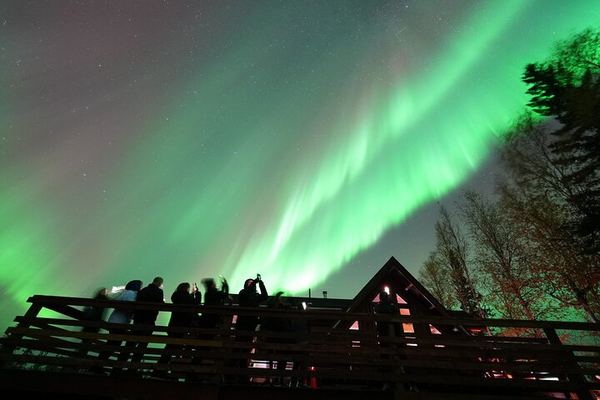
Aurora Viewing at Aurora Husky Lodge with a Ridge Top View
A ridge overlooking the Alaska Range, 40 minutes out, with a rustic cabin and unlimited hot drinks to wait in. Note the operator's firm no-refund policy.
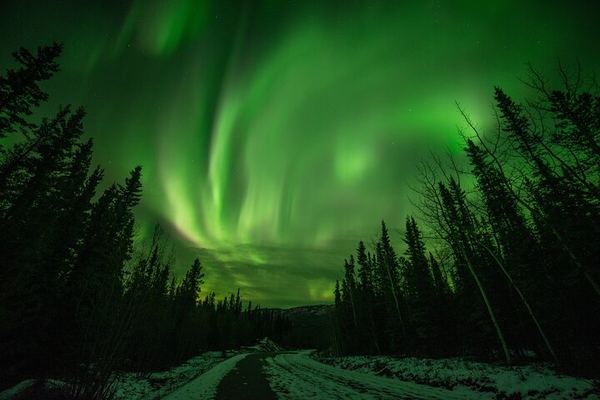
Autumn Aurora and Dog Mushing Cart Ride near Fairbanks
A cart instead of a sled is how mushers train before the snow, so this runs in September and October, when the aurora is back but the ground is still bare.
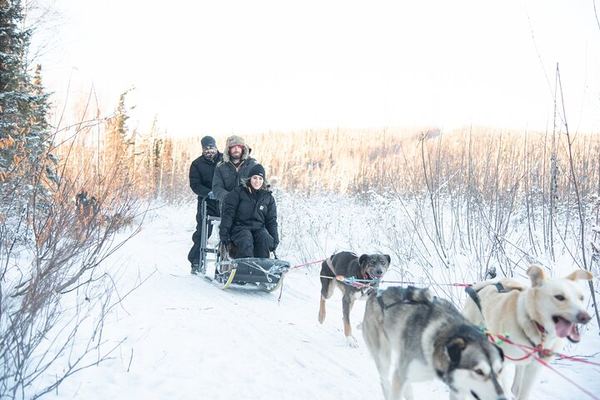
Dog Sled and Reindeer Day Trip to Borealis Basecamp
An hour behind a team of eight through snowy forest, plus the kennels and a replica race checkpoint, which explains the sport better than a start line does.
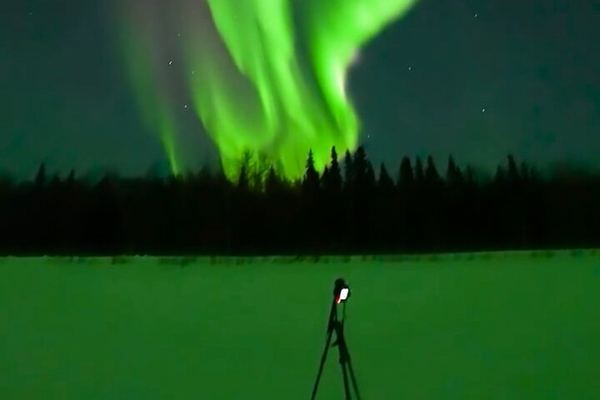
Five Night Alaska Winter Package with Dog Sledding and Aurora Alerts
The lodge sends aurora alerts, which is what gets you out of bed at 1am instead of hearing about it at breakfast. One night is a coin flip; five is not.
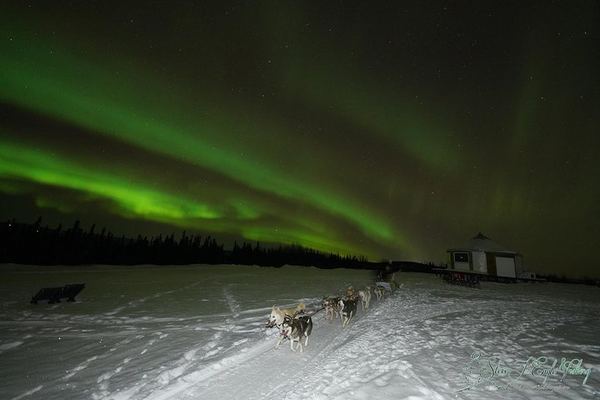
Northern Lights Viewing with Dog Sledding and an Alaskan Dinner
Home cooked salmon in a yurt, or vegetarian pasta on request, gives the group somewhere warm between looks at the sky. A dog sled run fills the waiting.
Ratings collected by Viator and Tripadvisor
The five departures
They are not five versions of one thing. Two are essentially aurora evenings with dogs attached, one is a daytime trip, one is a multi-night package, and one is the cheapest aurora product in Alaska that happens to be attached to a kennel.
| Departure | Price | Reviews | What it actually is |
|---|---|---|---|
| Ridge-top lodge with a husky yard | 120 EUR | 294 | An aurora night above the Alaska Range, 40 minutes out, with unlimited hot drinks and a sled ride as a paid extra |
| Autumn aurora and a dog-cart ride | 176 EUR | 8 | Runs in September, before the snow. The team pulls a training cart, which is how mushers condition dogs in autumn |
| Dog sled and reindeer day trip | 242 EUR | 50 | An hour behind a team of eight through forest, plus the reindeer herd. Daytime, so the aurora is a separate evening |
| Sledding with a home-cooked Alaskan dinner | 282 EUR | 112 | Salmon in a cabin, a run behind the dogs, and the cabin as somewhere warm to wait between looks at the sky |
| Five-night winter package with aurora alerts | 2,201 EUR | 2 | Accommodation, activities and a lodge that wakes you when the aurora starts. Five chances instead of one |
That last row contains the single most useful feature in Alaskan aurora accommodation, and it is worth more than any tour on this page: an alert system. The aurora habitually arrives at one in the morning on a night nobody expected, and a lodge that knocks on your door converts a wasted night into a seen one. If you are booking accommodation independently, ask whether they do it.
Why there is a cart tour in autumn
It looks like a compromise and it is standard practice. Sled dogs cannot go from a summer of rest to a thousand-mile race, so kennels start conditioning as soon as the temperature drops far enough to run safely, usually in late August, and until the snow arrives the team pulls a wheeled cart or a quad instead of a sled. The dogs do not care. The gangline, the commands and the pace are identical.
What it means for a visitor is that Alaska's most famous winter activity is available before the snow. What it does not mean, and what this page used to imply, is that autumn is the good time to be here for the aurora. On our numbers September is the weakest month of the Fairbanks season by a wide margin. Take the cart tour if your trip falls in autumn; do not plan an autumn trip around it.
The reason this is the state sport
In January 1925 an outbreak of diphtheria reached Nome, on the Bering Sea coast, with no serum closer than Anchorage and no way to fly it in. Twenty mushers and around 150 dogs relayed the antitoxin 674 miles across interior Alaska in five and a half days, in temperatures reported below minus 50.
The dog most people can name is Balto, who led the final leg into Nome and got the statue in Central Park. The team that did the hard part belonged to Leonhard Seppala and was led by Togo, who covered roughly 264 miles including a crossing of the sea ice on Norton Sound, by a wide margin the longest and most dangerous stretch of the relay. It is a useful thing to know before you meet a kennel here, because mushers will tell you about Togo and assume you have heard of Balto.
The modern descendants are the Iditarod, run to Nome since 1973, and the Yukon Quest, which since 1984 has run about a thousand miles between Fairbanks and Whitehorse. Several kennels around Fairbanks run teams in one or both, which is why the guide holding your sled may casually mention a race that took them nine days.
When to go, and why we changed our answer
This page used to say that September paired the best aurora conditions of the year with cart training. The first half of that was wrong, and the correction matters because it points at a different month entirely.
Two things decide how much aurora time a month contains: how often the sky is usable, and how many hours of real darkness there are to use it in. Multiplied together they rank the Fairbanks season like this.
| Month | Usable-sky nights | Darkness per night | Expected usable dark hours |
|---|---|---|---|
| January | 58.1% | 6.9 h | 4.01 |
| December | 47.4% | 7.5 h | 3.55 |
| February | 53.0% | 5.7 h | 3.02 |
| November | 41.3% | 7.0 h | 2.89 |
| October | 46.5% | 5.7 h | 2.65 |
| March | 51.9% | 3.9 h | 2.02 |
| September | 44.0% | 3.1 h | 1.36 |
September is the worst month of the Fairbanks season, not the best: a mediocre sky over barely three hours of darkness, roughly a third of what January delivers. The cart tour is a good tour and it does not make September a good month.
For sledding proper the answer is January and February. Both have the snow, both sit near the top of that table, and both are when the dogs work best: a team pulling hard overheats above freezing, so the cold everyone else complains about is the condition the animals need. March is the comfortable compromise, with the best snow of the season, temperatures a visitor enjoys and a sky still usable on half the nights, and it costs you about half the expected dark hours of January.
Two limits, stated because they cut against us. Our data window covers September to March, so the April end of the sled season is outside it. And below roughly minus 35 the Tanana valley fills with ice fog, a shallow local effect a 28 km reanalysis grid will under-resolve: the January figure describes the regional sky, which is what a kennel out of town sits in, and it overstates what somebody in the city sees.
Two seasons in one category
| Month | 1 | 2 | 3 | 4 | 5 | 6 | 7 | 8 | 9 | 10 | 11 | 12 |
|---|---|---|---|---|---|---|---|---|---|---|---|---|
| Behind a sledNeeds snow on the ground. January is the best month for the sky at 58.1% and the best for the dogs, who overheat above freezing. March swaps about half the expected dark hours for comfort and the best snow. | 1 | 2 | 3 | 4 | 5 | 6 | 7 | 8 | 9 | 10 | 11 | 12 |
| Behind a training cartHow kennels condition teams before the snow. October is the better of the two months on our numbers: 46.5% sky over 5.7 hours of darkness, against September's 44.0% over 3.1. | 1 | 2 | 3 | 4 | 5 | 6 | 7 | 8 | 9 | 10 | 11 | 12 |
Cloud: ERA5 via Open-Meteo, 11 seasons. Darkness: ephemerides. Our window stops at March, so April is not covered. Full method on the Fairbanks page.
How dogs became Alaska's state sport
The origins
January 1925
The serum run to Nome
Twenty mushers relay diphtheria antitoxin 674 miles across the interior in five and a half days. Balto led the last leg and got the statue; Togo ran 264 miles including the sea ice, and did the dangerous part.
The growth
1972
The state sport
Alaska makes dog mushing its official state sport. Not skiing, not fishing: a form of transport that stopped being necessary decades earlier and never stopped mattering.
1984
The Yukon Quest
A thousand-mile race between Fairbanks and Whitehorse is run for the first time, over harder country and with less support than the Iditarod. Several Fairbanks kennels still enter it.
Today
October 2024
Solar maximum declared
NOAA and NASA confirm Solar Cycle 25 has peaked. Activity stays elevated for a year or two on either side, which is the window the current seasons fall inside.
Before you book a husky night
When should I come?
January or February for sledding: best sky, reliable snow, and the temperatures the dogs actually want. March if you would rather be comfortable, at the cost of about half the expected dark hours. Not September, despite what this page used to say and despite the cart tour running then: it is the weakest month of the Fairbanks season.
Will I see the aurora from the sled?
Possibly, and it is not what you are paying for. A sled is quiet and slow, so it is a far better place to look up from than a snowmobile, but the ride is an hour and the aurora keeps its own hours. All five of these separate the two: dogs first, sky later, with somewhere warm in between.
Do I drive the team myself?
Depends on the tour, and it is worth checking. Some seat you in the basket with a musher on the runners, some let you stand and take the runners yourself under supervision. Neither is difficult; standing is colder and considerably more fun.
Are the dogs well treated?
Ask, and look. A working kennel is loud, busy and enthusiastic, and dogs that want to run make it extremely obvious before a run starts. The signals worth watching are the state of the yard, whether the dogs approach you, and whether the musher talks about their individual dogs by name and temperament. In this catalogue the mushers are family operations and generally do.
Can I do this in September?
Yes, on a cart rather than a sled, and it is the same team doing the same work. Just do not book an autumn trip for the aurora: September gives a mediocre sky over three hours of darkness, about a third of what January delivers.
Data verified on. Cloud: ERA5 via Open-Meteo, 11 seasons. Darkness: computed ephemerides. Prices and review counts read off the 5 departures on 10 August 2026. Serum run and race history from published records.