

Photography
17 departures where someone else's job is the photograph, and where the camera sees more than you do
There are two completely different products filed under aurora photography in Rovaniemi and the listings do not always make it obvious which is which. One sends a professional photographer out with the group whose job is to hand you a picture of yourself under the lights. The other teaches you to take it, in the dark, with your own camera, while it is happening. Both are on this page. They suit different people and they are priced almost identically.
What they share is the reason they exist at all, and it is worth understanding before you book either. A camera is not a better eye. It is a different instrument, and on an aurora night it is a substantially more sensitive one.
Human night vision comes from the rod cells in the retina, which are exquisitely sensitive to dim light and almost colour-blind, with their peak response around 507 nm and a steep fall-off toward red. A camera sensor has no such bias. So when someone shows you an aurora photograph full of magenta and crimson and you stand under the same sky seeing a pale grey-green arc, nobody is lying to you. Your eyes are simply not built to receive that part of it.
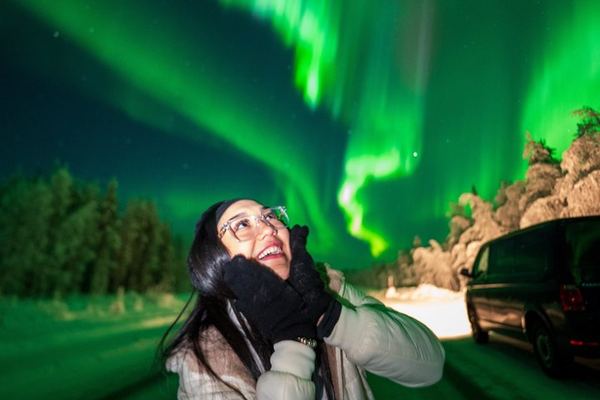
Aurora Chase from Rovaniemi with a Deep Sky Telescope on Board
A smart telescope rides in the van and locks onto Saturn, Andromeda or the Orion Nebula while the aurora watch continues. Eight guests, hosted by the owner.
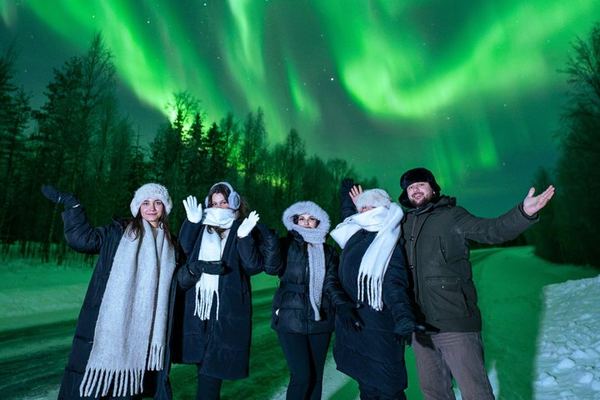
Aurora Hunt from Rovaniemi with a Professional Photographer
A photographer whose aurora images have been seen millions of times, mirrorless cameras and astro lenses, and every good frame at print quality in two days.
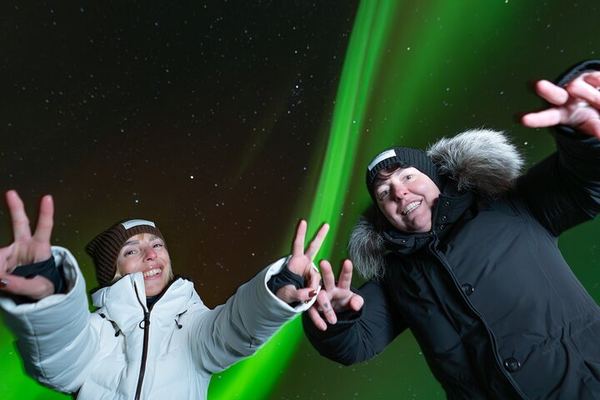
Aurora Photography Expedition from Rovaniemi with Video and Refund Terms
Departure timed from Arctic weather patterns rather than a standard 20:00 slot, running 3 to 10 hours, with money back if the camera catches nothing.
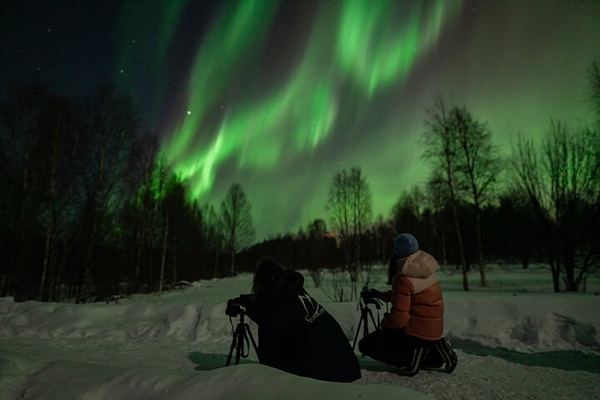
Aurora Photography Hunt from Rovaniemi with a Professional Hunter
A camera sees a faint aurora long before the eye does, which is often how the stop gets chosen. Arctic nature and life up here fill the drive in between.
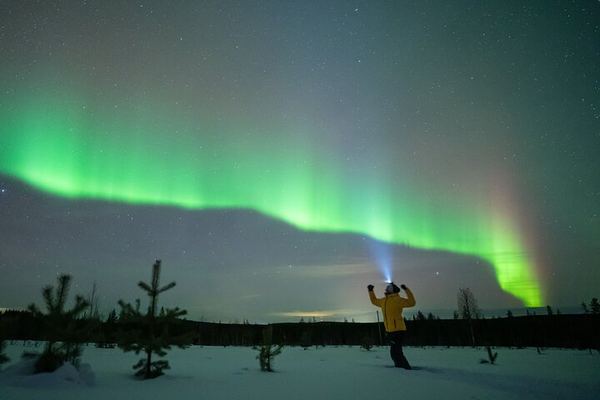
Aurora Photography Hunt from Rovaniemi with Next Day Photo Delivery
Cloud cover and solar wind data decide the driving, and the edited photographs arrive by email the following day. Hotel pickup within 8 km of the centre.
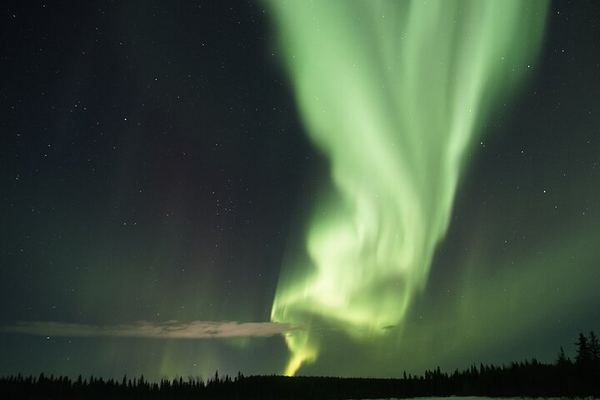
Aurora Photo Tour by Bus from Rovaniemi with Hot Drinks and Gingerbread
The bus works several spots instead of committing to one, which is how you beat patchy cloud. Light painting tricks, plus camera advice you keep afterwards.
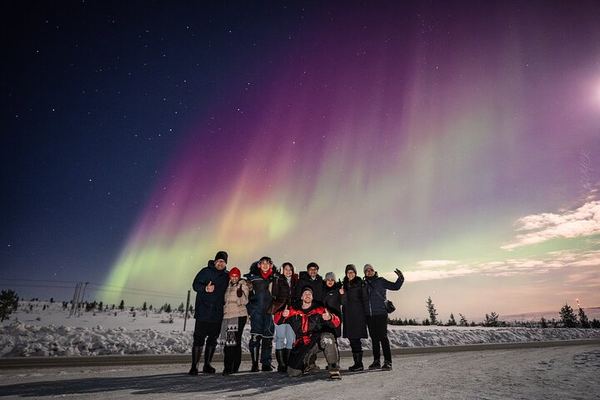
Expert Northern Lights Hunt from Rovaniemi with Photography, Max 8
One of the first real hunts out of Rovaniemi: meeting times move with the forecast, the drive can end in Sweden, and no aurora captured means a full refund.
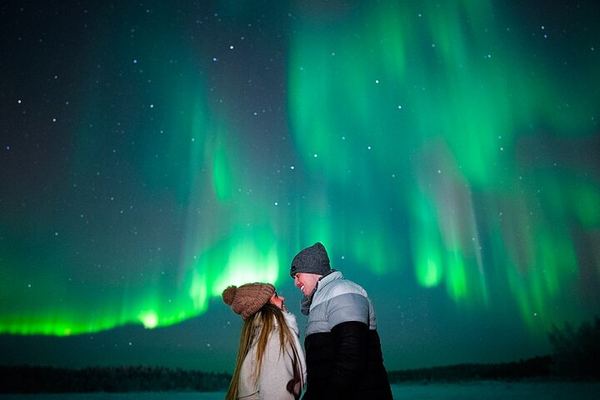
Guaranteed Small Group Aurora Expedition from Rovaniemi with DSLR Photos
No cap on time or distance, which some nights means 350 km across Lapland. DSLR photos taken while you watch, and no payment if the lights never appear.
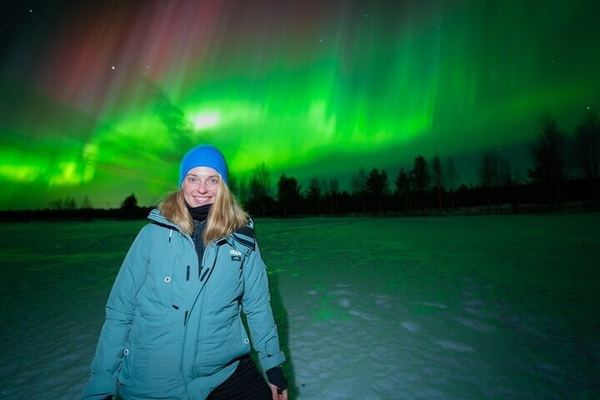
Money Back Guaranteed Aurora Bus Tour from Rovaniemi with Free Photos
No fixed route: live forecasts and space weather data decide where the bus goes, as far as Sweden to find clear skies. Free professional photos, 4 to 8 hours.
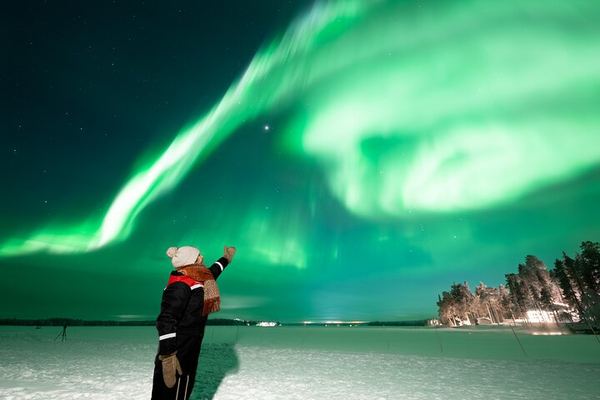
Northern Lights Photography Tour from Rovaniemi with Lappish BBQ Snack
The photographer's job is a picture of you standing under the aurora, not of the sky alone, with a traditional Lappish barbecue snack cooked at the stop.
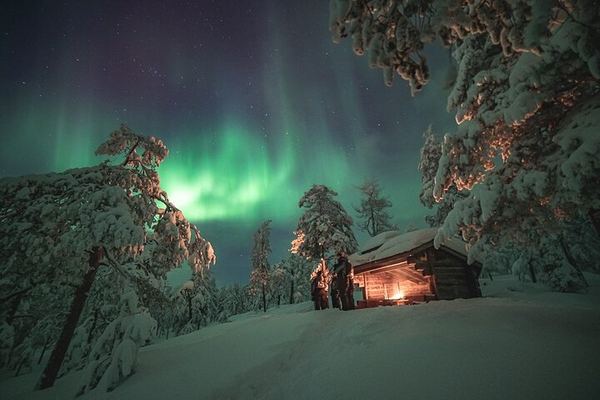
Private Northern Lights Photography Tour from Rovaniemi, 4 to 5 Hours
Four to five hours with a professional aurora photographer, learning the basics while standing under one. Your group alone, so the pace is yours to set.
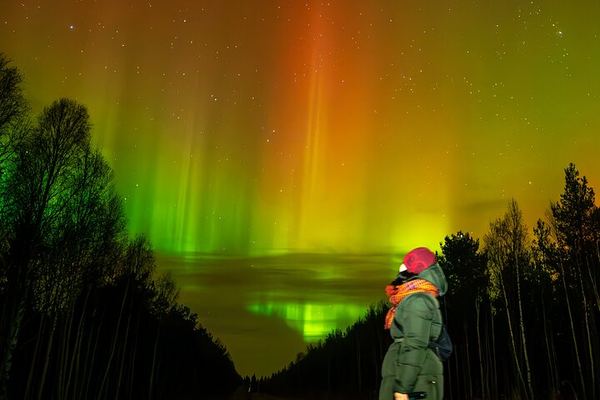
Rovaniemi Aurora Hunting and Photography Tour with Hotel Pickup at 20:00
Out at 20:00 to a remote spot where the silence lands before the sky does. Physics and folklore while you wait, and every photo emailed at full quality.
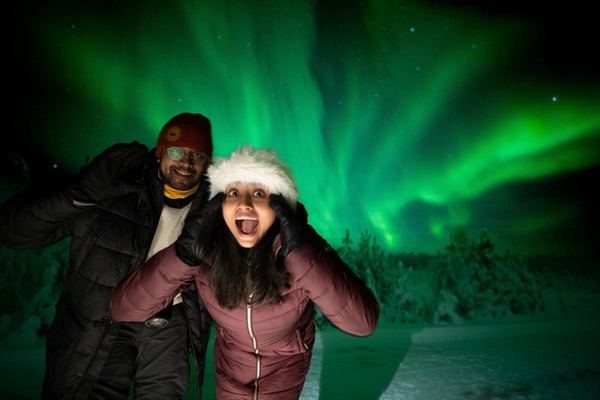
Rovaniemi Aurora Hunt with Money Back Guarantee and Free Photos
Five to eight hours, a minibus of 19 or a coach of 47, and a full refund if nothing appears. Winter clothing is not included, though you can rent it in town.
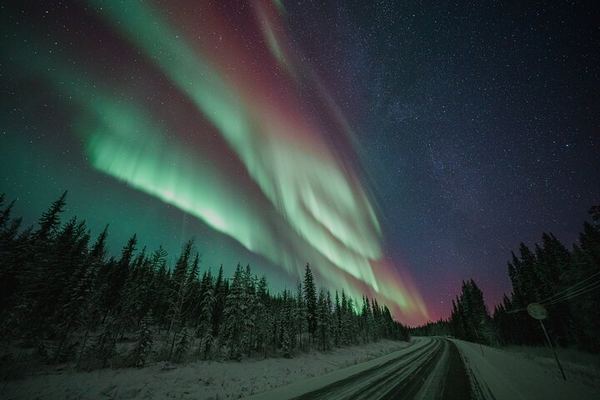
Rovaniemi Aurora Tour with Money Back Guarantee and Free Photos, 4 to 6 Hours
Live aurora data watched around the clock, and the van commits only when conditions justify it. Some nights that means 50 km, some nights 200 and into Sweden.
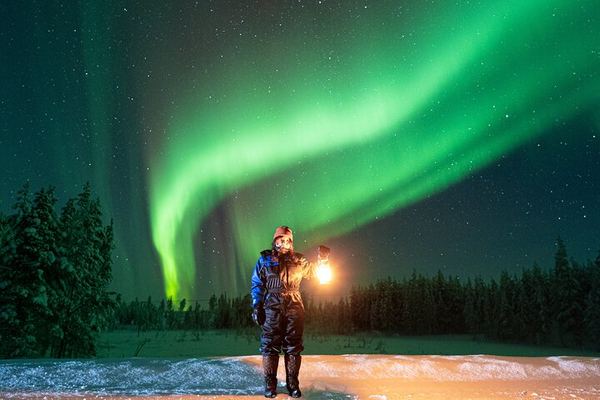
Short Aurora Photography Expedition from Rovaniemi
The short format: clear of the city's light pollution to a spot worth photographing from, with the local readings of these lights over the past few centuries.
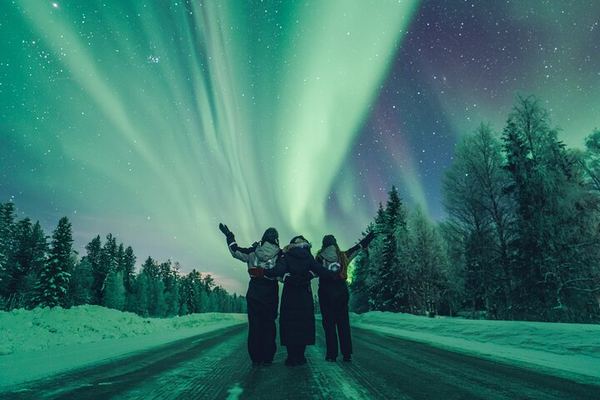
Small Group Northern Lights Photography Tour from Rovaniemi with Beyond Arctic
Lapland's first aurora hunting operator, planning each route from the morning's weather systems, with access to more than 20 private viewing locations.
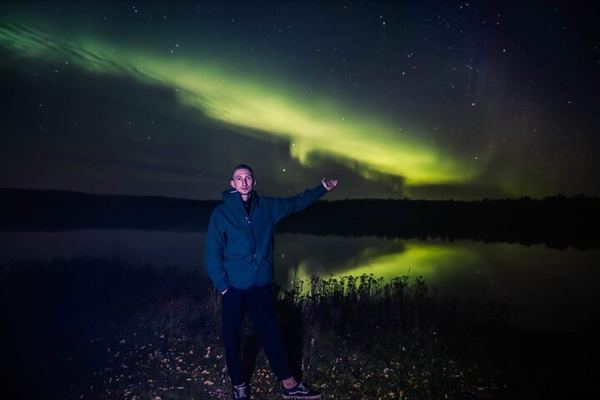
Small Group Northern Lights Photo Hunt with Campfire BBQ, Rovaniemi
A fire, hot sausages and a guide telling stories while the sky is watched. Waiting is what most aurora nights consist of, and this is how you spend it well.
Ratings collected by Viator and Tripadvisor
What the camera sees that you do not
The aurora is not one light. It is several distinct emissions from different gases at different heights, and they arrive at your eye and your sensor on very different terms.
| Emission | Source | Altitude | Your eye | The camera |
|---|---|---|---|---|
| 557.7 nm, green | Atomic oxygen | 100–150 km | The colour you reliably see; close to the rods' peak sensitivity | Records easily |
| 630.0 nm, deep red | Atomic oxygen | 200 km and above | Almost never. Rods are close to blind this far into the red | Records strongly; the source of most of the pink in aurora photographs |
| 427.8 nm, blue and violet | Ionised nitrogen | 90–100 km | Only in strong displays, and usually read as a purple fringe | Records clearly along the lower edge of active curtains |
Two useful consequences. First, when a guide says the aurora is out and you cannot see anything, point a camera at it: a fifteen-second exposure settles the argument in either direction, and this is exactly why several operators define a successful night as one the camera caught. Second, manage your expectations about the pink. It is real, it is in the sky, and you will mostly meet it on the back of the screen.

Settings, briefly, because the guide will be busy
Nothing here is a secret and every guide on this page will tell you the same, but reading it now means you are not learning it at minus 25 with cold hands. The single most common mistake is not exposure, it is leaving the shutter open too long: a fast, moving aurora smears into a flat green wash if you give it fifteen seconds. Structure needs speed.
| What the sky is doing | Shutter | Aperture | ISO |
|---|---|---|---|
| A faint, static arc low in the north | 10–15 s | As wide as the lens goes, f/2.8 or better | 1600–3200 |
| Active bands, visibly moving | 2–5 s | Wide open | 3200–6400 |
| A corona directly overhead | 1–3 s | Wide open | 6400 and up |
| You in the frame | 2–4 s, plus a brief torch on the subject | Wide open | 3200 |
Three practical notes that matter more than any of those numbers. Autofocus will hunt and fail in the dark, so switch to manual, magnify a bright star on the live view and focus on that once, then tape the ring if your lens creeps. Batteries empty fast in the cold, so keep the spares in an inside pocket against your body and swap rather than wait. And that torch flash on the subject is not showmanship: it is the only way a person and an aurora end up correctly exposed in the same frame.
Phones
A phone from the last few years will produce a usable aurora picture and this is a genuinely recent development. Night modes work by stacking a burst of frames and aligning them computationally, which is superb for a static arc and falls apart on a fast one, because the thing being aligned has moved between frames. The other constraint is holding still. A phone braced against a fence post or a car roof will do far better than the same phone held at arm's length.
What separates the 17
Prices run from 79 EUR to 199 EUR for shared departures, with one private option at 800 EUR, and that band is narrow enough that price is not much of a signal. The differences that matter are elsewhere. Several operators here refuse to publish a fixed departure time, setting it each afternoon from the forecast, which is a good sign rather than an inconvenience. One carries a deep-sky telescope so the waiting has something to look at. One delivers edited files the following day rather than a link a week later. Two include video as well as stills. Four attach a refund if nothing is seen.
The oldest operators here describe themselves as the first in Lapland to run a hunt rather than a bus to a viewpoint, and their listings still read that way: no fixed route, meeting times that move, and a willingness to drive into Sweden. The most-reviewed departure here has 871 traveller reviews at 4.9. Across all 17 the catalogue holds 2,500 reviews, which for a niche within a niche is a lot of nights.
When to go, and why photography answers differently
This page used to recommend the shoulder months on the usual reasoning. Running the numbers for Rovaniemi changes the picture, and it changes it in a way specific to photography, because a long exposure is affected by twilight that your eye ignores completely.
| Month | Usable-sky nights | Darkness per night | Moon-free nights | Expected usable dark hours |
|---|---|---|---|---|
| March | 50.0% | 4.3 h | 61% | 2.15 |
| October | 33.2% | 6.1 h | 48% | 2.03 |
| February | 30.4% | 6.2 h | 57% | 1.88 |
| December | 22.3% | 8.0 h | 58% | 1.78 |
| January | 22.9% | 7.5 h | 58% | 1.72 |
| November | 20.0% | 7.6 h | 53% | 1.52 |
| September | 41.7% | 2.8 h | 37% | 1.17 |
March and October are effectively tied, and for photography they are not the same product. March gives you the best sky in Finland at 50.0%, snow in the foreground, and 61% of nights free of moonlight, on 4.3 hours of darkness. October gives you 6.1 hours of darkness, unfrozen water for reflections, and temperatures at which a battery lasts an hour, on a sky open one night in three. If you shoot, October's extra two hours of true dark is worth more than the table suggests; if you want the classic snow-and-aurora frame, March.
September is the month to skip, and it is the one most often recommended. The second-best cloud figure of the year, 2.8 hours of astronomical darkness, and only 37% of nights free of moonlight. A three-hour tour leaving at eight in September spends a good part of its evening shooting into twilight.
One limit, stated because it argues against the ranking: it measures how much dark clear sky a month contains, not the chance the aurora does something inside it. Geomagnetic storms are close to twice as frequent at the equinoxes, favouring September and March. Even doubling September leaves it behind October; March wins either way.
| 1 | 2 | 3 | 4 | 5 | 6 | 7 | 8 | 9 | 10 | 11 | 12 |
How the aurora came to be photographed at all
The origins
1741
The needle moves
In Uppsala, Anders Celsius and his assistant Olof Hiorter notice that a magnetic needle swings while the aurora is overhead. It is the first hard evidence that the lights are a magnetic phenomenon rather than an optical one.
1892
The first photograph
The German astronomer Martin Brendel exposes a plate at Bossekop in northern Norway and produces what is generally credited as the first photograph of an aurora. Everything on this page descends from that exposure.
The growth
1902–03
Birkeland goes north
Kristian Birkeland runs observatories across the Arctic and, in the laboratory, fires cathode rays at a magnetised sphere to reproduce the rings of light around its poles. The mechanism guides describe at the roadside is his.
Today
2019
The phone catches up
Computational astrophotography arrives in consumer phones, stacking bursts of frames to pull stars and aurora out of the dark. It is why a photography tour now has to offer more than simply owning a camera.
Before you book a photography night
Which month should I book?
March for the best sky and snow, October for the most darkness and open water for reflections. They come out almost level on our combined measure and they produce different photographs. Skip September: it has the second-best cloud figure of the Rovaniemi year and 2.8 hours of real darkness to use it in.
Do I need my own camera?
No. Every departure on this page includes photographs taken by the guide, and on several that is the entire point of the product. Bring a camera if you want to be taught; leave it at the hotel if you want the picture without the homework.
Which lens?
Wide and fast. Something in the 14 to 24 mm range at f/2.8 or brighter covers almost everything, because the aurora is large and you want the landscape under it. A kit zoom at f/3.5 will work at higher ISO; it just costs you a stop you would rather have.
Why do the guide's photos look better than mine?
Usually focus and shutter speed rather than the camera. They focused once on a star at the start of the night and did not touch it again, and they matched the exposure to how fast the aurora was moving instead of leaving it at fifteen seconds. Both are learnable in about ten minutes.
Are the photographs edited?
Yes, and openly: contrast, white balance and noise reduction are normal on any night exposure. What is not editing is the colour itself. The pink and violet in a good aurora photograph are emissions at wavelengths your eye is not equipped to register, recorded rather than added.
Data verified on. Cloud: ERA5 via Open-Meteo, 11 seasons. Darkness and moon: ephemerides. Prices, inclusions and review counts read off the 17 departures on 10 August 2026.