Three Nights in Tromsø Is a Coin Flip: How Many Nights You Need to See the Northern Lights
The trade says three nights, and attaches a percentage with no method behind it. On eleven seasons of cloud data three nights in Tromsø is 51.2%, a coin flip on the weather alone. Here is the calculation, and why the obvious version of it is wrong.
How many nights do you need to see the northern lights? The trade answers three, sometimes four, and it answers with a percentage attached: 88, 90, 95, 98. In our own survey of the market, not one of those percentages arrived with a metric, a denominator or a period. They are numbers in the shape of evidence.
Here is ours, with the method bolted to it. Three nights in Tromsø gives you a 51.2% chance of getting one night with at least two usable hours of open sky, measured across eleven seasons of reanalysis. Read that carefully, because it is weaker than it sounds. Not one night of aurora. One night on which the cloud was thin enough for long enough that an aurora, had there been one, could have reached you.
Three nights in the most famous aurora town in Europe is a coin flip on the weather alone. What follows is where that number comes from, why the obvious way of calculating it is wrong in a direction that flatters everyone selling you something, and the conclusion the arithmetic keeps arriving at: a fourth night in Tromsø is usually the weakest thing you can buy with that money.
Where the three night rule comes from
The advice is not stupid. More nights really is better than fewer, and three is roughly where a short break stops being a gamble and starts being a trip. The problem is that a sensible rule of thumb has been repeated for so long that it has grown decimal places, and nobody went back to check whether the decimal places were ever calculated.
What a percentage needs before it means anything is short: a definition of success, a period, and a denominator. How many nights, in how many seasons, counted as what. Almost none of the figures in this trade carry any of the three. The ones we could trace back came from companies who sell the tours, which is not an accusation of dishonesty so much as a description of the incentive.
One worked example from our own files. A Tromsø operator publishes that 60 to 70% of nights are free of cloud between 21 November and 15 February. Over that same window and that same town, ERA5 gives between 16.8% and 23.5%. That is a factor of four, and it is almost certainly not bad faith: they are counting something else, probably nights on which the sky opened at some point, on a definition they never state. That is the whole problem in one line. A number without a metric cannot be checked, cannot be wrong, and cannot help you. If you want the version of this argument that deals with the contractual side, the guide covers what an aurora guarantee actually guarantees.
Three nights is not three coin flips
Here is the calculation almost everybody does, usually without noticing they are doing it. One night in Tromsø is clear enough 25.4% of the time. So three nights must be 1 minus 0.746 cubed, which is 58.5%. Four nights gets you to 69%, a week to 87%, and the reassuring shape of that curve is why the advice sounds so confident.
It is wrong, and it is wrong in the generous direction. That calculation assumes the weather forgets. It assumes that waking up under a week of Atlantic low pressure tells you nothing about tonight. Anyone who has actually sat out a cloudy spell in the Arctic knows better, and the data is unambiguous about it.
| Destination | Any night | After a clear night | After a cloudy night |
|---|---|---|---|
| Tromsø | 25.4% | 44.3% | 19.1% |
| Abisko | 18.7% | 34.8% | 15.0% |
| Rovaniemi | 31.5% | 49.7% | 22.8% |
| Reykjavík | 35.7% | 45.3% | 30.2% |
| Kiruna | 38.8% | 50.4% | 31.4% |
| Fairbanks | 48.9% | 60.3% | 37.9% |
| Yellowknife | 47.7% | 56.7% | 39.4% |
In Tromsø a clear night is more than twice as likely to follow another clear night as to follow a cloudy one. Weather in the Arctic arrives in weather systems, which is not a surprising sentence, and yet every published version of this calculation ignores it.
We model that persistence with a two state Markov chain, which is the simplest thing that captures the effect without inventing structure that is not in the data. The probability of striking out completely across N nights is:
P(no usable night in N) = (1 − p) × (1 − p₀₁)^(N−1)
where p is how often a night is usable at all, and p₀₁ is the chance a night is usable given that the night before was not. The chain starts from its steady state, which is the honest description of a traveller who lands on an arbitrary Tuesday knowing nothing about last week's sky. Every number below comes out of that one line, so you can check all of them with a calculator.
How many nights to see the northern lights, destination by destination
Fourteen destinations, whole season, September through March. The second to last column is the naive independent calculation, included so you can see the size of the error that everyone else publishes. The last column is the one that tends to end arguments.
| Destination | 1 night | 2 | 3 | 5 | 7 | 3 if independent | Nights for 90% |
|---|---|---|---|---|---|---|---|
| Tromsø | 25.4% | 39.7% | 51.2% | 68.0% | 79.1% | 58.5% | 11 |
| Alta | 29.3% | 46.9% | 60.1% | 77.4% | 87.2% | 64.7% | 8 |
| Bodø | 32.9% | 49.3% | 61.6% | 78.1% | 87.5% | 69.8% | 8 |
| Reykjavík | 35.7% | 55.1% | 68.6% | 84.7% | 92.6% | 73.4% | 7 |
| Akureyri | 23.3% | 39.5% | 52.3% | 70.4% | 81.6% | 54.8% | 10 |
| Rovaniemi | 31.5% | 47.2% | 59.2% | 75.7% | 85.6% | 67.9% | 9 |
| Levi | 32.3% | 49.2% | 62.0% | 78.6% | 88.0% | 68.9% | 8 |
| Saariselkä | 27.9% | 43.3% | 55.3% | 72.3% | 82.8% | 62.6% | 10 |
| Kiruna | 38.8% | 58.0% | 71.2% | 86.4% | 93.6% | 77.1% | 6 |
| Abisko | 18.7% | 30.9% | 41.2% | 57.5% | 69.2% | 46.3% | 14 |
| Fairbanks | 48.9% | 68.3% | 80.3% | 92.4% | 97.1% | 86.7% | 5 |
| Anchorage | 36.4% | 54.3% | 67.2% | 83.1% | 91.3% | 74.3% | 7 |
| Yellowknife | 47.7% | 68.3% | 80.8% | 92.9% | 97.4% | 85.7% | 5 |
| Whitehorse | 43.6% | 65.3% | 78.7% | 91.9% | 97.0% | 82.0% | 5 |
Two things fall out of that table immediately. The first is that the independence error is worth between 2.5 and 8.7 percentage points depending on where you are, and it is largest exactly where people most need the truth: Rovaniemi loses 8.7 points to it, Bodø 8.2, Tromsø 7.3. The second is that nobody sells a trip long enough to reach 90% in Europe. Eleven nights in Tromsø, fourteen in Abisko. No realistic holiday buys that number, and no operator quoting it has done this calculation.
Abisko deserves a caveat here, not a victory lap, and we would rather give it than take the cheap headline. Abisko markets a "blue hole" of clear sky a few kilometres wide, and ERA5 runs on a grid of roughly 28 km, so our model physically cannot see a feature that size. The bottom row of our table is not a refutation of the blue hole. It measures something else at a scale that would miss it either way, and we say so on the page where the method lives.
Each extra night buys less than the one before
This is the part that changes what you do, and it falls out of the formula, not out of any opinion of ours. Look at what each successive night in Tromsø actually adds.
| Nights booked | Chance of at least one usable night | What that night added |
|---|---|---|
| 1 | 25.4% | — |
| 2 | 39.7% | +14.3 points |
| 3 | 51.2% | +11.5 |
| 4 | 60.5% | +9.3 |
| 5 | 68.0% | +7.5 |
| 6 | 74.1% | +6.1 |
| 7 | 79.1% | +5.0 |
Every increment is 80.9% of the one above it, and that is not a coincidence or an artefact of the rounding. Each night you add multiplies the chance of total failure by exactly (1 − p₀₁), so in Tromsø every extra night removes 19.1% of whatever risk is still standing, and 19.1% is precisely the probability that a cloudy night is followed by a clear one.
That is the whole economics of the decision in one sentence. If the sky is shut, the only thing that rescues your trip is the weather pattern breaking, and in Tromsø the pattern breaks on about one night in five. Under the independent model you would be clearing 25.4% of the remaining risk every night instead. The gap between those two numbers looks small and it compounds, which is how a plausible rule of thumb ends up seven points adrift.
In Tromsø every extra night you book removes only 19.1% of the risk that is left. The fourth night is worth 9.3 points, the seventh is worth 5.0, and the eleventh is the one that finally reaches 90%. Nobody sells that trip.
December is the worst month to spend those nights in
Everything above is a season average, and the season is not flat. Run the same model on December alone, which is peak booking season, and three nights in Tromsø drops from 51.2% to 40.0%. Reaching 90% would take fourteen nights instead of eleven. December has the most darkness available anywhere in this table, a full eight hours of astronomical night inside our window, and the least sky to spend it under: 16.8% of nights usable, the worst month on Tromsø's row.
That combination is not widely advertised, for the obvious reason. The advice to go deep into winter because the nights are long counts the darkness and forgets the cloud. Both matter, and they move in opposite directions across the season, which is why we publish the product of the two rather than either one alone.
| 1 | 2 | 3 | 4 | 5 | 6 | 7 | 8 | 9 | 10 | 11 | 12 |
Moving is worth more than staying longer
Here is where the table stops being trivia. Length of stay is the variable everyone optimises, and it is the weaker of the two levers you are holding. The stronger one is which row of the table you are standing in, and swapping rows is usually cheaper than adding nights.
| What you were going to book | Chance | What beats it | Chance |
|---|---|---|---|
| 3 nights in Tromsø | 51.2% | 2 nights in Kiruna | 58.0% |
| 5 nights in Tromsø | 68.0% | 2 nights in Fairbanks | 68.3% |
| 7 nights in Tromsø | 79.1% | 3 nights in Fairbanks | 80.3% |
| 3 nights in Abisko | 41.2% | 1 night in Fairbanks | 48.9% |
| 7 nights in Abisko | 69.2% | 3 nights in Reykjavík | 68.6% |
Two nights in Kiruna beat three in Tromsø. Two nights in Fairbanks match five in Tromsø. A single night in Fairbanks beats three in Abisko, which sits ninety kilometres from Kiruna and is marketed as the clearest sky in the world. These are not close calls, and none of them asks you to be luckier or better at reading a forecast. They ask you to buy a different plane ticket.
We are not going to pretend this settles a holiday. Tromsø has flights from everywhere, a town you can enjoy when the sky is shut, and the deepest catalogue of tours we carry. Kiruna has less of all three. Fairbanks is a long way from Europe, and −35 °C is its own argument. The point is narrower than "go to Alaska": if you have been told that a fourth night is how you buy certainty, the numbers say the fourth night is the most expensive percentage point you will ever purchase, and that the same money moved sideways buys more of them.

The continent nobody compares
The North American destinations are not marginally better on cloud. They are in a different regime. Fairbanks never drops below 41.3% of usable nights in any month of the season and reaches 58.1% in January, its deepest winter. Tromsø's best month of the entire year is 34.0%.
That difference inverts the standard advice as well as the odds. In Scandinavia you are told to aim for the equinoxes. In Fairbanks the middle of winter is the best part of the season and September is the worst of it. Advice that travels well between Tromsø and Rovaniemi does not survive the Atlantic.
So how many nights should you book?
Taking our own numbers seriously, and accepting that a real trip has a budget and a job to go back to:
Three nights is the floor, not the recommendation. It is a coin flip in Tromsø and worse in Abisko. If three is genuinely all you have, that is still a trip worth taking, but go knowing you are betting rather than buying.
Four and five are where the curve still pays. The fourth night in Tromsø adds 9.3 points and the fifth adds 7.5. Those are the last two nights that move the number in a way you would notice afterwards.
Past six nights, change destination instead. A seventh night in Tromsø buys 5.0 points. Moving those same nights to Kiruna, Reykjavík or Alaska buys twenty or thirty. This is the largest single effect in the whole dataset and it is the one nobody mentions.
If you want 90%, only North America sells it. Five nights in Fairbanks, Yellowknife or Whitehorse crosses it. Europe needs six nights in Kiruna, seven in Reykjavík, eleven in Tromsø and fourteen in Abisko. That is the honest answer to the most common question in this trade, and it is why nobody else answers it with a number.
One thing does improve your odds without adding a night: a tour that drives. Every figure here is measured at a fixed point, which is unfair to an operator willing to put 200 km between you and the cloud. That is the strongest argument for booking one, and it is an argument from our own data working against our own data. What all of this costs, night by night, is in the guide's breakdown of what an aurora trip costs.

What this calculation does not tell you
- It is not the probability of seeing the aurora. It is the probability of the sky being open. You also need the magnetosphere to be doing something, and you need to be looking up while it does. Every number above is a ceiling, and the real figure sits below it.
- The thresholds are ours. Cloud cover at or below 50%, at least two hours, an 18:00 to 02:00 window. Reasonable choices, not laws of nature, and different ones give different numbers. We publish them so that any disagreement can be specific.
- ERA5 is a reanalysis on a grid of roughly 28 km. Excellent for climate, useless as a forecast for next Thursday, and blind to microclimate at valley scale. Abisko is the case where that limit bites hardest.
- The two state chain captures persistence from one night to the next, not a fortnight of blocking high pressure or a week of Atlantic fronts. On long spells it stays optimistic, which means these numbers are if anything generous.
- It is measured at a fixed point, so it understates any tour that drives to find a gap, and understates it most in exactly the places with the worst rows.
- The moon is not in it. Darkness and lunar interference are tracked separately, and a full moon high in the sky will spoil a faint display that this calculation counts as a success.
How many nights to book: the questions people actually ask
How many nights do you need to see the northern lights?
There is no number that guarantees it, and anyone quoting one is quoting marketing. On our cloud record three nights in Tromsø gives a 51.2% chance of at least one night with two or more usable hours of open sky, five nights gives 68.0%, and reaching 90% would take eleven. The same three nights are worth 71.2% in Kiruna and 80.3% in Fairbanks. Where you go moves the number far more than how long you stay.
Is three nights enough in Tromsø?
It is a coin flip on the weather alone, and 40.0% if those three nights fall in December. That is not an argument against going, but it is an argument against expecting. Three nights is the floor, not the recommendation, and the fourth and fifth nights are the last two that meaningfully move the odds.
Why do operators say 90% over three nights?
We have not found a published version of that claim that states its metric, its period or its denominator, which makes it uncheckable, and uncheckable is not the same as false. Part of the gap is that operators usually count nights on which the sky opened at all, at some moment, while we count nights with at least two hours of workable sky. One Tromsø operator's figure for clear nights runs about four times our number for the same weeks, which is the size of gap a difference in definition can produce.
Does booking more nights keep helping?
It helps less each time, in a way you can calculate exactly. Each extra night in Tromsø removes 19.1% of the risk that is left, so the increments run +14.3 points, +11.5, +9.3, +7.5, +6.1, +5.0. Every one of them is 80.9% of the one before. The curve flattens quickly, which is why nights six and seven are poor value next to spending the same money somewhere with a better sky.
Is it better to stay longer or go somewhere else?
Go somewhere else, by a wide margin. Two nights in Kiruna beat three in Tromsø. Two nights in Fairbanks match five in Tromsø. Three nights in Fairbanks beat seven in Tromsø. Destination is the strongest lever in the dataset, and length of stay is the one everybody optimises instead.
How many nights do you need in Fairbanks or Yellowknife?
Three nights reaches 80.3% in Fairbanks and 80.8% in Yellowknife, and five nights crosses 90% in both. They are the only destinations we measure where a normal holiday buys that number. The trade off is distance from Europe and genuine cold, and that is a real cost, not a footnote.
Should I avoid December because it is the weakest month?
December has the worst sky on Tromsø's row, 16.8% of nights usable, together with the most darkness available and the highest prices. If school holidays fix your dates, go anyway and book an extra night. If your dates are genuinely free, October and January carry more expected usable hours in Tromsø, and March is the strongest month in Finnish Lapland while still being low season.
Aurora tours in Tromsø
The destination most of the numbers on this page refer to, and the deepest catalogue we carry. A tour that drives is worth more here than in any other row of the table.
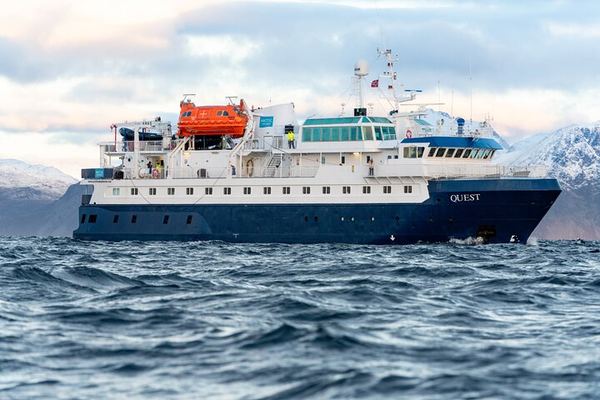
24 Hour Northern Lights and Whale Watching Cruise from Tromso
Sail across the auroral oval in the evening, sleep in a cabin while the ship moves, and wake on the whale grounds. Three-course dinner and lecture on board.
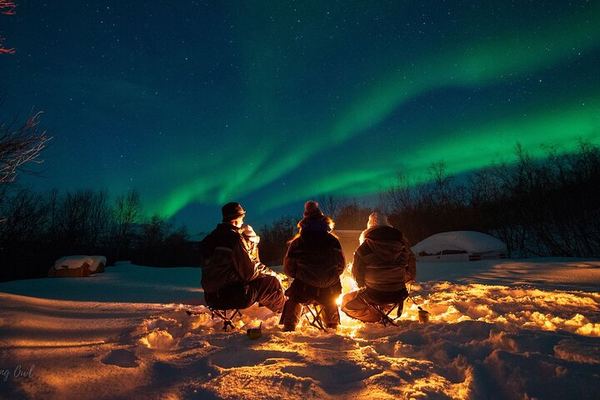
Adults Only Aurora Hunt from Tromso with Wandering Owl
An adults-only northern lights hunt from Tromsø: thermal suits, a campfire and a hot meal while the guides read the night's forecast. Photos included.
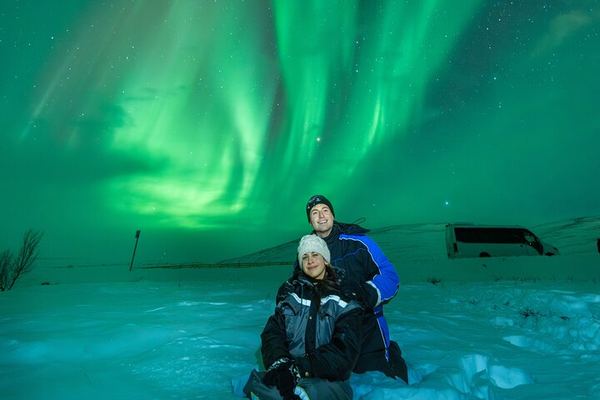
All Inclusive Aurora and Arctic Evening from Tromso with Campfire
Campfire, hot meal and photos on an all-inclusive aurora night from Tromsø. You get a forecast update the morning of, and can rebook if it turns.
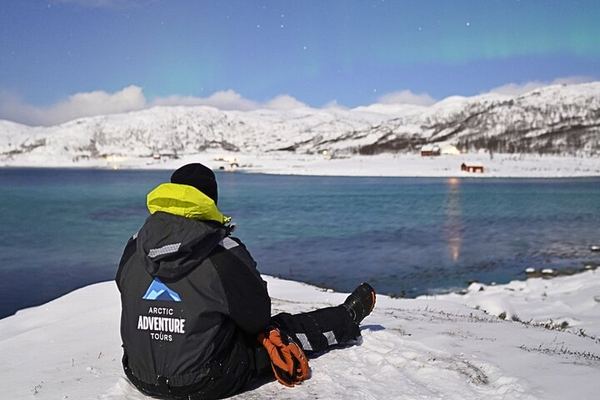
All Inclusive Northern Lights Hunt from Tromso, Max 15 Guests
Up to nine hours hunting clear sky from Tromsø in a group of 15, with a guide and driver working as a pair, an expedition meal and warm gear included.
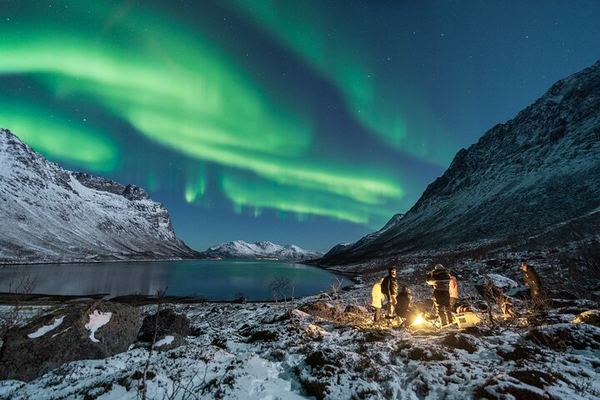
All Inclusive Northern Lights Hunt with The Green Adventure, Photos Included
Thermal suit and meal built into the price, a campfire with marshmallows, and expedition soup made in Tromsø that beats standing closer to the flames.
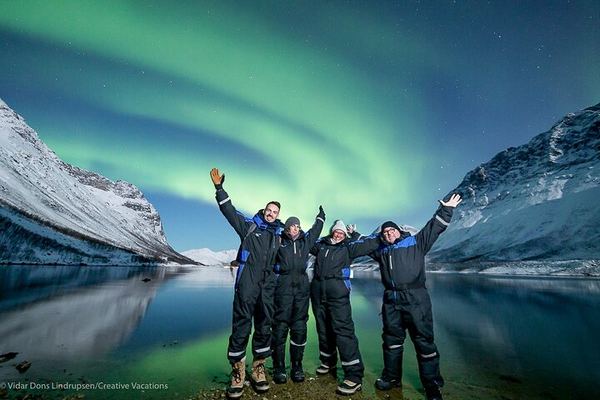
Aurora Adventure Tour from Tromso with Photographer Vidar
Seven hours under Arctic sky with Vidar, a professional photographer: real advice if you brought a camera, your portrait emailed to you if you did not.
Ratings collected by Viator and Tripadvisor
Sources
This article deliberately carries no outbound links. Every figure in it is either computed by us from named open datasets, or drawn from our own documented survey of the market, and we were not able to open an external page at the time of writing to confirm that a link still resolved. On a site whose whole argument is that numbers should be checkable, a link we have not opened ourselves is worse than no link, so the datasets are named precisely enough to be found and re-run.
- Cloud cover: ERA5 reanalysis, produced by ECMWF for the Copernicus Climate Change Service, queried through the Open-Meteo historical weather archive. Eleven seasons, 1 September 2015 to 30 April 2025. A night counts as usable at 50% cloud cover or less for at least two continuous hours between 18:00 and 02:00 local standard time, with the hours after midnight attributed to the preceding day.
- Persistence and the night count model: computed by us from that same ERA5 record, as a two state Markov chain started from its stationary distribution. The governing equation is printed above, so the results can be reproduced without our code.
- Darkness: sun below −18° inside the same 18:00 to 02:00 window, from standard ephemeris algorithms (Meeus). Exact, not statistical, and stable for years.
- Moon phases: Meeus chapter 49, accurate to minutes on the instant of each phase.
- Geomagnetic climatology, referred to here but not central: GFZ Potsdam Kp and ap series, 1932 to 2026, open data.
- Claims made by the trade: our own survey of operator and tourism board material, recorded in August 2026. Operators are not named where our own record does not name them.
Data verified on. Cloud from ERA5 via Open-Meteo, eleven seasons to April 2025. Night counts from a two state Markov chain on the same record. Darkness and moon from standard ephemerides. All thresholds are ours. About This Site
The number that decides your trip is cloud, not Kp
How often the sky opens in each destination, the thresholds behind every figure on this page, and the four things the measurement cannot see.