

Photography
Eight departures where the camera is the point, from a 98 EUR seat to a private vehicle for the night
The most useful thing to know before booking any of these is that the sensor sees colour your eyes cannot. In near darkness human vision switches to rod cells, which are far more light-sensitive than cones and effectively colour blind. A camera has no such switch, so a display that looks like grey cloud to you comes back from a ten second exposure as a saturated green band.
Nobody is cheating. But it does mean the photograph and the memory will not match, and it is worth deciding in advance which of the two you came for.
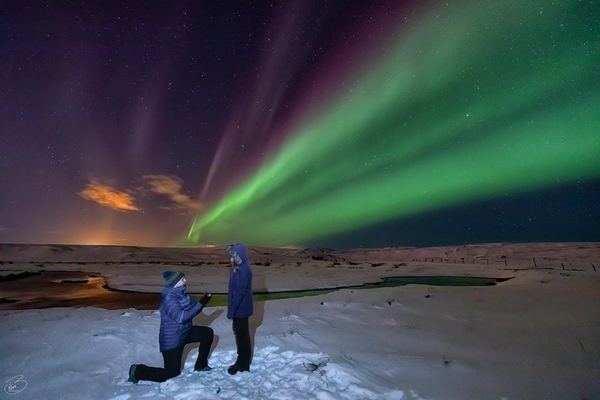
Northern Lights Hunt with Photography Help, Small Group Tour
Hands-on help with your settings in the dark, or a portrait if you brought no camera, delivered as high resolution files. This one does not go out under cloud.
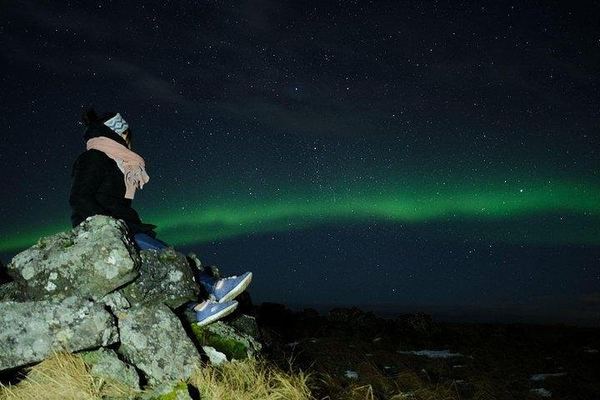
Private Northern Lights Hunt with Professional Photographs
The guide writes the forecast for the Northern Lights Iceland group and reads solar wind daily. Poor conditions mean a refund, a blank night a free retry.
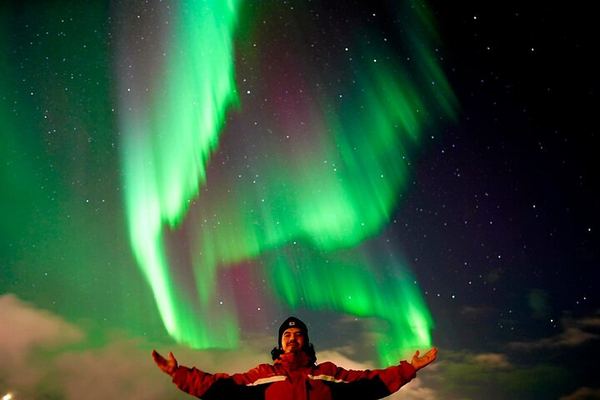
Private Northern Lights Tour with a Guide and Professional Photos
Flexible pickup time and place, your group alone, and the option to reschedule if the forecast turns. A coach commits to its first choice; a car does not.
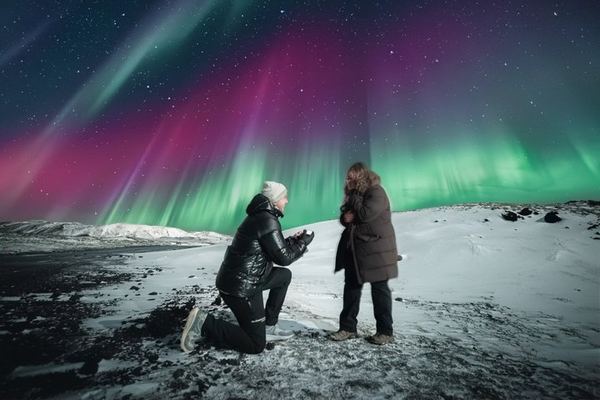
Private Reykjavik Northern Lights Tour with a Professional Photographer
Fleece blankets, homemade cocoa and pastries, and a photographer for the long exposures a phone cannot manage. Private means changing plan mid-evening.
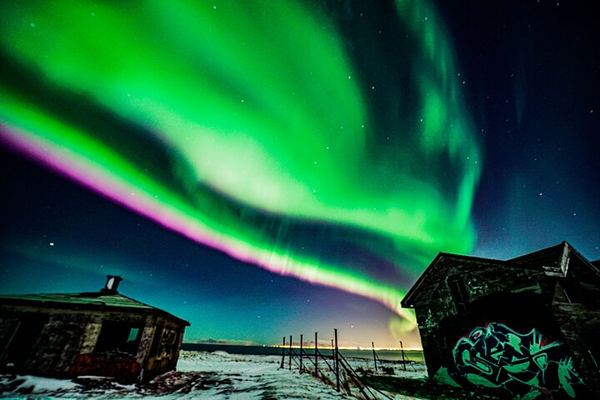
Reykjavik 4x4 Northern Lights Small Group Tour with a Photographer
A heated 4x4, stops chosen for long exposure as much as viewing, edited photos included, and museum entry to use on a clouded-out afternoon in town.
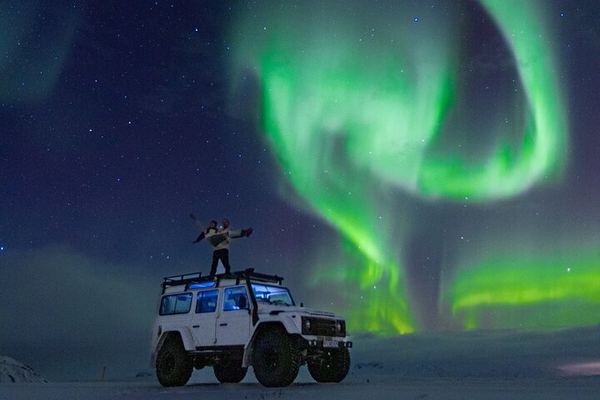
Reykjavik Private Northern Lights Tour with a Professional Photographer
A small family company reporting a 95% success rate, with cinnamon buns for the wait. Reschedule before you go, or take a free second attempt afterwards.
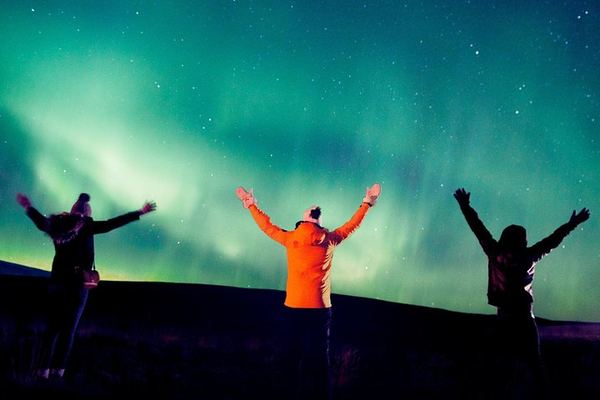
Small Group Northern Lights Tour from Reykjavik with Free Photos
The guide teaches you to photograph a moving green light in the dark, phone or camera, and sends a portrait afterwards. The destination changes nightly.
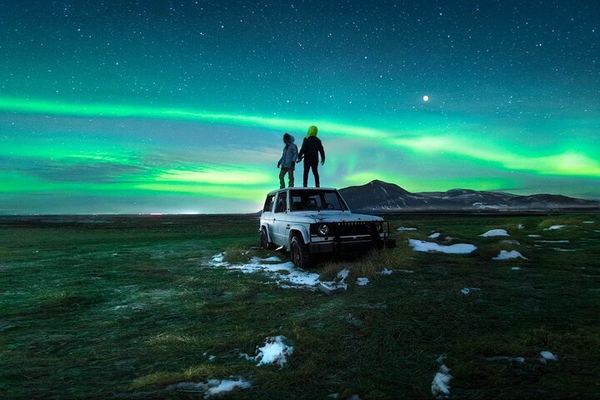
Small Group Northern Lights Tour with Free Photos and Hot Chocolate
A minibus with Wi-Fi, a location chosen from that night's cloud data, and free rebooking if nothing shows. Green comes from oxygen around 100 km up.
Ratings collected by Viator and Tripadvisor
Why the capital region needs a chase
Iceland sits under the auroral oval from end to end, so the sky over Reykjavík is as good as the sky anywhere else on the island. The difference is what is underneath it. Greater Reykjavík holds most of Iceland's population, and the light that comes off it lifts the base of the sky enough to erase everything except a strong display.
Twenty or thirty minutes of driving fixes it. That is short by the standards of northern Norway, where a chase can run three hours to the Finnish border, and it is why Icelandic tours are typically 3 to 5 hours rather than 5 to 9. The trade-off runs the other way too: less driving means less ability to escape a weather system that has settled over the whole southwest.
What separates the eight
| The tour | Group | Price | What it is really selling |
|---|---|---|---|
| Small group with free photos | shared minibus | from 98 EUR | Hotel or bus stop pickup, WiFi on board, photographs of you under the lights |
| Small group with photography teaching | shared | from 118 EUR | The settings and techniques, taught to whoever turns up, camera or phone |
| 4x4 with a photographer | small group | from 208 EUR | Entry to the Aurora Reykjavík museum included, and long exposure stops built into the route |
| Photography help, small group | small group | from 281 EUR | An operator that does not go out when conditions are poor, which is why it is at the top of the shared range |
| Private with a photographer | your group | 1,184 to 1,567 EUR | Flexible pickup times, undivided attention, and the freedom to stay out longer |
The 281 EUR departure deserves the closer look. Its listing says plainly that it does not run when the sky is too cloudy: an operator declining departures is declining revenue, and the photographs from the nights it does run are the reason it can charge the most on this page. Compare that with a tour that sails regardless and hands you an apology.

The three things that go wrong in the dark
Focus, first and worst. Autofocus has nothing to lock onto and will hunt indefinitely. The fix is to switch to manual, magnify a bright star in live view, focus on it once, and then not touch the ring again. More aurora photographs are lost to soft focus than to any exposure mistake.
Exposure length is a trade, not a setting. A longer shutter collects more light but smears a fast-moving display into a flat wash. When the aurora is actually dancing, shorter and noisier produces the better picture, because the structure is what makes it worth looking at.
Batteries fail in the cold. Lithium cells lose a large share of their capacity below freezing. A dead battery often revives after twenty minutes in an inside pocket, so carry spares against your body and rotate rather than replacing.
Phones are genuinely usable now. Night modes stack several frames into one image and will register an aurora, provided the phone does not move, which in practice means the guide's tripod, or a wall.
When to come, and the month that catches photographers out
This page used to say the season runs October to March with September and April as workable shoulders, and note that September gives bare ground some photographers prefer. That is true and it buries the more important point, which only shows up when you put the cloud record and the darkness on the same line.
Photography needs darkness more than viewing does: twilight your eye ignores completely still lifts the sky in a ten-second exposure, which is exactly why late April is a problem. September is the same problem at the other end of the season, and nobody says so.
| Month | Usable-sky nights | Darkness per night | Moon-free nights | Expected usable dark hours |
|---|---|---|---|---|
| December | 38.7% | 6.9 h | 55% | 2.67 |
| November | 37.0% | 6.4 h | 50% | 2.37 |
| January | 33.9% | 6.3 h | 58% | 2.14 |
| October | 34.5% | 5.1 h | 48% | 1.76 |
| February | 31.1% | 5.1 h | 57% | 1.59 |
| March | 33.5% | 3.5 h | 61% | 1.17 |
| September | 40.7% | 2.7 h | 40% | 1.10 |
December is the month to photograph in Reykjavík, and that is the reverse of the advice that holds in Tromsø, where December is the worst month of the year. Iceland's cloud record barely changes across the season, so the darkness peak in midwinter is a clean gain rather than a trade. November and January follow closely.
September is the weakest month here, in spite of having the best cloud figure of the year at 40.7%. Two point seven hours of astronomical darkness, on tours that run three to five hours, means a meaningful part of your evening is spent shooting into residual twilight. The bare ground is a real aesthetic argument; it does not outweigh losing more than half your dark sky.
One limit on the ranking, stated because it argues against us: it measures how much dark clear sky a month contains, not the chance the aurora does something inside it. Geomagnetic storms are close to twice as frequent at the equinoxes, favouring September and March. Even doubling September leaves it behind December.
| 1 | 2 | 3 | 4 | 5 | 6 | 7 | 8 | 9 | 10 | 11 | 12 |
Questions worth asking
Which month should I book for photography?
December, then November and January. Photography needs darkness more than viewing does, because twilight you cannot see still registers in a long exposure, and Reykjavík's sky is steady enough across the season that midwinter costs you nothing in cloud. Avoid September: best cloud figure of the year, 2.7 hours of real darkness.
Will I get the photographs, and in what size?
Every departure here includes images taken by the guide. Sizes vary from web files to full resolution, and delivery ranges from the same night to a few days later. If you are leaving Iceland quickly, confirm the timing before booking.
Is a private tour worth it for photography?
More than in any other category. Photography needs time in one place and the willingness to move when a spot does not work, and a shared minibus with fourteen people has to compromise on both. Read the private price as a vehicle hire split across your party.
Do I need to know anything beforehand?
No. These tours are pitched at whoever turns up. The one useful thing to do in advance is find manual focus on your camera in daylight, because looking for it in the dark with cold hands is how the first thirty minutes disappear.
What if the tour is cancelled?
Cancellations for weather are common here and are usually a good sign rather than a bad one. Check the rebooking terms rather than the refund terms: on a three-night trip, being moved to tomorrow is worth more than getting your money back.
Data verified on. Cloud: ERA5 via Open-Meteo, 11 seasons. Darkness and moon: ephemerides. Prices, formats and inclusions read from the 8 departures on 10 August 2026.