The Nights Worth Booking This Northern Lights Season, Destination by Destination
Seven new moons, fourteen destinations and eleven seasons of cloud data on one line. Which weeks of the 2026-27 season are worth booking, where, and why the month you pick matters more than the operator you pick.
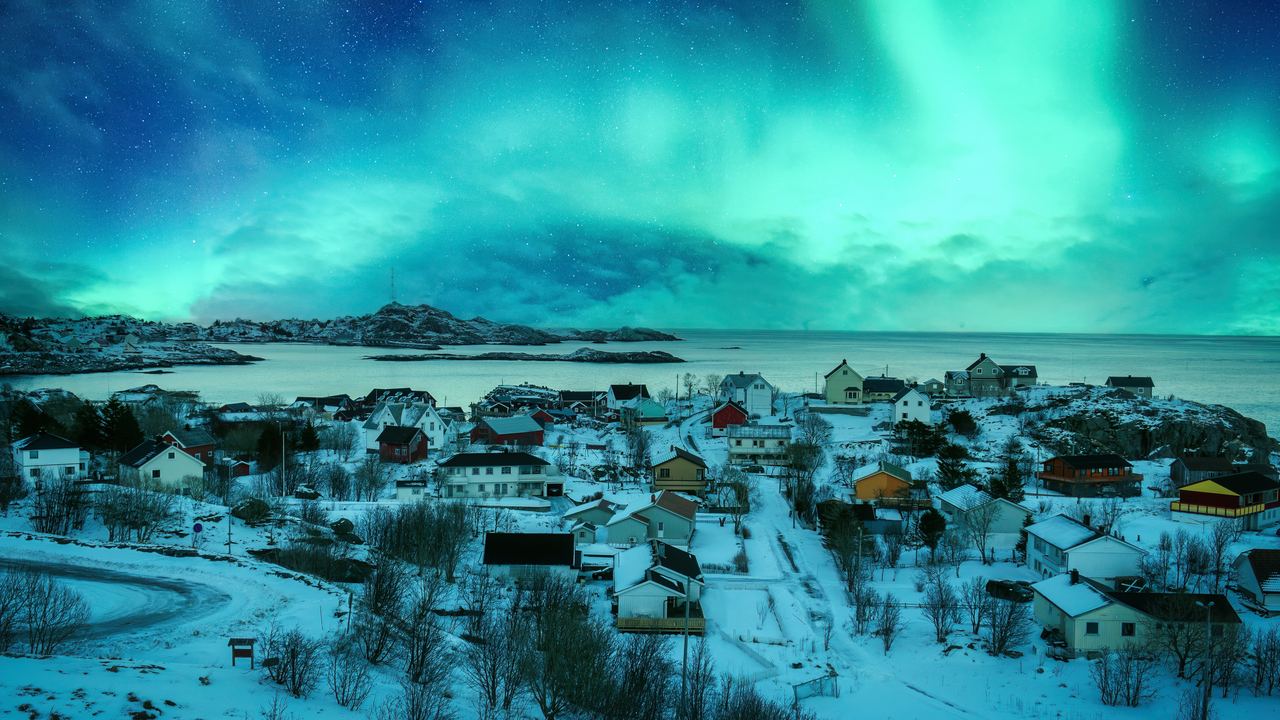
The first new moon of the northern lights season falls on 11 September 2026, and that fortnight will be sold hard. On the moon, the sales pitch is right. Those are dark nights. On everything else it is close to the worst fortnight of the winter to be standing outside in Tromsø, which gets about 1.8 hours of genuine darkness per night in September and spends the rest of it in a twilight that never quite finishes.
That gap between what a new moon promises and what a September night actually hands you is the whole difficulty of booking an aurora trip. Three things have to line up. The sky has to be open, there has to be enough real darkness to pick out a faint arc, and the moon has to be thin or already down. They do not peak in the same month, and in several places they move in opposite directions.
So here is the 2026-27 season with all three on the same line, fourteen destinations at a time, and the weeks that are worth paying for.
What a bookable northern lights night has to have
Every figure below comes from three measurements, and it is worth saying plainly which is which, because in this trade almost nobody does.
Cloud is a statistic. Eleven seasons of ERA5 reanalysis, September 2015 to April 2025, counting the nights when cloud cover sat at or below 50% for at least two hours between 18:00 and 02:00. The 50% and the two hours are our thresholds rather than laws of nature, and a different pair would produce different numbers. We publish them so you can disagree with them.
Darkness is not a statistic, it is arithmetic. The sun is more than 18 degrees below the horizon or it is not. The answer holds for years, which is why a table built on it does not go stale the way a forecast does.
The moon is arithmetic with a threshold on top. We count a night as undisturbed when average lunar interference across the dark window comes in under 25%, and that calculation looks at both how lit the moon is and whether it is above the horizon at all. A full moon that has already set costs you nothing.
Cloud and darkness multiply into the single figure used throughout this piece:
expected useful hours = (nights with a usable sky ÷ 100) × hours of astronomical darkness
It is not a probability and does not pretend to be one. It multiplies two averages as if they were independent, which they are not, and what it produces is closer to how much aurora can physically fit inside an average night of that month, in that place. Its job is ranking, and the ranking it produces is not the one the market sells.
Last week's piece folded in a third factor for geomagnetic activity. This one deliberately leaves it out. The question here is which week to book, and for that decision the moon matters more than a ten per cent swing in a month's average Ap.
The northern lights season has seven dark windows
New and full moon dates are ephemerides. They are exact, they are the same for everybody, and unlike a cloud statistic they will still be true in five years. Set against the month each destination peaks in, they sort the season into seven windows, and some of those windows are worth a great deal more than others.
| New moon | Full moon | Falls inside the best month of |
|---|---|---|
| 11 September 2026 | 26 September 2026 | Nobody's. September is the weakest month of the season in thirteen of fourteen places |
| 10 October 2026 | 26 October 2026 | Tromsø, Alta, Abisko |
| 9 November 2026 | 24 November 2026 | Bodø, Kiruna, Akureyri, Anchorage |
| 9 December 2026 | 24 December 2026 | Reykjavík |
| 7 January 2027 | 22 January 2027 | Fairbanks, Levi |
| 6 February 2027 | 20 February 2027 | Yellowknife, Whitehorse |
| 8 March 2027 | 22 March 2027 | Rovaniemi, Saariselkä |
Northern Norway: book October, not December
December in Tromsø gives all the darkness our window can hold. Eight hours out of eight, every one of them full astronomical night, because the sun does not rise at all. It is also the worst sky of Tromsø's own year: 16.8% of December nights give two hours at or below half cloud cover, against 31.9% in October.
Multiply the two and October comes out at 2.04 expected useful hours against December's 1.34. October wins by better than half again. December is high season, and it is the month the brochures are built around.
One Tromsø operator publishes 60 to 70% cloud-free nights for the stretch between 21 November and 15 February. Over that same window ERA5 gives between 16.8% and 23.5%. That is a factor of four, and we do not think it is bad faith. They are almost certainly counting something else, probably nights when the sky opened at some point, over a period they never state. The problem is exactly that: a number with no stated metric cannot be checked by anyone, and most of the numbers in this vertical are that kind of number.
Then there is the awkward part. Alta, further up the coast to the north east, has a clearer sky than Tromsø in all seven months of the season and scores 2.20 in October against Tromsø's 2.04. Bodø peaks in November at 2.83, the second highest single month anywhere in Europe on this measure. Kiruna, over the Swedish border, takes first place at 2.86, also in November.
None of those three towns has a tour catalogue worth the name. Tromsø has seventy-four aurora tours on this site. Alta has five, Bodø three, Kiruna six. Tours cluster where the airport and the beds are, which is a perfectly good reason for an operator and a poor one for a traveller picking a month. We sell nothing directly and have no stake in which of them you choose, which is the only reason we can print both halves of this.
October in Tromsø is worth half again as much as December, on cloud and darkness combined. December is the one that is high season.
The moon is the one factor you can plan around
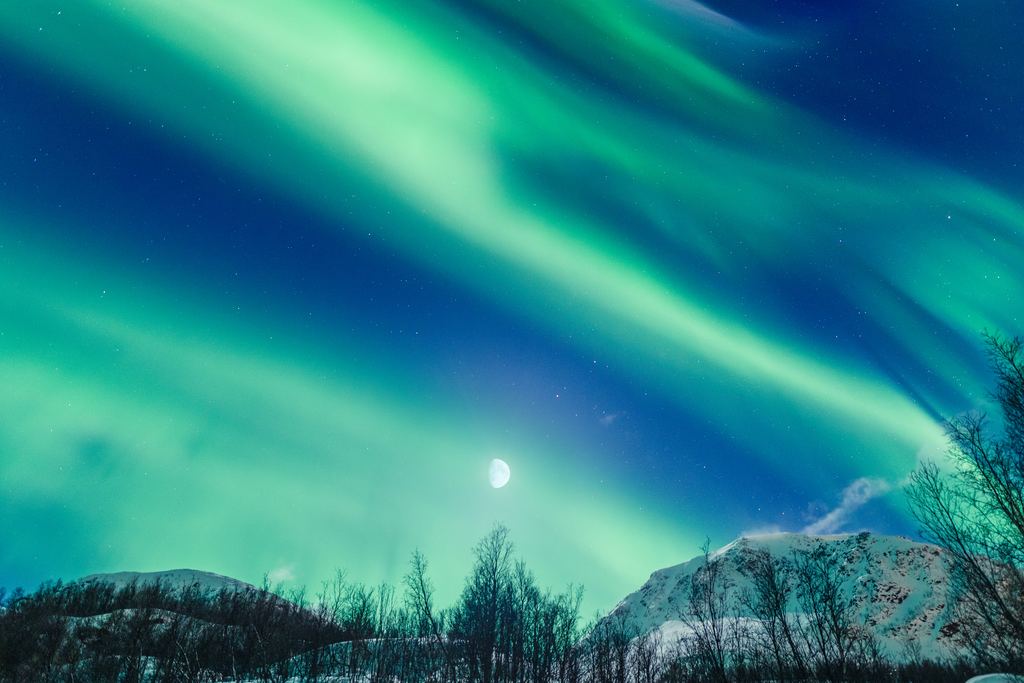
A full moon that has set costs you nothing
Most moon advice stops at the phase, which is half the answer. What ruins a faint arc is a bright moon sitting high in the sky during your dark hours. The same moon three hours after it sets is irrelevant.
So our column counts both, and the results are lopsided. Across October to February, between 45% and 61% of nights come out undisturbed almost everywhere. September is the outlier and not in a good way: 17% at Tromsø, 13% at Alta, the two lowest figures in the whole table. In March it splits, 39% at Tromsø against 61% at Rovaniemi and Reykjavík.
Here is the honest limit of that column. It is a monthly percentage, so it will not tell you that 12 October beats 19 October. The new moon dates will, and they are the part of this whole exercise that carries no uncertainty at all. Book the week around one and the moon has been taken out of the equation. Everything after that is cloud, and cloud is the thing you cannot plan around.
Which leads to the practical order of decisions, and most people run it backwards. Month first, because the spread between a destination's best and worst month is larger than the spread between destinations. Destination second. Operator third, and by then you are choosing between products rather than between odds. Our guide to the best time to go takes that decision apart properly.
Finnish Lapland waits for March, and does not agree with itself
Rovaniemi in March is the one place in our data where everything lines up at once. The sky gives 50.0% of nights usable, its own best figure and one of the highest anywhere. Around 61% of March nights are free of moon. The new moon falls on 8 March 2027. And it is low season.
Then the three Finnish rows stop agreeing. Levi has a marginally clearer March sky than Rovaniemi, 50.3% against 50.0%, and still peaks in January on expected hours, because March leaves it only 3.8 hours of true darkness against 7.5 in January. Saariselkä peaks in March at 1.80 and has the worst November of the group at 17.0% of nights. Three towns within a couple of hours of each other, three different answers. Anyone advising you on "the best month for Lapland" as a single region has not looked.
North America runs the Scandinavian advice backwards
Every piece of European aurora advice tells you to travel near the equinoxes and avoid midwinter. At Fairbanks that is precisely wrong. January gives 58.1% of nights with a usable sky and 4.01 expected useful hours, the highest single figure in our table. September gives 1.36, a third as much. Whatever the reason, the Alaskan interior is at its clearest when it is at its coldest, and the European rule of thumb does not survive the crossing.
Yellowknife peaks in February at 3.67, and its March sky, 61.6% of nights usable, is the best month of any destination we measure. It is also the only row in the table where September is not the weakest month. November is. Whitehorse nearly doubles between November and February, 28.7% of nights to 53.4%.

The consequence for a booking is blunt. Three nights at Fairbanks give an 80.3% chance of catching at least one usable sky. Three nights at Tromsø give 51.2%. No European destination reaches what Fairbanks and Yellowknife reach, and the gap is wide enough to survive any reasonable argument about our thresholds.
Two things keep that from being a straight recommendation. It is cloud, not aurora: a clear sky over a quiet magnetosphere shows you stars. And Fairbanks in January runs to minus thirty, which decides how long you actually stay outside in a way no dataset captures. The local tourist board advertises around 90% for sightings, a figure that measures something different again and never says over how many nights.
The 2026-27 season, destination by destination
The highlighted month is the strongest in that destination's own row on expected useful hours, cloud multiplied by darkness. The excluded months are that row's weakest, plus the five months when there is not enough darkness to bother. Every cell is calculated.
| Month | 1 | 2 | 3 | 4 | 5 | 6 | 7 | 8 | 9 | 10 | 11 | 12 |
|---|---|---|---|---|---|---|---|---|---|---|---|---|
| TromsøOctober gives 2.04 expected useful hours against 1.34 in December, which is the month most people book. | 1 | 2 | 3 | 4 | 5 | 6 | 7 | 8 | 9 | 10 | 11 | 12 |
| AltaOctober scores 2.20 here against Tromsø's 2.04, on a sky that is clearer in every month of the season. | 1 | 2 | 3 | 4 | 5 | 6 | 7 | 8 | 9 | 10 | 11 | 12 |
| BodøNovember reaches 2.83, the second best single month in Europe, on 36.3% of nights with a usable sky. | 1 | 2 | 3 | 4 | 5 | 6 | 7 | 8 | 9 | 10 | 11 | 12 |
| ReykjavíkThe only row that peaks in December, at 2.67, because the Icelandic sky changes so little from month to month. | 1 | 2 | 3 | 4 | 5 | 6 | 7 | 8 | 9 | 10 | 11 | 12 |
| AkureyriNovember at 1.45 is the best of a weak row: 21.7% of nights usable, against Reykjavík's 37.0% in the same month. | 1 | 2 | 3 | 4 | 5 | 6 | 7 | 8 | 9 | 10 | 11 | 12 |
| RovaniemiMarch gives 50.0% of nights with a usable sky and 61% free of moon, and it is low season. | 1 | 2 | 3 | 4 | 5 | 6 | 7 | 8 | 9 | 10 | 11 | 12 |
| LeviMarch has the clearer sky at 50.3%, but January wins on expected hours because March keeps only 3.8 dark hours. | 1 | 2 | 3 | 4 | 5 | 6 | 7 | 8 | 9 | 10 | 11 | 12 |
| SaariselkäMarch at 1.80, on 48.7% of nights usable. November is the month to avoid here, at 17.0%. | 1 | 2 | 3 | 4 | 5 | 6 | 7 | 8 | 9 | 10 | 11 | 12 |
| KirunaNovember at 2.86 is the best single month anywhere in Europe, and Kiruna beats Abisko, 90 km away, in all seven months. | 1 | 2 | 3 | 4 | 5 | 6 | 7 | 8 | 9 | 10 | 11 | 12 |
| AbiskoThe weakest row we measure, October at 1.26. The clear sky claims made for the blue hole sit below the resolution of any public dataset. | 1 | 2 | 3 | 4 | 5 | 6 | 7 | 8 | 9 | 10 | 11 | 12 |
| FairbanksJanuary at 4.01 is the highest figure in the table, on 58.1% of nights with a usable sky. | 1 | 2 | 3 | 4 | 5 | 6 | 7 | 8 | 9 | 10 | 11 | 12 |
| AnchorageNovember at 2.38, and 3.8 hours of darkness in September, more than any other row gets that month. | 1 | 2 | 3 | 4 | 5 | 6 | 7 | 8 | 9 | 10 | 11 | 12 |
| YellowknifeThe one row where September is not the weakest month. November is, at 2.03, and February peaks at 3.67. | 1 | 2 | 3 | 4 | 5 | 6 | 7 | 8 | 9 | 10 | 11 | 12 |
| WhitehorseFebruary at 2.46 on a 53.4% sky, against 28.7% in November. Its darkest month tops out at 6.2 hours, the lowest peak here. | 1 | 2 | 3 | 4 | 5 | 6 | 7 | 8 | 9 | 10 | 11 | 12 |
Cloud from ERA5 via Open-Meteo, eleven seasons 2015-2025. Darkness from ephemerides, sun below 18 degrees. A ranking aid, not a probability: it ignores the moon and the cold.
Read down the highlighted column and the season sorts itself into four blocks. October belongs to northern Norway and to Abisko. November belongs to Bodø, Kiruna, Akureyri and Anchorage. Midwinter belongs to Iceland and to Alaska. March belongs to Finnish Lapland. Not one of those four blocks is December in Tromsø, which is high season.
The other thing that falls out of the grid is how little September has to offer. It is the weakest month in thirteen of fourteen places, and it is the month the trade recommends by reflex, because it reads a cloud statistic and forgets that the darkness has not arrived yet. Tromsø in September has one of its most open skies of the year, 34.0%, and 1.8 hours of night to use it in.
Three nights is a coin flip
The standard advice is three or four nights, usually attached to a success rate somewhere between 88% and 98% and never to a calculation. The arithmetic behind those figures, where anyone shows it, assumes each night is independent of the last. Weather does not work like that.
At Tromsø, 25.4% of season nights give a usable sky. After a clear night the odds of another clear night are 44.3%. After a cloudy one they are 19.1%, less than half. Cloud arrives in blocks and leaves in blocks. Run the persistence properly and three nights at Tromsø come out at 51.2%, against the 58.5% you would get by treating the nights as independent. Seven nights do not reach 80%. Eleven nights get you to 90%, and nobody books eleven nights.
This is a ceiling, not a forecast. It is the chance the sky opens, before you ask whether the magnetosphere was doing anything at the time, so the real figure is lower. That calculation deserves a piece of its own, and it will get one.
What these numbers do not tell you
- A usable sky is not aurora seen. It says the cloud would have let you see something, not that there was anything to see.
- ERA5 sits on a grid of roughly 28 km. It is a reanalysis built for climate, not a weather station and not a forecast, and it cannot resolve a valley microclimate. That limit is why we say what we cannot see around Abisko rather than claiming to have measured it.
- The thresholds are ours. Cloud at or below 50%, at least two hours, lunar interference under 25%. Move any of them and the numbers move.
- Expected useful hours ignores the moon, which lives in its own column, and ignores the cold, which at minus thirty decides how long you last outside.
- All of it is measured at a fixed point, which is unfair to a tour that will drive 200 km to get out from under the cloud. That is also the best argument anyone has for taking a tour rather than standing outside your hotel.
Questions we get about booking a season
Which is the best week to book for the 2026-27 northern lights season?
It depends where you are going, which is the point of the table above. The week around 10 October 2026 for Tromsø, Alta and Abisko. Around 9 November for Bodø, Kiruna, Akureyri and Anchorage. Around 7 January 2027 for Fairbanks and Levi, around 6 February for Yellowknife and Whitehorse, and around 8 March for Rovaniemi and Saariselkä. Those dates are new moons, so they carry no forecasting risk at all.
Is September a bad month to see the northern lights?
It is the weakest month of the season in thirteen of the fourteen places we measure, and the exception is Yellowknife, where November is weaker. September usually has a decent cloud record, which is why it gets recommended, but at high latitude there is very little true darkness to spend it on. Tromsø averages 1.8 hours a night in September against 8.0 in December.
Does a full moon ruin the northern lights?
Not on its own. A strong display is perfectly visible under a full moon; it is the faint arc that gets washed out. What matters is whether the moon is above the horizon during your dark hours, which is why our calculation looks at altitude as well as phase. A full moon that has already set does no harm at all.
How many nights should I book?
More than three, if the destination is European. Three nights at Tromsø give a 51.2% chance of at least one sky clear enough to see through, and that already accounts for the fact that cloudy nights arrive in runs. Three nights at Fairbanks give 80.3%. Both are the chance of an open sky rather than the chance of a sighting, so treat them as ceilings.
Is Tromsø the best place to go?
It has the deepest catalogue of tours by a wide margin, and the easiest flights, and neither of those is the same as the best sky. Alta beats it on usable sky in all seven months of the season. Kiruna records the strongest single month in Europe. If the tours and the flights matter to you more than a few percentage points of cloud, Tromsø is a defensible choice, and it should be a choice you make knowingly.
Where do these numbers come from, and can I check them?
Cloud comes from ERA5, the ECMWF reanalysis, queried through the Open-Meteo historical archive, over eleven seasons from September 2015 to April 2025. Darkness and moon phases are calculated from standard ephemeris algorithms with no external dataset. Both are free to access, our thresholds are stated above, and anybody who repeats the calculation should get the same answers. That is the entire point of publishing the method alongside the number.
Aurora tours in northern Norway
Tromsø, Alta and Bodø. October is the strongest month for two of the three on our figures, and it is the one the season brochures skip past on their way to December.
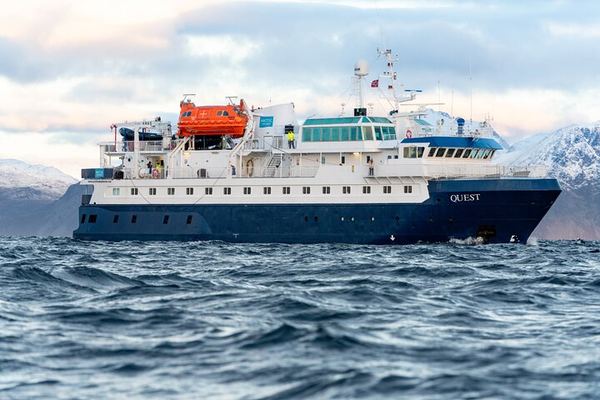
24 Hour Northern Lights and Whale Watching Cruise from Tromso
Sail across the auroral oval in the evening, sleep in a cabin while the ship moves, and wake on the whale grounds. Three-course dinner and lecture on board.
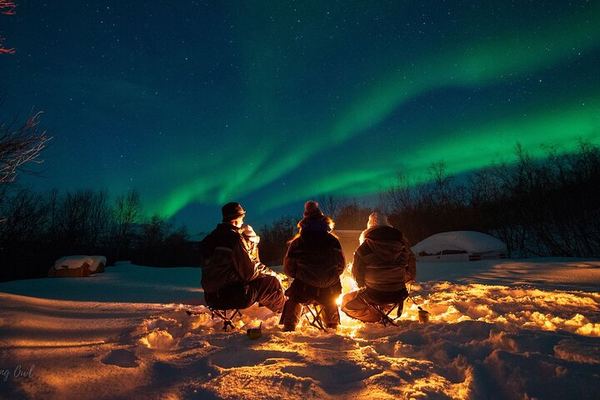
Adults Only Aurora Hunt from Tromso with Wandering Owl
An adults-only northern lights hunt from Tromsø: thermal suits, a campfire and a hot meal while the guides read the night's forecast. Photos included.
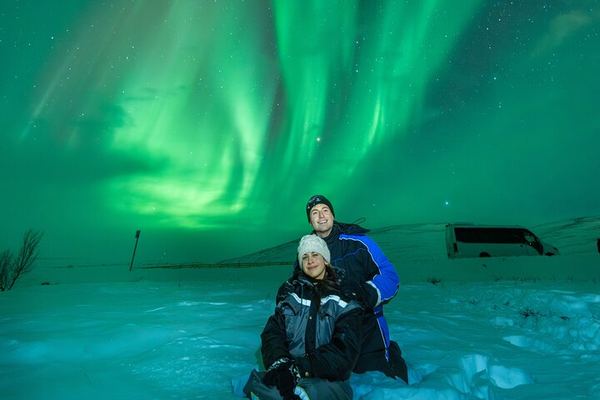
All Inclusive Aurora and Arctic Evening from Tromso with Campfire
Campfire, hot meal and photos on an all-inclusive aurora night from Tromsø. You get a forecast update the morning of, and can rebook if it turns.
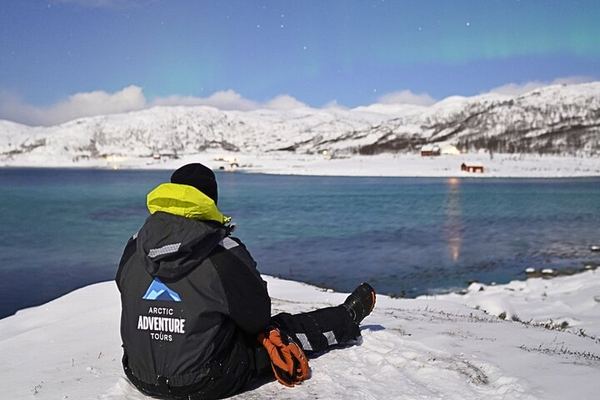
All Inclusive Northern Lights Hunt from Tromso, Max 15 Guests
Up to nine hours hunting clear sky from Tromsø in a group of 15, with a guide and driver working as a pair, an expedition meal and warm gear included.
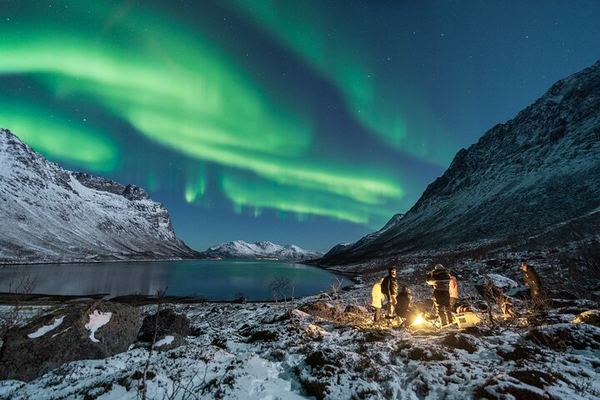
All Inclusive Northern Lights Hunt with The Green Adventure, Photos Included
Thermal suit and meal built into the price, a campfire with marshmallows, and expedition soup made in Tromsø that beats standing closer to the flames.
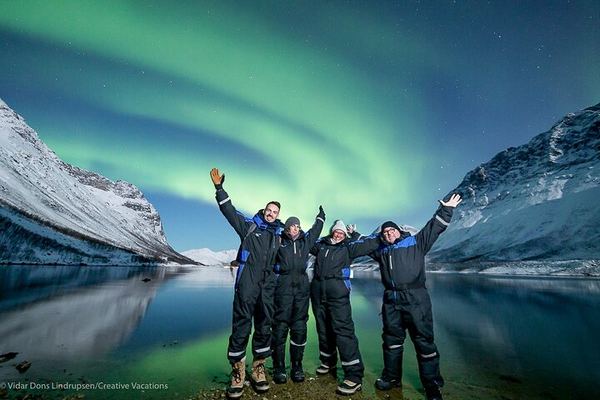
Aurora Adventure Tour from Tromso with Photographer Vidar
Seven hours under Arctic sky with Vidar, a professional photographer: real advice if you brought a camera, your portrait emailed to you if you did not.
Ratings collected by Viator and Tripadvisor
Sources
- Cloud cover: ERA5 reanalysis, produced by ECMWF for the Copernicus Climate Change Service, queried through the Open-Meteo historical weather archive at open-meteo.com. Eleven seasons, 1 September 2015 to 30 April 2025. Nights counted as usable when cloud cover was at or below 50% for at least two hours between 18:00 and 02:00 local standard time.
- Darkness and moon: calculated from the standard ephemeris algorithms in Jean Meeus, Astronomical Algorithms, chapters 25 and 49, with no external dataset. Astronomical darkness is the sun more than 18 degrees below the horizon. Lunar interference combines illuminated fraction with the moon's altitude, sampled every twenty minutes, and a night counts as undisturbed below a mean of 25%.
- Compound probability over several nights: a two-state Markov chain fitted to the same ERA5 series, which is how the persistence of cloudy runs enters the calculation rather than assuming each night is independent.
- Tour counts and catalogue figures: this site's own catalogue, read on 26 August 2026.
- Everything above is ours and recomputed from those sources. The full method, including where the thresholds bite, is set out on the cloud page of the guide.
Data verified on. Cloud from ERA5 via Open-Meteo, eleven seasons 2015-2025. Darkness and moon from ephemerides. Catalogue counts read on 26 August 2026. Full source list above.
The moon is the part of the plan you can fix in advance
How much darkness each destination actually gets per night, which nights the moon leaves alone, and the dates of every new moon this season.