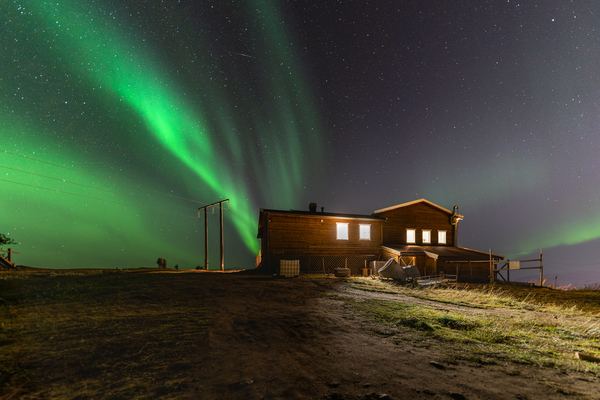
September Is the Worst Month for Northern Lights in Thirteen of the Fourteen Places We Measure
September has the clearest sky of the whole aurora season in six of the fourteen places we measure, and it is still the weakest month of the season in thirteen of them. The reason is not cloud. It is that this far north the darkness has not arrived yet.
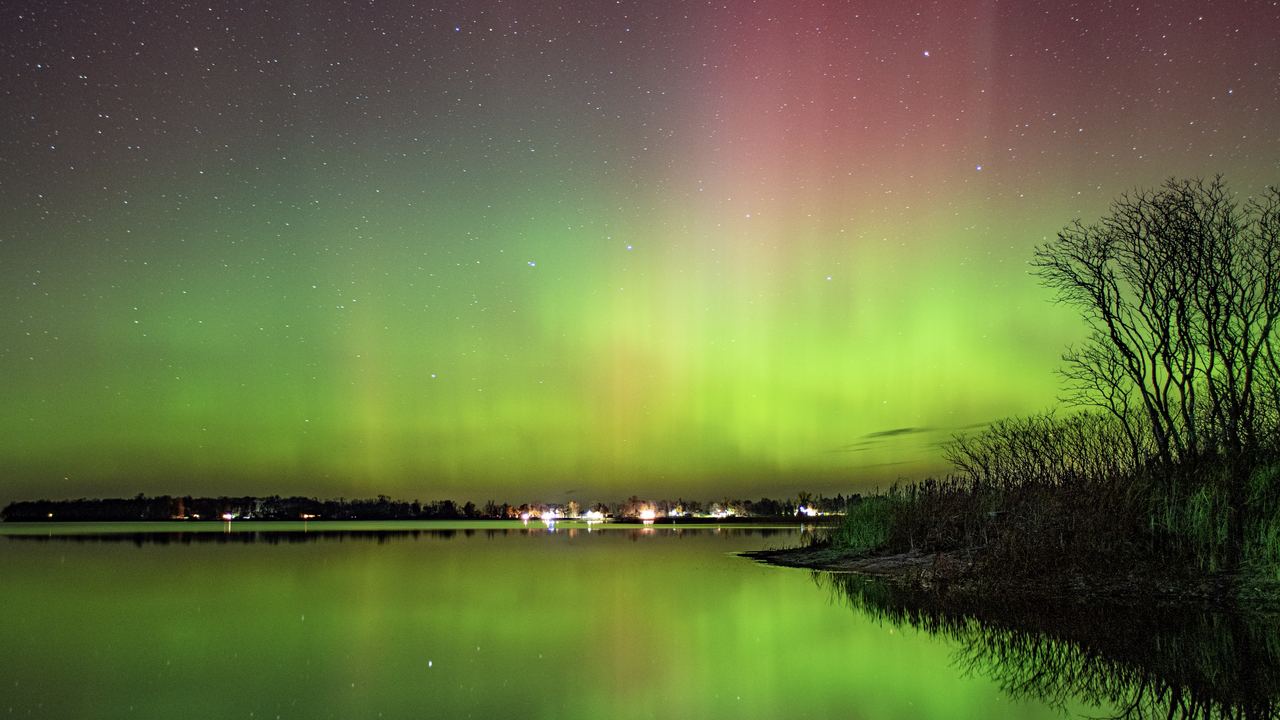
The northern lights in September come with a problem that stays out of the brochures. Tromsø gets about 1.8 hours of genuine darkness in a September night. Not dusk, not the long blue hour, darkness: the sun more than 18 degrees below the horizon, which is the point at which a faint arc stops competing with the sky it is sitting in. In December the same place gets 8.0 hours, every hour of the window we measure.
September also has the most open sky Tromsø sees all year. Both of those are true at the same time, and only the second one gets sold.
We ran eleven seasons of cloud record and the ephemerides together for fourteen aurora destinations. On the combined figure September is the weakest month of the entire season in thirteen of the fourteen. The exception is Yellowknife, and it is worth the detour.
Why September looks like the right month
The advice to travel in September is not stupid and it is not a stitch-up. It rests on two things that are true.
The first is cloud. September really does have the most open sky of the season across a lot of the north. In six of our fourteen rows it is the clearest month of the whole aurora season: Tromsø at 34.0% of nights with two usable hours, Alta 36.0%, Bodø 37.7%, Reykjavík 40.7%, Abisko 27.3% and Whitehorse 57.7%. No other month of Tromsø's season has a clearer sky than its September.
The second is the equinox. Geomagnetic activity has a real seasonal shape, with a bump either side of the equinoxes, and September sits inside one of them. On the GFZ Potsdam record since 1932, September's mean Ap is 15.68, which is 17.5% above the annual mean and second only to March. So both halves of the September pitch check out.
What the pitch leaves out is that neither of them is worth anything without hours to spend them in.
The hours the cloud statistic does not count

A sky that has not finished getting dark
Astronomical darkness is the sun more than 18 degrees below the horizon. That threshold is not one we chose. Below it the scattered sunlight stops interfering; above it a weak aurora is competing with a lit sky, and usually loses.
At high latitude in September the sun does not get far enough down for long enough. Alta averages 1.7 hours a night, Tromsø 1.8, Levi 2.2. Every Fennoscandian row in our table sits between 1.7 and 2.8 hours. By December every one of those same rows reads 8.0, which is the most our eight hour window can hold.
Up here the twilight is not a rounding error at either end of the night. In September it is most of the night.
Multiply the cloud figure by the darkness figure and you get the number this site uses throughout:
expected useful hours = (nights with a usable sky ÷ 100) × hours of astronomical darkness
A night counts as usable when cloud cover sat at or below 50% for at least two hours between 18:00 and 02:00 local standard time. The 50% and the two hours are our thresholds rather than laws of nature, and a different pair would give different numbers; we publish them so you can argue with them. The result is a ranking aid rather than a probability, and it is honest about being a product of two monthly averages that are not independent of each other. What it answers is roughly how much aurora can physically fit inside an average night of that month, in that place. Here is every row's September set against that row's own best month.
| Destination | September: nights with a usable sky | September: hours of darkness | September: expected useful hours | That row's own best month |
|---|---|---|---|---|
| Tromsø | 34.0% | 1.8 | 0.61 | October, 2.04 |
| Alta | 36.0% | 1.7 | 0.61 | October, 2.20 |
| Bodø | 37.7% | 2.6 | 0.98 | November, 2.83 |
| Reykjavík | 40.7% | 2.7 | 1.10 | December, 2.67 |
| Akureyri | 27.3% | 2.5 | 0.68 | November, 1.45 |
| Rovaniemi | 41.7% | 2.8 | 1.17 | March, 2.15 |
| Levi | 41.3% | 2.2 | 0.91 | January, 2.13 |
| Saariselkä | 34.7% | 2.1 | 0.73 | March, 1.80 |
| Kiruna | 44.0% | 2.5 | 1.10 | November, 2.86 |
| Abisko | 27.3% | 2.3 | 0.63 | October, 1.26 |
| Fairbanks | 44.0% | 3.1 | 1.36 | January, 4.01 |
| Anchorage | 39.3% | 3.8 | 1.49 | November, 2.38 |
| Yellowknife | 55.7% | 4.0 | 2.23 | February, 3.67 |
| Whitehorse | 57.7% | 2.8 | 1.62 | February, 2.46 |
Read the last two columns against each other. September delivers somewhere between 30% and 66% of what the same destination's best month delivers. Tromsø sits at the bottom of that range: 0.61 in September against 2.04 in October, so a September night there holds about three tenths of an October night. Alta is the same shape, 0.61 against 2.20.
The three rows where September comes off least badly are Whitehorse, Anchorage and Yellowknife, all at roughly two thirds of their own best month. They are also the three most southerly places we measure, which is not a coincidence. Yellowknife and Anchorage get the two longest September nights in the table, 4.0 and 3.8 hours. Whitehorse gets the clearest September sky of anywhere, 57.7% of nights.
September has the clearest sky of the year in six of the fourteen places we measure, and it is still the weakest month of the season in thirteen of them. Cloud was never the binding constraint.
Yellowknife, the one row that refuses to agree
Yellowknife is the exception, and it gets there for a fairly ordinary reason. It has the best September in the table by a distance: 55.7% of nights with a usable sky and 4.0 hours of darkness, which comes to 2.23 expected useful hours. That is more than Tromsø manages in any month of its entire season.
September is not the low point of Yellowknife's own year, which is what makes it the exception. Its weakest cell falls in late autumn or in March depending on which of our two published tables you read, and those two tables do not currently agree with each other about the size of the November cell. We would rather flag that than quietly pick the version that reads better. What survives either reading is the part that matters here: Yellowknife's September, at 2.23, is not the weakest cell in its row, and it is the only row in the table of which that is true.
Then there is the catch, and it is the same catch this site keeps walking into. Yellowknife carries eleven tours in our catalogue, Whitehorse four, Anchorage three, out of 307 across the network. The places where September works best are the places with the fewest ways to book it. Tours cluster around airports and hotel beds, which is a good reason for an operator and a bad one for a traveller choosing a month.

Change the metric and the count changes
Everything above leaves the magnetosphere out, and September is the month with the strongest claim on putting it back in. So we did.
The GFZ Potsdam series of Kp and ap values runs from 1932. Taking each month's mean Ap against the annual mean gives a factor that sits above 1 near the equinoxes and below 1 near the solstices; multiply the expected useful hours by it and you get a three-axis index of cloud, darkness and activity. September's factor is one of the two highest in the year, so this is September's best case.
It moves the answer, and by less than you would think. On the three-axis index September is the weakest month in eleven of the fourteen rows instead of thirteen. The three that escape are Anchorage, whose December falls to 1.42 against September's 1.76; Yellowknife, whose November is 2.05 against September's 2.60; and Whitehorse, whose November is 1.59 against 1.93. All three are North American, which is the earlier story wearing a different coat.
Tromsø, meanwhile, moves from 0.61 to 0.71 in September, and from 2.04 to 2.27 in October. The equinox bonus is real. It does not come close to closing a gap that size.
While we are here, one number that circulates in this trade needs its metric bolted to it. "Activity is roughly double at the equinoxes" is broadly right, and which version of roughly you get depends entirely on what is being counted. On mean monthly Ap across the full series the equinox to solstice ratio is 1.41. On the frequency of three-hour intervals reaching Kp 4 or higher it is 1.71, because the tail of the distribution stretches further than the middle does. Both are correct. An article that publishes one of them without saying which has published a number nobody can check, and that habit is most of the reason this site exists. The figure used above is the mean Ap one, and the Kp page in the guide goes through what the index does and does not measure.
The September moon, and why that number lies about itself
Our moon column counts the share of nights in a month that clear two hurdles at once: at least two hours of astronomical darkness, and a moon that is thin, low or already down.
September is the worst month of the season on that column almost everywhere, and not by a little. Tromsø comes out at 17% and Alta at 13%, the two lowest cells in the whole table. From October through February nearly every row sits between 45% and 61%.
Here is where a careless reading goes wrong, ours included if we are not paying attention. Those September figures are mostly not about the moon at all. They are the darkness hurdle failing. Alta averages 1.7 hours of astronomical darkness in September, under the two hour gate on most nights, so the night is disqualified before the moon is ever consulted. That 13% is a statement about the sun.
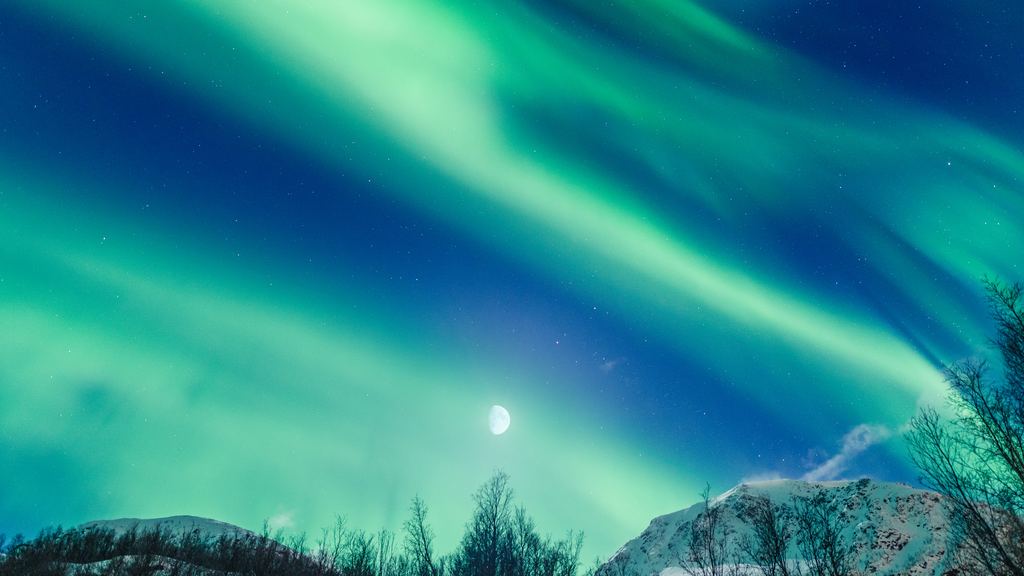
The moon itself behaves perfectly normally this month. New moon falls on 11 September 2026, full moon on 26 September. If you are already going, the fortnight around the 11th is the dark half, and those two dates carry no forecasting risk whatsoever. They are arithmetic, and they will still be right in ten years.
| 1 | 2 | 3 | 4 | 5 | 6 | 7 | 8 | 9 | 10 | 11 | 12 |
How long each half of this calculation has been available
The seasonal shape of geomagnetic activity has had a published explanation for over fifty years. The cloud record that decides whether you get to see any of it has been freely queryable for about ten. Putting the two on the same line is the only new thing here.
The origins
1932
The Kp record starts
The GFZ Potsdam series of Kp and ap values begins. Every monthly geomagnetic figure in this article rests on it, and it is open data with no key required.
1973
Russell and McPherron explain the equinoxes
The geometric account of why the interplanetary magnetic field couples more efficiently with Earth's near an equinox. It is the reason September has a case to argue at all.
The growth
2015
Our cloud window opens
The eleven seasons of ERA5 reanalysis we count nights across run from 1 September 2015 to 30 April 2025.
Today
2026
The two get multiplied together
Cloud and darkness on the same line for fourteen destinations. The result contradicts the standard September advice in thirteen of them.
What September is actually good for
None of this makes September a wasted trip, and if you are reading it in September with the booking already made, these are the parts worth acting on.
The sky is open, and a clear sky is the one variable you cannot influence at all. Six of our fourteen rows have their clearest month of the season right now. What you are short of is hours, and hours are something you can partly buy back by staying up. In September the dark window is narrow and it sits close to local midnight, which is not where a lot of evening tours sit.
The ground is also not frozen yet, and that is why September aurora photographs look unlike January ones. Lakes are still liquid and still reflect. There is colour on the tundra. It is far warmer than the same place in midwinter, which decides how long anybody actually stands still outdoors, and that is a variable none of our tables contain.
Last, September is not one month. The autumn equinox falls just after midnight UTC on 23 September 2026, and the darkness is growing quickly across these weeks: Tromsø's monthly average goes from 1.8 hours in September to 6.4 in October. The end of the month is a different proposition from the first week of it, and a monthly average is precisely the thing that flattens that out. If your dates can move, move them later.
If the dates are already fixed
Three things that still change the odds once the flights are booked.
Move later inside the month
Darkness grows week by week through September, and the monthly average hides it completely. The last week is a different trip from the first.
Read what the cloud number means
Nights with a usable sky, the thresholds we picked, and the four things this measurement cannot see from a 28 km grid.
Plan around the new moon
11 September is new, 26 September is full. Those dates carry no uncertainty at all, which makes them the only part of the plan you can fix in advance.
What these numbers do not say
- A usable sky is not an aurora seen. It says the cloud would have let you see something, not that there was anything there to see. Every figure above is a ceiling.
- ERA5 sits on a grid of roughly 28 km. It is a reanalysis built for climate work, not a weather station and not a forecast, and it cannot resolve a valley microclimate.
- The thresholds are ours: cloud at or below 50%, at least two hours, lunar interference under 25%. Move any one of them and the numbers move with it. We publish them so that you can disagree with them.
- Expected useful hours multiplies two monthly averages as though they were independent, which they are not, and it ignores the moon entirely. The three-axis index adds activity and still ignores the moon and the cold.
- All of it is measured at a fixed point, which is unfair to a tour that will drive 200 km to get out from under the cloud. That is also the strongest argument anybody has for taking a tour instead of standing outside the hotel.
- A monthly average cannot tell you that 26 September beats 5 September, and in September that gap is unusually wide.
Questions we get about September
Is September a bad month to see the northern lights?
It is the weakest month of the aurora season in thirteen of the fourteen places we measure, on cloud multiplied by darkness. That is not the same as saying you will see nothing. It means an average September night in those places holds between a third and two thirds of what an average night in that destination's best month holds, and the shortfall is almost entirely darkness rather than cloud.
Why does everyone recommend September then?
Because the cloud statistic is good, and honestly so. In six of our fourteen destinations September is the clearest month of the whole season. The equinox also raises geomagnetic activity, and that is real too. What the advice skips is that at these latitudes there are only 1.7 to 4.0 hours of true darkness in a September night to spend either advantage in.
How much darkness does an Arctic September night actually have?
Averaged over the month, inside the 18:00 to 02:00 window we measure: 1.7 hours at Alta, 1.8 at Tromsø, 2.2 at Levi, 2.8 at Rovaniemi and Whitehorse, 3.1 at Fairbanks, 3.8 at Anchorage, 4.0 at Yellowknife. In December those same places sit between 6.2 and 8.0 hours, and the Nordic ones are all at 8.0, the ceiling of our window. Darkness here means the sun more than 18 degrees below the horizon, which is the standard definition rather than a threshold of ours.
Is there anywhere September still works?
Yellowknife, and to a lesser degree Whitehorse and Anchorage. Yellowknife gets 55.7% of September nights with a usable sky and 4.0 hours of darkness, which comes to 2.23 expected useful hours, more than Tromsø reaches in any month of the season. It is the only one of the fourteen rows where September is not the weakest cell in its own year.
Does the equinox make September worth it?
It helps and it does not rescue the month. Folding a geomagnetic factor into the calculation moves September from weakest month in thirteen rows to weakest in eleven, and the three rows it rescues are all North American. Tromsø's September goes from 0.61 to 0.71 while its October goes from 2.04 to 2.27, so the ranking between them does not budge.
When in September should I go, if I am going?
As late in the month as the dates allow, and if possible around the new moon of 11 September 2026. Darkness increases sharply across September, to the point where Tromsø's October average is more than three times its September average, so the last week of the month is meaningfully better than the first. The moon dates are exact and involve no forecasting; the cloud is the part nobody can plan around.
Where do these numbers come from, and can I check them?
Cloud comes from ERA5, the ECMWF reanalysis, queried through the Open-Meteo historical archive, over eleven seasons from September 2015 to April 2025. Darkness, moon and equinox figures are calculated from standard ephemeris algorithms with no external dataset. Geomagnetic figures come from the GFZ Potsdam Kp and ap series, which runs from 1932. All three are free to access, our thresholds are stated above, and anyone repeating the calculation should land on the same answers. Publishing the method next to the number is the entire point.
Aurora tours in Yellowknife
The one destination in our data where September is not the weakest month of its own year, and one of the thinnest catalogues we carry. Both of those facts are on the record above.
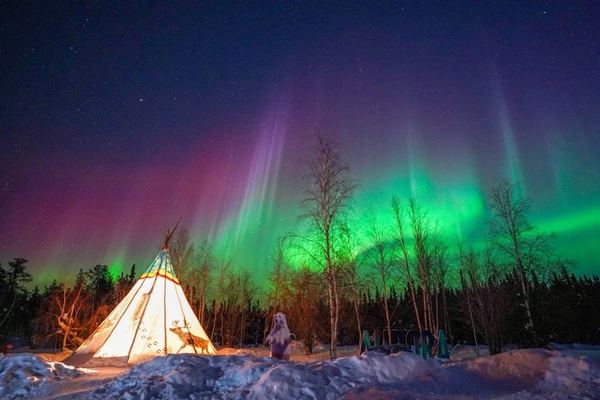
4D3N Yellowknife Aurora Package with Mandarin Guide and Lodge Stay
Guiding is not primarily in English, so read that first. Indoor lodge viewing, hotel stay, airport pickup at any hour, and a city tour taking in the Ice Road.
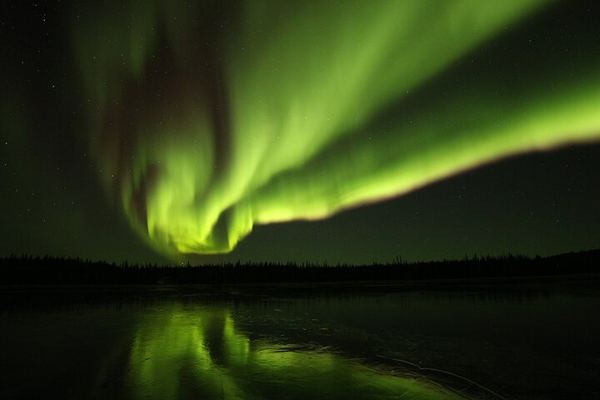
Aboriginal Owned Aurora Hunting Tours from Yellowknife
A wholly Aboriginal owned company whose guides grew up here and hunt the aurora for a living. Free photographs, tripods lent, hot chocolate and maple cookies.
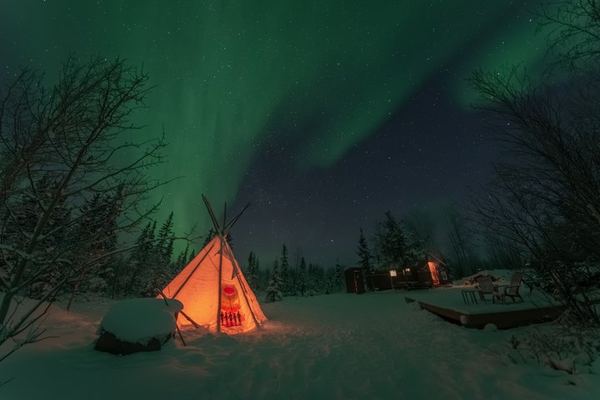
Intimate Aurora Cabin Night with Bannock and Fish Chowder
A small warm cabin, hot bannock and local fish chowder at midnight, and northern clothing to pose in. Five guests minimum, or book the whole cabin outright.
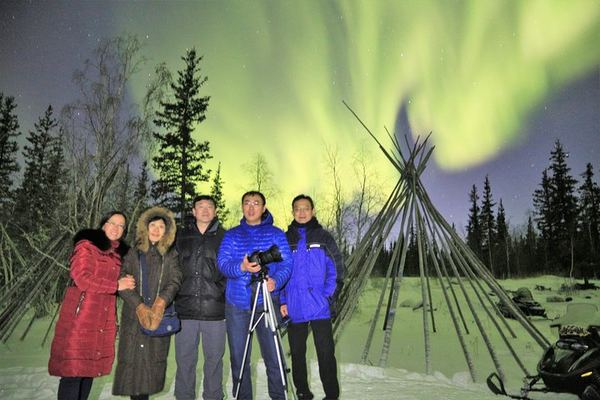
Northern Lights Bus Tour on the Ingraham Trail from Yellowknife
The trail runs past a chain of lakes, and stopping at several means the same aurora over three sets of water and rock. Free photographs and pickup included.
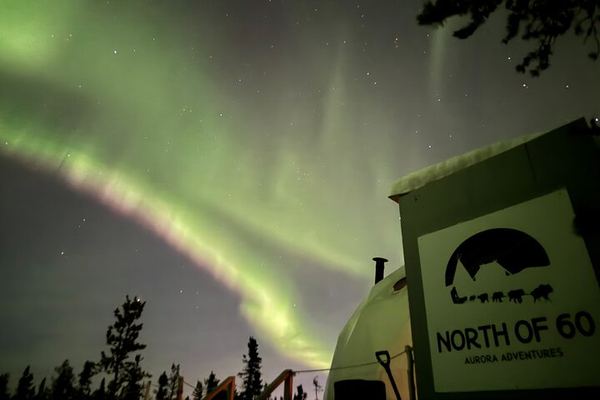
Skydome Aurora Viewing near Yellowknife with Hotel Pickup
Three heated domes a short drive from town, one large and two mini, with guests free to move between them and the outdoor space all night. No car needed.
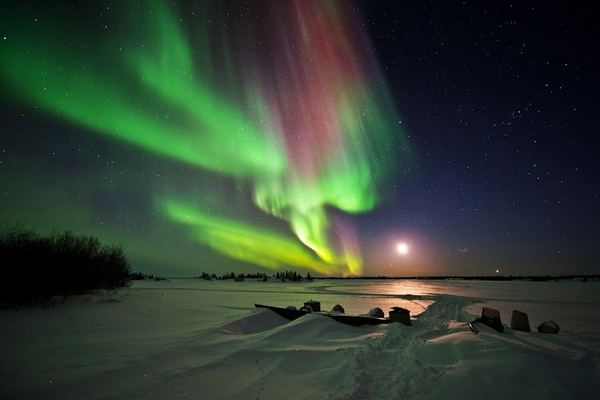
Yellowknife Aurora by Bus: Lake Hopping with Hotel Pickup
In autumn the lakes mirror the sky; once the ice locks, the bus parks out in the middle of one. Four guests minimum, or you are moved to another tour.
Ratings collected by Viator and Tripadvisor
Sources
- Cloud cover: ERA5 reanalysis, produced by ECMWF for the Copernicus Climate Change Service and queried through the Open-Meteo historical weather archive at open-meteo.com. Eleven seasons, 1 September 2015 to 30 April 2025. A night counts as usable when cloud cover sat at or below 50% for at least two hours between 18:00 and 02:00 local standard time.
- Darkness, moon phases and the equinox: calculated from the standard ephemeris algorithms in Jean Meeus, Astronomical Algorithms, chapters 25 and 49, with no external dataset. Astronomical darkness is the sun more than 18 degrees below the horizon. Lunar interference combines illuminated fraction with the moon's altitude, sampled every twenty minutes, and a night counts as undisturbed below a mean of 25%.
- Geomagnetic activity: the Kp and ap series published as open data by GFZ Potsdam, covering 1932 to 2026. Monthly mean Ap, the share of three-hour intervals reaching Kp 4 or above, and the equinox to solstice ratios quoted here are all computed from that series.
- Tour counts: this site's own catalogue, read on 2 September 2026.
- The method behind the cloud figures, including where the thresholds bite hardest, is set out on the when the sky opens page of the guide, and the month by month decision on best time to go.
Data verified on. Cloud from ERA5 via Open-Meteo, eleven seasons 2015-2025. Darkness and moon from ephemerides. Geomagnetic figures from the GFZ Kp series since 1932. Catalogue read 2 September 2026. About This Site
The month matters more than the operator
How much darkness each destination gets per night, which nights the moon leaves alone, and every new moon of this season.